


In Archaic Greece, vase painters transformed terracotta vessels into narrative boards. By combining black slip silhouettes with fine incised details, craftsmen recorded complex mythological stories and scenes of daily life directly onto clay surfaces.
Crafting Narratives on Archaic Clay
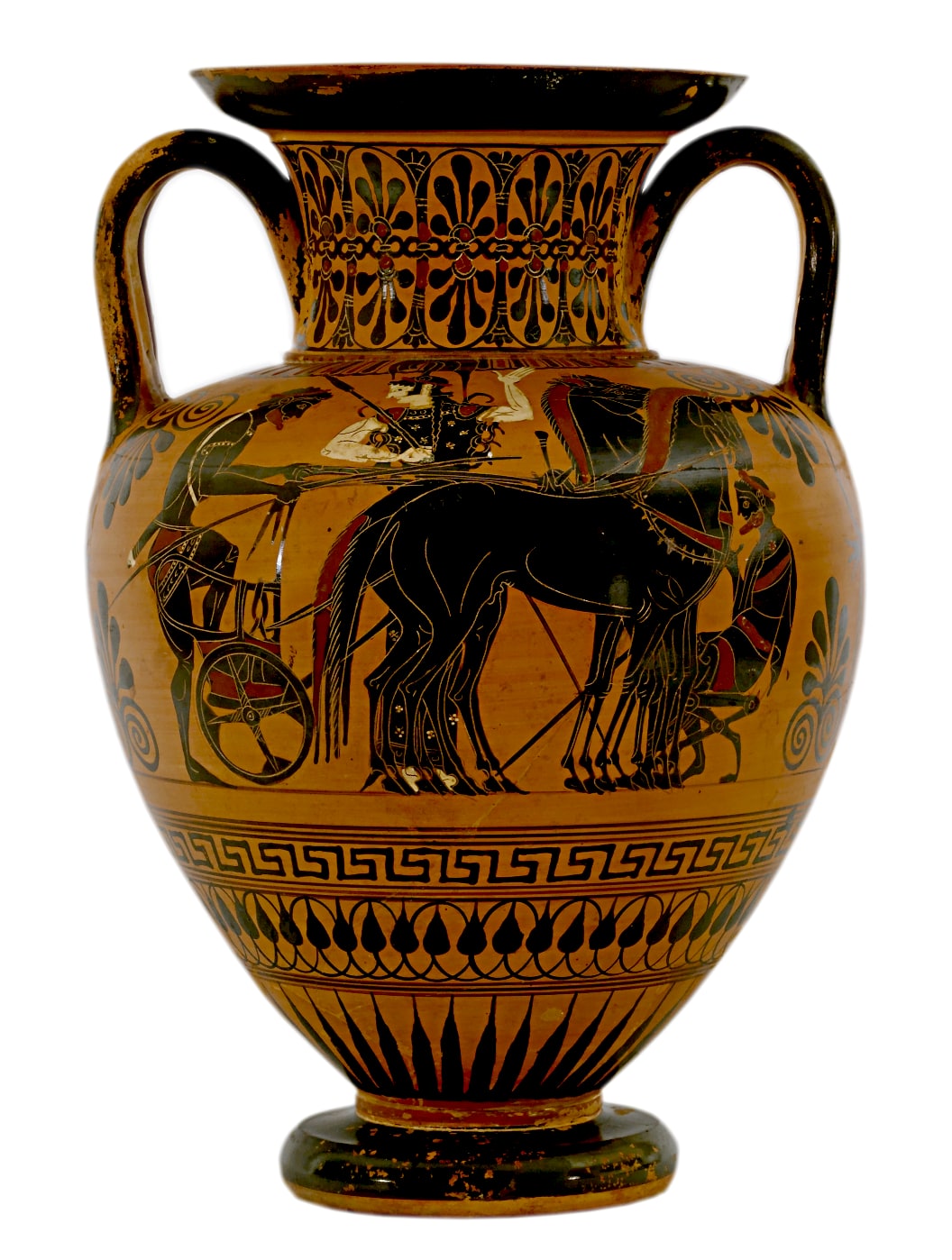
Potters in Corinth developed the black-figure technique during the seventh century BC. Athenian craftsmen adopted this method by the end of the century, mastering the process to produce exported ceramic fineware. The artist sketched outlines with charcoal onto the reddish clay surface before painting the figures in silhouette using wet clay slip. To define interior details, the painter scraped through the dark slip with a sharp point or metal graver. This incised line exposed the pale red clay underneath, delineating facial features, muscle structures, and drapery folds against dark silhouettes.
Painters frequently applied purplish-red and white pigments over dark silhouettes prior to firing vessels in a kiln. White paint traditionally indicated female flesh, whereas purplish-red marked garments, hair, and armour. These decorated vessels fulfilled clear practical functions in Greek society. Citizens used large mixing bowls named kraters for wine during male drinking parties termed symposia, stored oil in narrow lekythoi, and poured water from three-handled hydriai. The placement of painted pictures responded directly to vessel shapes. Two-handled amphorae typically carried two separate scenes, while handleless dinoi allowed continuous friezes around their round bodies.
Early Masters and Multi-Tiered Friezes
During the early sixth century BC, Attic artists studied Corinthian models to organise decorated surfaces. The Gorgon Painter decorated a dinos on a stand between 600 BC and 590 BC, dividing the vessel into five distinct horizontal zones. The lower three bands feature repeating rows of animals and floral patterns. The uppermost band depicts a myth where winged Gorgons pursue Perseus across the vessel wall while their decapitated sister Medusa falls to the ground. Anatomy became regularised in this period, with legs and heads drawn in profile, while Gorgons retained broad frontal faces.
Between 580 BC and 570 BC, Sophilos painted and signed a dinos now preserved in London. Sophilos added written labels beside his drawn figures, using letters to identify gods and title scenes. While he painted animal rows on lower friezes with conventional repetition, he concentrated his effort on the top frieze showing the wedding of Peleus and Thetis. The divine procession extends around the vessel rim, depicting Peleus standing outside his house offering a kantharos of wine to Iris, Dionysus, Hebe, and Cheiron. White paint applied over black slip clearly marked the bodies of attending goddesses.
Detailed Storytelling on the François Vase
Around 570 BC, the painter Kleitias and potter Ergotimos created a large volute krater known as the François vase. Kleitias divided the vessel surface into seven narrow friezes, devoting five bands entirely to mythological narratives. The lip features the hunt of the Calydonian boar, the neck shows chariot races from Patroklos's funeral games, and the shoulder depicts the wedding of Peleus and Thetis. Below these scenes, Kleitias painted pygmies battling cranes alongside animal bands. Inscriptions identify over two hundred individual figures and inanimate objects across the vessel.
Kleitias demonstrated narrative precision in depicting Achilles pursuing the Trojan prince Troilos. On one side of the frieze, a youth fills a hydria at a fountain-house while goddesses watch the scene. In the centre, Achilles leaps forward toward Troilos, who rides two galloping horses while his dropped water jar rests beneath the hooves. The pursuit moves toward King Priam sitting near the city gates as Trojan warriors emerge to intervene. On the vessel handle, Kleitias painted a compact rectangular panel showing Ajax carrying the lifeless body of Achilles out of battle, establishing an upright composition.
Scale and Space from Drinking Cups to Amphorae
By the middle of the sixth century BC, miniaturist painters concentrated on smaller drinking cups called kylikes. Lip cups featured small figures set against bare light clay in the upper lip centre, such as the BMN Painter's rendering of Theseus fighting the Minotaur. In contrast, band cups were painted black except for a thin horizontal band between the handles. On one band cup, an artist depicted Dionysus and Ariadne flanked by alternating satyrs and maenads. The repeating dancing poses balanced the composition across the narrow space.
Other craftsmen preferred decorating large surfaces with fewer figures. Between 550 BC and 530 BC, the Amasis Painter decorated a neck amphora using three large figures that occupied the central rectangular panel. He depicted Dionysus holding a kantharos to receive two approaching maenads who hold wild animals and ivy branches. Unusually, the painter omitted white pigment for female skin, leaving the maenads' flesh outlined directly against the natural orange clay. Repeated incised patterns marked the drapery folds and hair locks to balance the spacious layout.
Exekias and the Height of Black-Figure Artistry
Exekias painted a one-piece amphora between 540 BC and 530 BC that demonstrated precise alignment between painted forms and ceramic shape. Within a single dark panel, he painted the heroes Achilles and Ajax seated opposite one another at a gaming board. Their hunched shoulders echo the curved contours of the amphora body, while their leaning spears align with the handle joins. Exekias incised geometric patterns into their woven cloaks. Written labels record their calls, with Achilles shouting 'four' and Ajax calling 'three'.
Exekias also painted the interior tondo of a drinking cup portraying Dionysus sailing on a red ground. The composition illustrates a story where pirates abducted the god, only for vines to wrap around the ship mast and drive the captors into the sea. Exekias painted Dionysus reclining in a boat beneath a central vine bearing seven grape clusters. Seven dolphins swim through the red field surrounding the vessel. As the drinker tilted the cup to finish their wine, the painted ship appeared to float out from the liquid.
Ritual Retention and the Red-Figure Transition
Around 530 BC, painters working with the potter Andokides introduced the red-figure technique. By covering the background in black slip and leaving figures in reserved terracotta clay, artists could paint interior details using fine brushes instead of incising lines with metal tools. This technique permitted fluid brush strokes and subtle variations in glaze dilution. Red-figure gradually superseded black-figure as the dominant style for fine Athenian ceramics over the following decades.
Black-figure remained in continuous use for Panathenaic amphorae throughout the fifth and fourth centuries BC. Athens awarded these distinct narrow-necked vessels filled with sacred olive oil to winners of the quadrennial Panathenaic games. Religious custom required painters to maintain the traditional black-figure style on these official prize jars. Artists painted Athena armed with shield and spear on the front of the vessel, while depicting specific athletic events such as sprinting and javelin throwing on the reverse side.


