


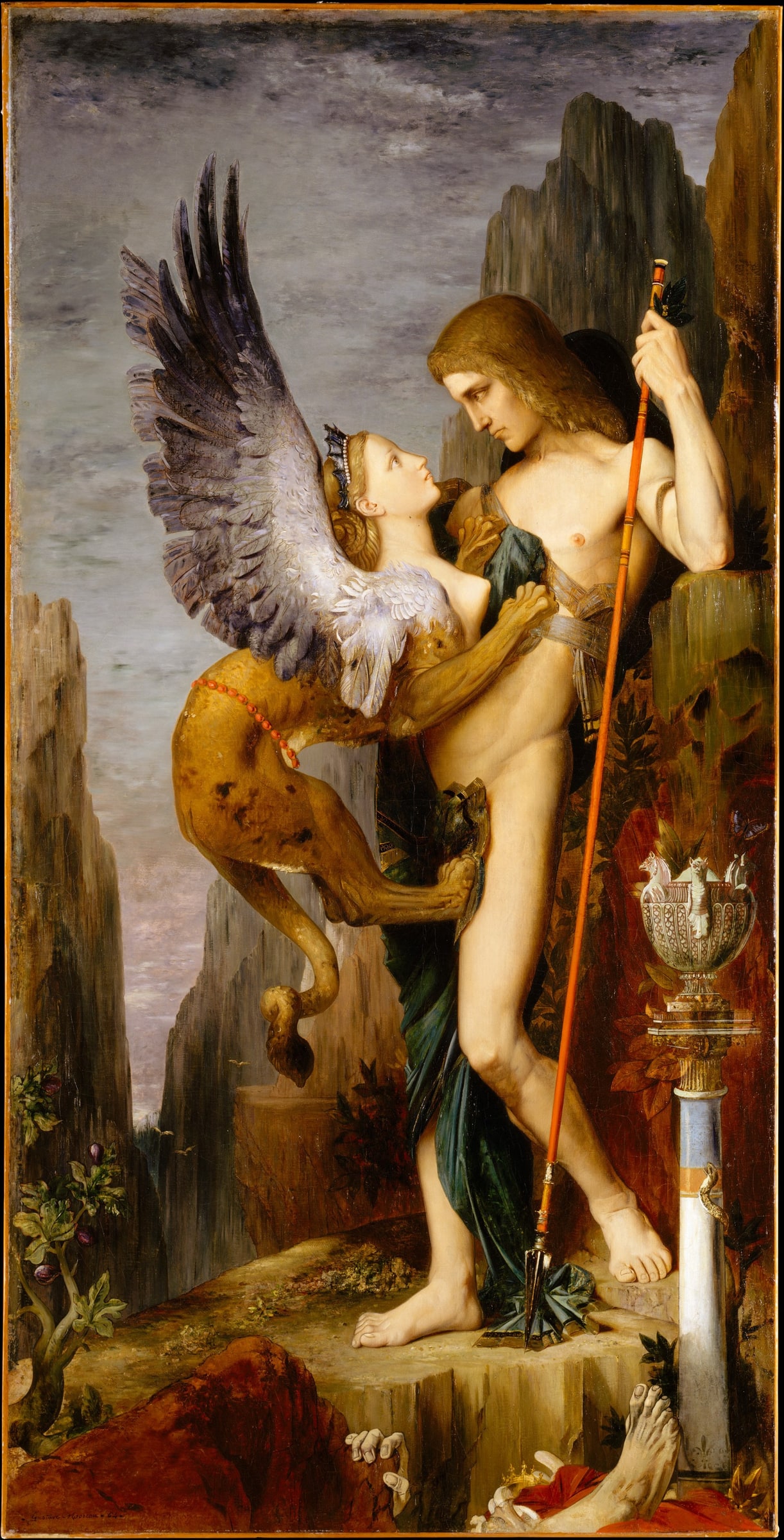
In 1864, French painter Gustave Moreau exhibited Oedipus and the Sphinx at the Paris Salon. The thirty-eight-year-old artist spent three years and thirty preparatory studies completing the work, earning a medal and gaining recognition from prominent art critics.
The Paris Salon of 1864
In 1864, Room M was the main attraction at the annual Paris Salon. Visitors gathered in large numbers to view paintings by Jean-François Millet alongside the work of Gustave Moreau. Moreau was thirty-eight years old and had trained under the history painter François-Édouard Picot. Although Moreau had disdained the Salon in previous years, he decided to submit Oedipus and the Sphinx to the 1864 exhibition. His submission earned him a Salon medal, establishing his presence within the official French exhibition system.
Many visitors entered Room M primarily to see two new canvases by Ernest Meissonier, who was celebrating his thirtieth anniversary at the Salon. Meissonier had debuted in 1834 with A Visit to the Burgomaster and had shown work at seventeen Salons, yet he had not exhibited for three years prior to 1864. He approached the exhibition with self-doubts regarding The Battle of Solferino, a major commission commemorating the Emperor. Meissonier spent four years working on the painting but remained concerned that he had failed to capture His Majesty at his moment of glory.
A few weeks before the Salon opened, Meissonier expressed his frustration in a private letter regarding his struggle with the commission. He wrote that it was grievous, after so many years of effort and reliance on what he had learned, to acknowledge that he felt powerless to succeed as well as he wished at the first task requested by the Emperor. Despite Meissonier's central presence in Room M, Moreau's new painting drew sustained attention from visitors and critics throughout the exhibition.
The Critical Response in Room M
Moreau spent three years and executed thirty preliminary studies to complete Oedipus and the Sphinx. His detailed preparation paid off when major Parisian art critics greeted the canvas with enthusiastic reviews. Critics including Théophile Gautier, Paul de Saint-Victor, and Maxime du Camp praised the work, heralding Moreau as a significant artistic force. The painting depicts the mythic confrontation between Oedipus and the Sphinx, a composition that now resides in the Metropolitan Museum of Art in New York.
A review published in Le Temps expressed warm approval of Moreau's contribution to the Salon. The critic wrote that the painter represented unflagging effort, devotion to the Old Masters, and the application of sound principles and traditions. This reception established Moreau's reputation among intellectuals. Following his success in 1864, Moreau began creating paintings in a more Baroque style while continuing to depict unreal worlds of fantasy and imagination on his canvases.
Artistic Background and Training
Gustave Moreau was born in Paris, the son of an architect. In his teenage years, he began formal instruction with the history painter François-Édouard Picot, who lived from 1786 to 1868. From the age of twenty, Moreau continued his studies at the École des Beaux-Arts. His early style was strongly influenced by his friend Théodore Chassériau, who lived from 1819 to 1856, as well as by Eugène Delacroix, who lived from 1798 to 1863.
Moreau expanded his aesthetic approach through travel in Italy, completing visits in 1841 and 1857. These Italian trips encouraged him to blend elements of High Renaissance art with Romanticism. He focused primarily on the intellectual content of his themes, examining religious stories and mythological subjects for their underlying meanings and sentiments. Turning away from a nineteenth-century world increasingly dominated by science and technology, Moreau developed a distinctive style that incorporated symbolic elements alongside romantic imagery.
Technique, Symbolism, and Seclusion
Moreau developed a unique painting method characterised by thick, smooth paint application and intense colours. His works featured a flowing style alongside symbolic elements and embellished details. However, his interest in embellished details frequently prompted accusations of pretentiousness from certain observers. Because Moreau was sensitive to disapproval, he was often reluctant to exhibit his pictures publicly. He spent prolonged periods in seclusion, refraining from submitting his work to public exhibitions.
Because Moreau possessed private financial means, he did not need to rely on Salon medals or public sales to sustain his artistic production. Over time, he became appreciated by intellectuals and grew more willing to exhibit his work. Following Oedipus and the Sphinx, he produced Jason in 1865, now in the Musée d'Orsay in Paris. Moreau became recognised as a precursor of the Symbolist Movement, exploring themes such as the myth of Orpheus, where a girl adorned with iridescent jewels holds the killed musician's severed head upon his lyre.
Academic Career and Museum Legacy
Moreau continued to paint fantastical subjects throughout the following decades. He completed The Apparition between 1874 and 1876, followed by Galatea around 1880 and Hesiod and the Muse in 1891. In 1892, Moreau joined the faculty of the École des Beaux-Arts as a professor. As a teacher, he proved inspiring to his students by bringing out their individual talents and self-expression rather than attempting to impose his own aesthetic ideas upon them.
Moreau taught several students who became prominent artists, including Albert Marquet and Henri Matisse. His favourite pupil was Georges Rouault. Upon his death, Moreau left his Parisian house and its contents to the nation to establish the Moreau Museum. Rouault became the first curator of the museum, preserving the artist's home and work. Due to his focus on unreal worlds and fantasy imagery, Moreau was later recognised as a forerunner of Surrealism.


