


Les Très Riches Heures du Duc de Berry is a fifteenth-century illuminated manuscript created by the Limbourg brothers between 1413 and 1416. Its calendar presents detailed full-page paintings for every month, contrasting aristocrats with working peasants against changing seasonal backgrounds.
The Manuscript and Its Commission
The manuscript known as Les Très Riches Heures du Duc de Berry was commissioned by Jean, Duke of Berry, a major collector of medieval books. The three Limbourg brothers from Gelderland in the Netherlands, led by chief artist Pol de Limbourg, joined the Duke court around 1410. They worked on this devotional prayer book between 1413 and 1416. A Book of Hours contained prayers for set times of the day, from matins at dawn to compline at night. Books of Hours replaced traditional psalters for private devotion among northern European nobility during the fourteenth and fifteenth centuries.
Inventories recorded after the Duke death in 1416 showed he owned more than three hundred manuscripts. Earlier records listed seventy-eight books acquired as gifts, exchanges, thirty-two purchases, and three manuscripts executed by direct order. The Limbourg brothers did not finish the project because all three artists and the Duke died in 1416, likely from the plague. The unfinished vellum manuscript, measuring approximately eight and a half by five and a half inches, is preserved at the Musée Condé in Chantilly.
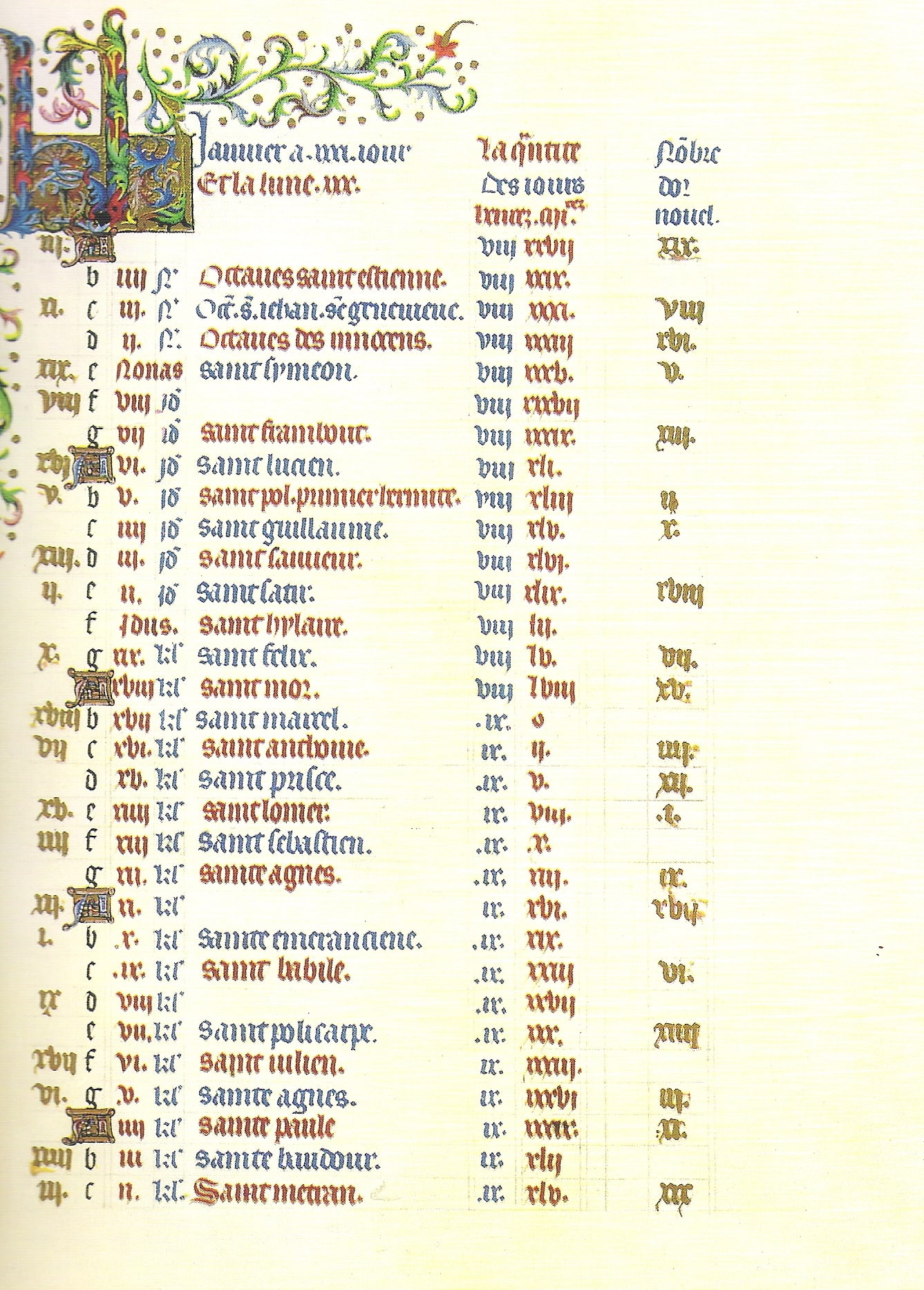
Before Les Très Riches Heures, calendars inside prayer books rarely received full-page paintings. The Limbourg brothers devoted a full page to each month of the year, topped by a lunette showing the chariot of the sun and signs of the zodiac. Their work combined northern European traditions with Italian stylistic elements. Pol de Limbourg introduced simplified facial shapes with rounded cheeks and straight noses derived from Italian models. The illustrations alternated between scenes of royal leisure and peasant labour.
Winter in Court and Countryside
The painting for January depicts a New Year feast in a grand hall. The Duke of Berry sits at a table wearing a blue and gold robe with a fur hat. A circular fire screen behind his head forms a halo shape. Next to him, his chamberlain urges guests forward with the call to approach. The stellar chart above the image marks the constellations of Capricorn and Aquarius. On the back wall behind the fireplace hangs a large woven cloth depicting scenes from the Trojan War.
The attendants in the January scene wear costumes coloured in vermilion, tan, blue, and green. In contrast, the February illustration depicts peasant life during winter. The artists removed one wall of a rural cottage, adopting an Italian composition technique to reveal an interior view. Inside, peasants sit by a fireplace to warm their bare feet. Outside, sheep stay inside a wattle fence while a man drives a donkey across snow toward a distant village.
February offers one of the earliest depictions of a snow-covered environment in European painting. Details in the scene show a peasant visiting a storage bin with visible breath condensing in the cold air. In the background, another worker cuts down a tree for firewood. Diagonal movement, wattle fences, sheepfolds, and storage buildings guide the eye from the foreground interior to the frozen fields outside. The composition pairs traditional domestic themes with new direct observations of winter conditions.
Spring Nobles and Peasant Fields
As the year moves into spring, the agricultural and courtly activities shift. The March page depicts a peasant plowing a field before the Duke castle of Lusignan. Cast shadows appear on the soil, demonstrating the Limbourg brothers attention to natural lighting. In April, courtly figures emerge outdoors to socialise in green fields filled with flowers. The background features another residence of the Duke, the castle of Dourdan.
The human figures in the April scene show elongated proportions and flowing drapery lines. Garments are decorated with shades of red, tan, blue, and green. Lightening of the sky near the horizon creates space and a sense of distance. The May illustration shows a procession of riders dressed in court garments riding horses before the castle of Riom. Hunters blow horns while courtiers converse with narrow-waisted ladies.
These spring illustrations demonstrate the International Gothic style through clear decorative contours and patterned clothing. The Limbourg brothers integrated architectural settings with natural surroundings. Castle towers, decorative stone walls, surrounding waters, and open fields reflect specific real places owned by the Duke or the royal family. The inclusion of accurate architectural backgrounds tied the cycle of months directly to the Duke holdings.
Summer Harvest and Royal Palaces
The June page shifts back to peasant labour outside the city walls of Paris. Workers mow hay and gather crops in fields next to the River Seine. In the background, the towers of the Sainte-Chapelle and the royal palace rise above the skyline. The scene illustrates the seasonal cycle of agricultural work necessary to sustain the city and court throughout the year.
In October, the cycle returns to agrarian tasks set against urban architecture. A sower scatters seeds across plowed soil while another worker rides a horse to drag a harrow. Washerwomen work near the riverbank while dressed citizens walk along the path. Behind these figures stands the Louvre, which served as the French king residence during the early fifteenth century. The painting records details of the palace towers, decorative windows, outer walls, and gates.
The October illumination records natural shadows, including those cast by an archer scarecrow and the harrower horse. The peasants perform their duties peacefully before the royal palace. This presentation depicted the structure of medieval society and the relationship between the ruler and rural workers. The detailed rendering of buildings turned each calendar page into a visual record of contemporary French architecture.
Autumn Hunts and Year End
The calendar sequence concludes with the month of December, which depicts a wild boar hunt in a forest. Mastiffs attack a cornered boar while hunters blow horns and prepare to strike. This composition shares direct similarities with a drawing in the notebook of Italian artist Giovannino de' Grassi in Bergamo. The Limbourg brothers modified the scene by omitting one dog and adding human hunters into the woods.
The December hunt scene was later copied in manuscript illuminations during the early sixteenth century. Through its twelve calendar pages, Les Très Riches Heures linked secular genre subjects with a sacred prayer book. The manuscript contributed to the wider spread of private devotional books among nobility and prosperous burghers. This shift in religious book ownership altered private devotional practice across northern Europe prior to the Reformation.


