


Zeus fathers Zagreus with Persephone and enthrones him as his successor, but the Titans lure the child from his guarded cave and tear him apart. Athena rescues his heart, and Zagreus returns to life in the Orphic account, where Dionysus is another name for him.
The Birth of Zagreus
Zeus secretly united with Persephone before she was taken to the Underworld by her uncle Hades. He sometimes approached her in the form of a serpent, while another account gives him the form of Hades. Persephone gave birth to Zagreus, whom the Orphic tradition also calls Dionysus. Zeus intended the boy to succeed him and enthroned him while he was still young.
Zeus placed Zagreus in the Idaean Cave under the protection of Rhea’s sons. These guardians were the Cretan Curetes, or, in another account, the Corybantes. They leaped around his cradle and struck their weapons together, as they had done for Zeus at Dicte. Zeus’s enemies, the Titans, whitened themselves with gypsum so that they could not be recognised. They waited until the guardians slept, then lured Zagreus away with toys. These included a cone, a bull-roarer, golden apples, a mirror, a knuckle-bone, and a tuft of wool.
When the Titans attacked, Zagreus changed his shape in an effort to escape. He became Zeus wearing a goat-skin coat, Cronus making rain, a lion, a horse, a horned serpent, a tiger, and finally a bull. The Titans seized him by the horns and feet, tore him apart, and ate his flesh. Another account says that they boiled the pieces in a cauldron. The Orphic story attributes the attack to Hera’s jealousy and says that she ordered the Titans to seize the child.
The accounts also differ about what followed. Athena is said to have rescued Zagreus’s heart and given it to Semele to swallow, allowing the child to be born again. In another Orphic version, Persephone and, in some accounts, Demeter cared for Dionysus after his return to life. From the remains that were rescued and collected, Dionysus rose again.
The Birth of Persephone
Zeus fathered Persephone with Demeter, and Demeter gave birth to the maiden. She was also known as Kore, meaning Girl or Maiden, and as Cora and Phersephone. Her name appeared in the Attic form Pherrephatta. Persephone was the daughter of Zeus and Demeter, and she was a grain goddess like her mother. Demeter ruled the earth, harvest, and fertility, while Persephone grew up among flowers and fertile fields.
Hades desired Persephone as his bride and queen. He went to Zeus, his brother, and asked for her hand in marriage. Zeus knew that Hades would care for her, but he feared Demeter’s anger and sorrow. He neither granted nor refused permission. Encouraged by this answer, Hades went to the place where Persephone gathered flowers. He seized her as she picked them, and a great chasm opened in the earth. Hades placed her under his arm, and his horses carried them into the dark world below.
Demeter did not realise at once that Persephone had vanished. After many hours, she understood that her daughter was gone, and she began to search for her. She rejected Zeus, avoided the council of the gods, and wandered in grief and anger. On the tenth day, Hecate told her that Persephone had been abducted, but she did not know by whom. Helios then told Demeter that Hades had taken her. While Demeter searched and mourned, nothing grew. Seeds failed to sprout, people starved, and the gods received none of their customary offerings.
Demeter found Persephone in the Underworld, but Persephone had eaten pomegranate seeds there. Zeus therefore arranged that she would marry Hades and live with him as queen of the Underworld for part of each year. The stories gave either four or six months for this stay. Persephone spent the rest of the year in the upper world with Demeter, and she and Hades acted together when she ruled among the dead.
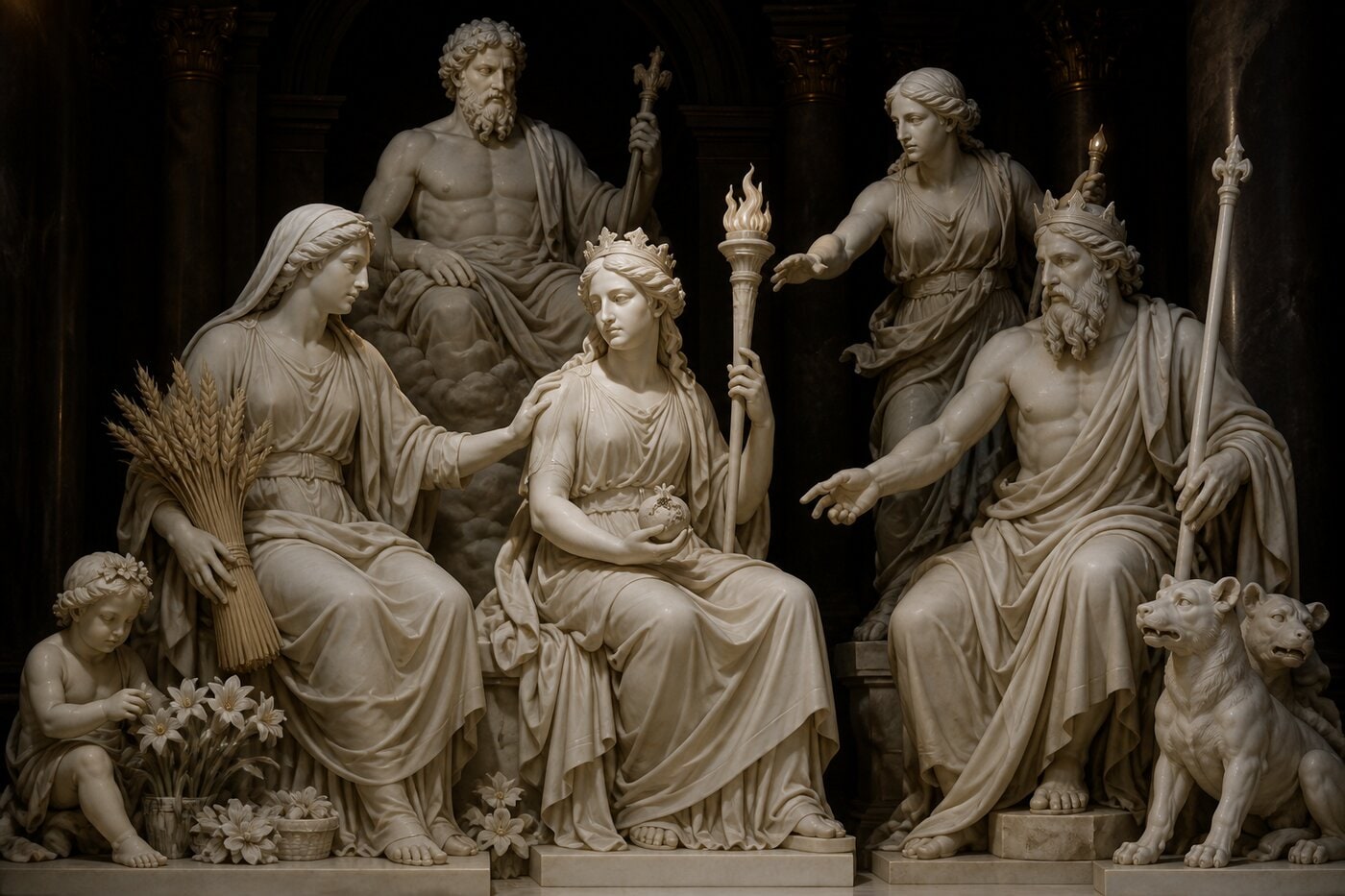
The Flower Gathering and Abduction
Persephone gathered flowers with the Oceanids in a peaceful meadow. Gaia had prepared a beautiful bloom at Hades’ request, and its appearance drew Persephone towards it. As she bent to pluck the flower, the earth opened beneath her. Hades rose from the depths in a golden chariot drawn by horses. He seized Persephone despite her cries, held her beneath one arm, and carried her into the dark world below.
Hades drove the chariot back into the earth and took Persephone into the land of the dead. There she became his queen. Hades had first asked Zeus for permission to marry her. Zeus knew that Hades would care for his daughter, but he feared Demeter’s anger and regretted losing Persephone to a world from which no mortal returned. He therefore said that he could neither grant nor deny his consent. Hades treated this answer as permission and carried out the abduction.
Demeter heard Persephone’s cry. She realised that her daughter had vanished and refused to accept the loss. She shunned Zeus, left the assembly of the gods, and began searching across the whole world. She wandered over land and sea, driven by grief and anger. She fasted, wore her hair untied, and carried flaming torches as she travelled.
In one telling, Demeter met different people in different lands, stayed in different places, and received news of Persephone from different informants. In another, the chasm opened near the Kyane spring beside Syracuse. Other tellings placed the meadow and the descent at Enna, Colonus, Hermione, Crete, Pisa, Lerna, Pheneus, Nysa, or Eleusis. Demeter continued her search for her vanished daughter.


