



The Idle 'Prentice Return'd from Sea, and in a Garret with a Common Prostitute - William Hogarth
Archival giclée
Frames arrive ready to hang
Secure checkout
Made to order
Description
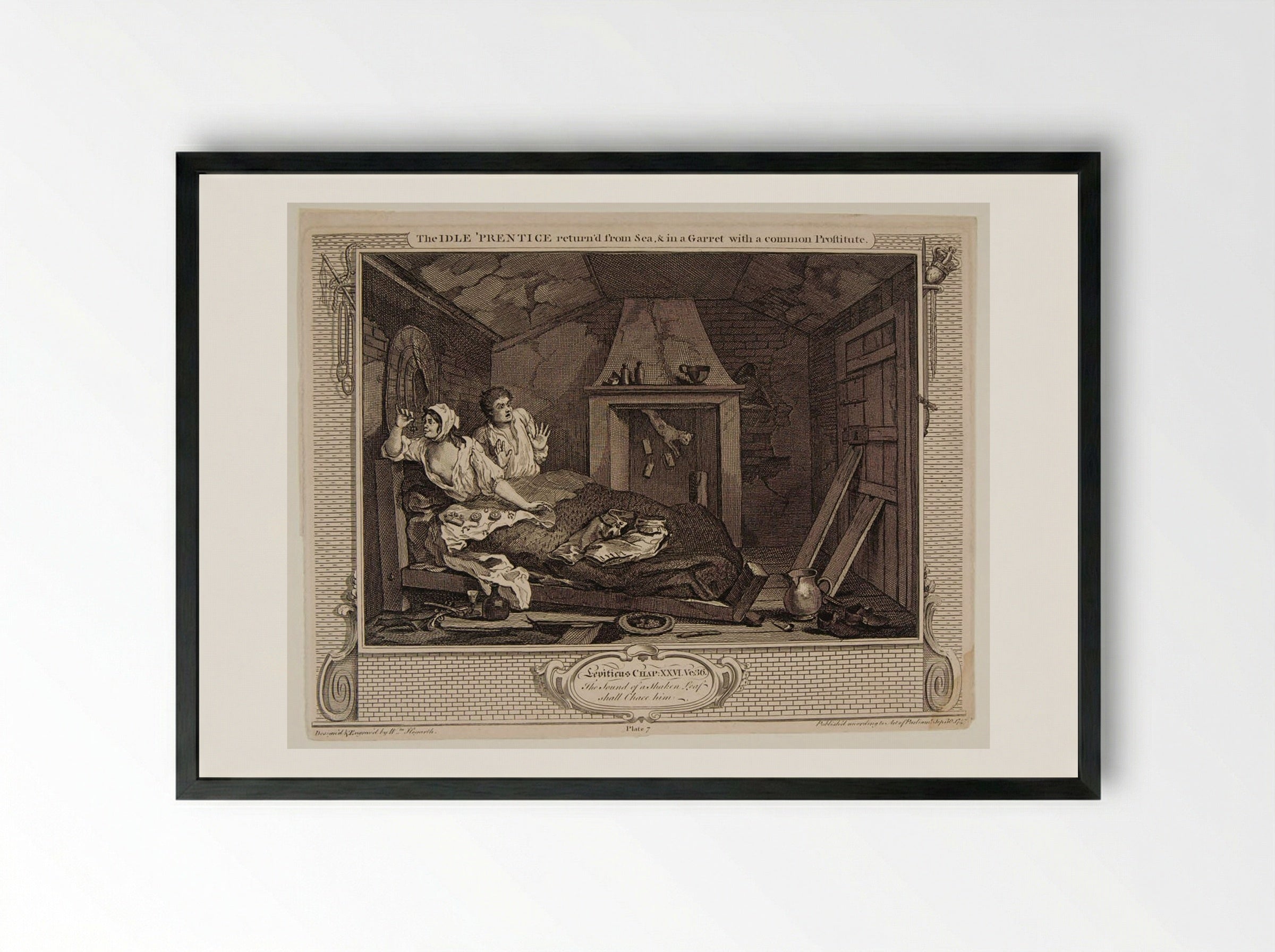
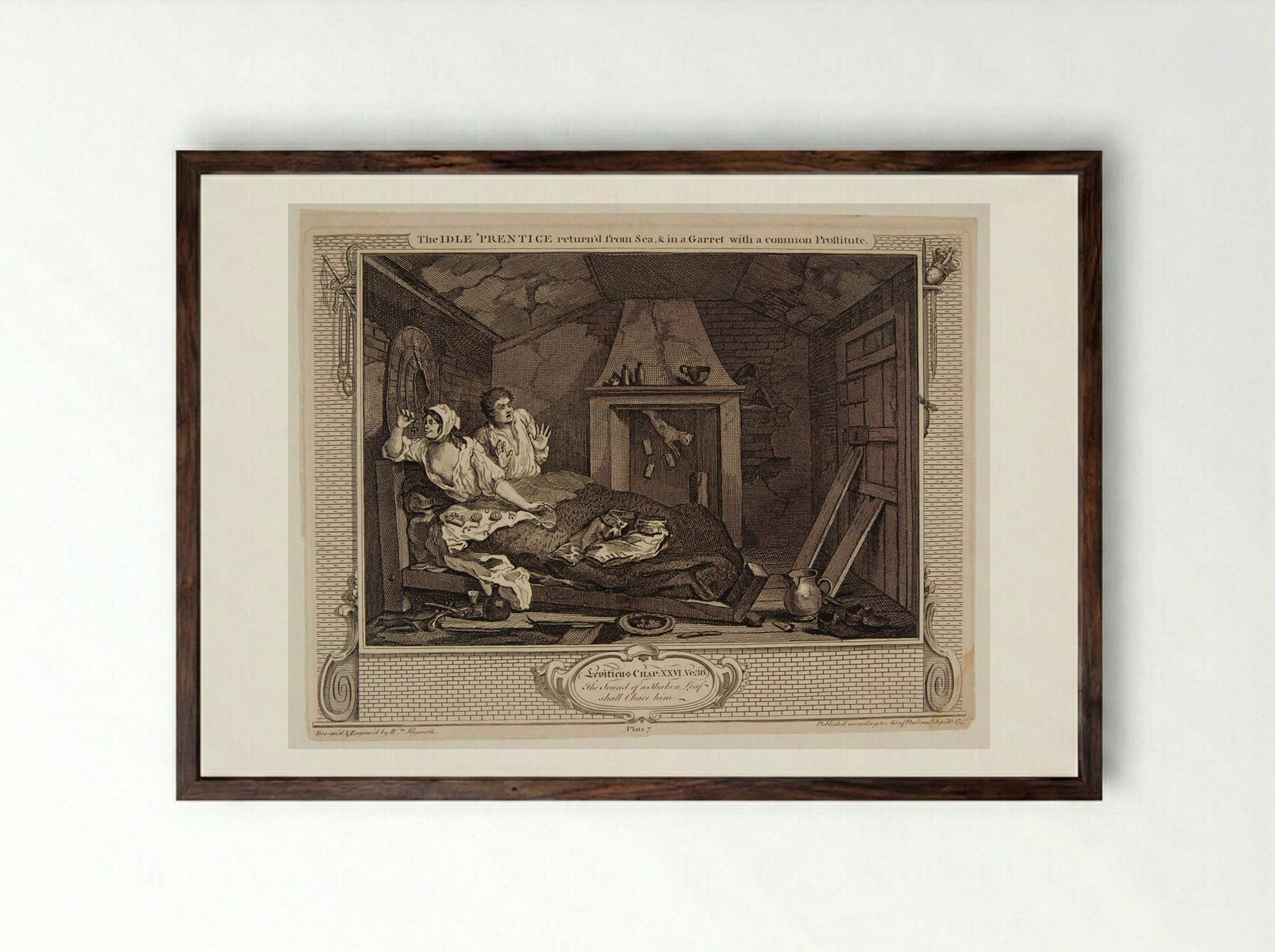
William Hogarth's engraving, 'The Idle 'Prentice Return'd from Sea, and in a Garret with a Common Prostitute', is a moralising scene from his 'Industry and Idleness' series, depicting the consequences of a dissolute life in 18th-century London.
This engraving by William Hogarth, titled 'The Idle 'Prentice Return'd from Sea, and in a Garret with a Common Prostitute', is part of a series of twelve depicting the contrasting fates of two apprentices, Francis Goodchild and Thomas Idle. Published in 1747, the series, titled 'Industry and Idleness', aimed to impart a moral lesson about the virtues of diligence and the consequences of vice. Hogarth's prints were widely circulated and admired for their narrative complexity and social commentary. In this scene, Thomas Idle is depicted in a state of disarray, having returned from sea. He is shown in a dilapidated garret with a prostitute, surrounded by signs of poverty and moral decay. The composition is filled with details that contribute to the narrative, such as the overturned furniture, the scattered objects, and the expressions of shock and dismay on the faces of the characters. Hogarth's skill as an engraver is evident in the fine lines and textures that bring the scene to life, capturing the gritty reality of 18th-century London life. The print is further embellished with a decorative border and a biblical quote, adding layers of meaning to the image.
Return policy
Because every print is made to order, we don't offer change-of-mind returns, refunds or exchanges. If your order arrives faulty, damaged or incorrect, we'll replace it free of charge — just contact us within 48 hours of delivery. See our refunds page for full details.
Shipping
We ship worldwide, printing at the production hub nearest to your delivery address. Delivery times and costs vary by destination — you'll see the options available to you at checkout.
Manufacturing
Each print is produced to order using 12-colour giclée printing on FSC-certified archival paper. Designed in Britain and printed at your nearest production hub to reduce waste and speed up delivery.
Care and materials
Specific Features
Every Solis piece is made to order with archival, gallery-quality materials built to last.
- Museum-grade giclée printing for rich, fade-resistant colour
- Archival matte fine-art paper, FSC-certified
- Multiple sizes and framing options available
- Frames in black, natural wood, dark wood or white
- Framed prints arrive ready to hang
Care & Cleaning
To keep your artwork looking its best:
- Dust gently with a soft, dry cloth
- Avoid prolonged direct sunlight
- Never use liquid cleaners on the print or canvas surface
- Keep in a dry, room-temperature space
- Handle prints with clean, dry hands
Materials & Sizing
Museum-grade giclée on FSC-certified archival matte paper, with framed and canvas options.
- Paper sizes: A4, A3, A2, A1, A0 and B2 (50×70 cm)
- Canvas: XS (20×30 cm) to Large (60×90 cm)
- Frames: black, natural wood, dark wood or white
The Idle 'Prentice Return'd from Sea, and in a Garret with a Common Prostitute - William Hogarth

Artist Biography
William Hogarth
He was born in Smithfield, London, near the meat market. His father, a schoolteacher, was imprisoned for debt when William was a child. The experience of debtors' prison appears throughout his work. He apprenticed to a silver engraver and taught himself painting by copying old masters and observing London street life with the attention of a novelist.
He was shrewd about money and copyright. The Engraving Copyright Act of 1735 ('Hogarth's Act') was passed largely through his lobbying. It gave printmakers legal ownership of their designs for the first time, preventing pirated copies. He was protecting his income: the popular prints were his main revenue source.
He painted portraits, historical scenes, and the extraordinary Shrimp Girl, an unfinished head study of a street vendor that anticipates Impressionism by a century. The brushwork is loose, fresh, and immediate. It does not look like anything else painted in the 1740s. He also wrote The Analysis of Beauty (1753), a treatise on aesthetics that argued beauty derived from serpentine lines, which was mocked but was not wrong.
He died in 1764, at sixty-six. He is buried in Chiswick, west London. His tomb has a modest inscription. His influence on British satirical art, from Gillray to Banksy, has no inscription and no end.
Why Choose Us ?
Damage-free delivery guarantee
Fast Shipping
Museum-Quality Materials
You May Also Like