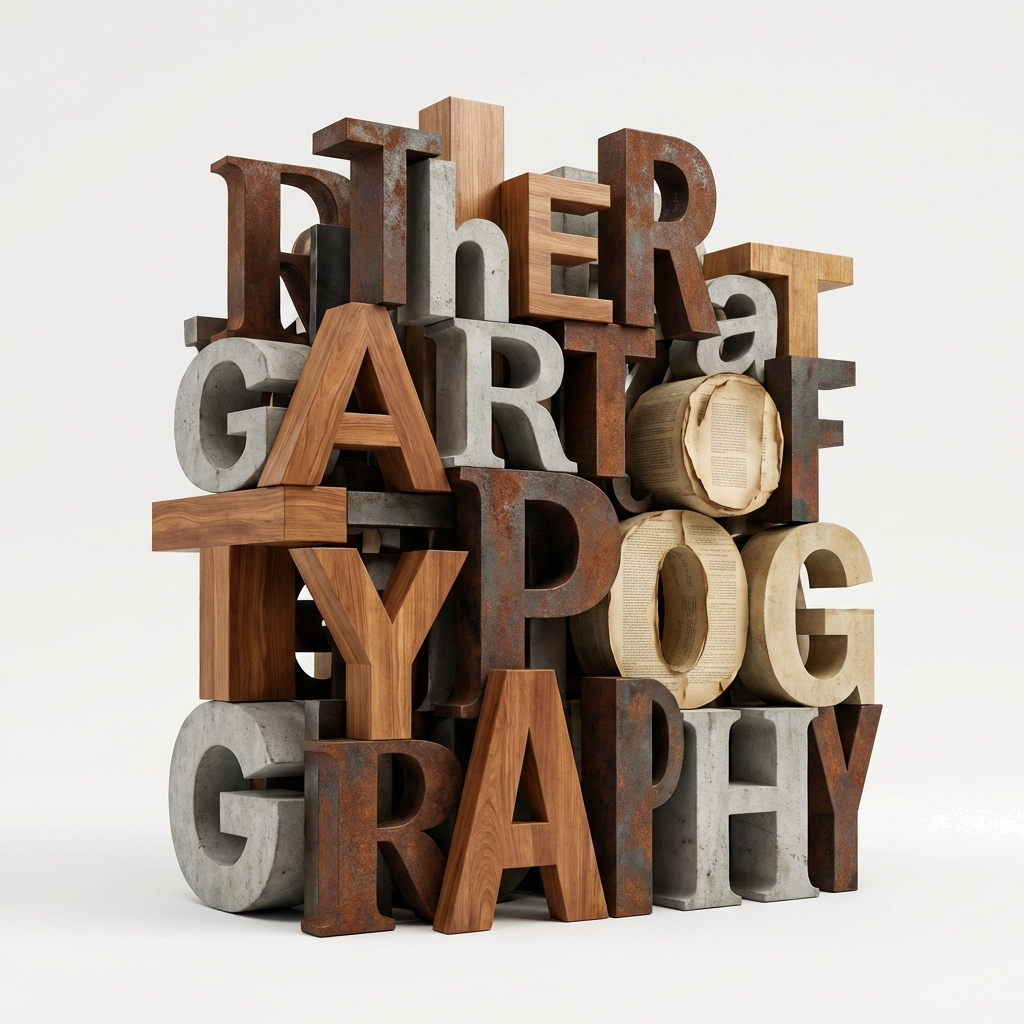
We often think of text and image as distinct entities-one to be read, the other to be viewed. Yet, in the hands of a master, the shape of a letter is as expressive as a brushstroke. The art of typography explores this fascinating intersection, where the written word transcends its function to become a work of art in itself.
From the illuminated density of medieval-inspired manuscripts to the stark, revolutionary geometry of the 20th century, typography has played a central role in shaping visual culture. In this edition of the Journal, we trace the evolution of text as image.
The Ornamental Word: William Morris & The Arts and Crafts
In the late 19th century, William Morris sought to rescue the book from the cheap mechanisation of the Industrial Revolution. Establishing the Kelmscott Press, Morris treated the page as an architectural space. His typefaces, such as the famous Golden and Chaucer types, were not merely vessels for information but dense, textured patterns that interlocked with elaborate woodblock borders.
For Morris, typography was inseparable from illustration. A page from the Kelmscott Chaucer is not just a story; it is a lush garden of ink, demonstrating the Arts & Crafts belief that utility should never be divorced from beauty.
The Modernist Revolution: Bauhaus & Constructivism
As the 20th century broke, the ornate vines of Morris gave way to the machine age. The Bauhaus movement and Russian Constructivism stripped typography down to its barest essentials. Artists like El Lissitzky and László Moholy-Nagy saw type as a construction material-a tool for building dynamic, diagonal compositions that mirrored the speed of modern life.
In works like Beat the Whites with the Red Wedge, text is no longer static. It shouts, points, and explodes across the page. This radical approach laid the foundation for all modern graphic design, proving that a sans-serif letter could carry as much emotional weight as a painted figure.
The Graphic Punch: Toulouse-Lautrec
Somewhere between the decorative and the modern lies the bold poster art of Henri de Toulouse-Lautrec. In fin de siècle Paris, the street poster became the primary gallery for the public. Lautrec’s genius lay in treating the lettering of his subjects-like the cabaret singer Aristide Bruant-as an integral part of the composition. The heavy, blocky text often flattens the space, locking the figure into a graphic icon that commands attention from across a crowded boulevard.
East Meets West: The Calligraphic Tradition
Long before the West debated the role of type, artists in Japan had perfected the synthesis of poetry and painting. In traditional ukiyo-e woodblock prints, the placement of the artist's signature and the title cartouche is never accidental; it balances the visual weight of the scene.
Masters like Utagawa Hiroshige used text columns to frame landscapes, creating a vertical rhythm that Western artists, including Vincent van Gogh, would later emulate. Even in the detailed nature studies of Ohara Koson, the calligraphy acts as a final, elegant gesture, grounding the composition in the rich history of ink wash painting.
Bringing Typography Home
Whether it is a vintage exhibition poster or a Japanese print featuring delicate script, typographical art brings a sophisticated, intellectual layer to interior design. It invites the viewer to look closer-first to see the shape, and then to read the meaning.
Explore our full range of text-integrated works in All Prints to find the perfect statement piece for your walls.