


Eugène Atget began photographing Paris in middle age, systematically recording its old architecture, street life, and parks before gentrification altered the city. His commercial documents later captured the attention of French and American Surrealists.
Commercial Beginnings and Working Methods
Eugène Atget was born in Libourne in 1857 and died in Paris in 1927. He began making documentary photographs of old Paris during his middle age. Working as a commercial producer on speculation, Atget compiled visual references available for purchase for a few francs each. His regular customers included builders, painters, designers, craftsmen, and the Musée Carnavalet. He framed his subjects in a standardised manner, maintaining an anonymous stance behind the camera. Atget did not consider himself an art photographer. Instead, he worked as a chronicler of the French capital, recording its physical structures, residents, iron grillwork, and public fountains with consistent clarity.
Atget adhered to traditional methods throughout his career. Long after the invention of handheld cameras, he continued to carry a heavy box camera and tripod into the streets of Paris. He eschewed darkroom chemical developing solutions, choosing instead to print his images in natural sunlight. This straightforward approach resulted in clean, uncluttered compositions focused directly on the subject. His work stood in contrast to Victorian academic photography, which often relied on soft-focus darkroom gimmickry to imitate traditional painting. Atget avoided prettified effects, capturing everyday urban objects with precise focus and simple alignment on axis in natural light.
The Shift Toward Existential Moods
From 1914, Atget produced photographs that contained a distinct existential mood and metaphorical power. His compositions began to set themselves apart from his earlier commercial output. A photograph taken in 1920 at Saint-Cloud illustrates this development. The gelatin silver print depicts the large pond outside Paris, where white marble statues stand silhouetted against vast trees that resemble symmetrical clouds. The still composition is peopled only by frozen stone figures, creating an eerie atmosphere. In this image, the conventional solidity of lawns, trees, and stone sculpture transforms into an illusion of surface, void, silhouette, and space.
Through clean framing and attention to telling detail, Atget charged commonplace subjects with unexpected significance. Everyday sights such as shop displays, ironwork, and fountains acquired a haunted quality. Later critics compared his deadpan quirkiness to the paintings of Giorgio de Chirico and his elevation of ordinary objects to the readymades of Marcel Duchamp. By reducing scenes to their essential elements, Atget produced a hyperclarity that made ordinary urban features appear extraordinary. This emerging uncanniness in his late output transformed simple topographical records into images imbued with quiet disquiet, appealing directly to Surrealist artists working in Paris.
Man Ray and the 1926 Photo Album
American photographer and painter Man Ray moved to Paris in the early 1920s and discovered Atget's archive. Man Ray, who was experimenting with darkroom manipulation and his light-exposed paper technique called rayographs, purchased nearly fifty photographs from the older photographer. Man Ray assembled these prints into a dedicated album embossed with the title E. Atget coll. Man Ray 1926. The date marked the moment Man Ray compiled the images rather than when Atget produced them. Formally, Atget's direct, daylight-printed photographs differed completely from Man Ray's manipulated and solarised compositions. Nevertheless, the Surrealist artist recognised a compelling quality in Atget's primitive images of the city.
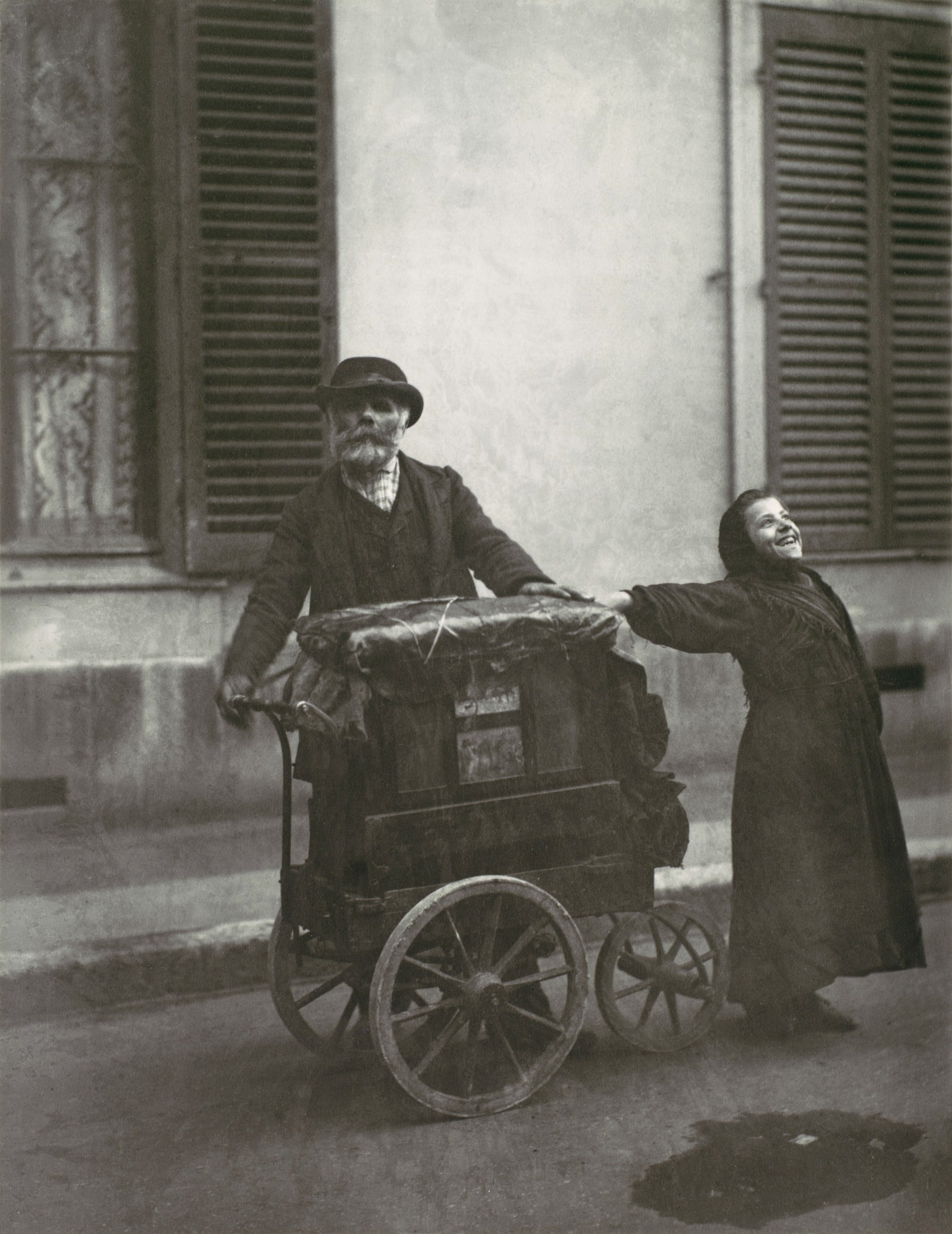
The album assembled by Man Ray contained a wide array of urban subjects across different Paris neighbourhoods. The selection included six photographs of ragpickers, two of street vendors, ten of shop display windows, and six of fairground sites. Geographically, the images ranged from a travelling circus encamped at rue de Vaugirard in Montparnasse to a ragpickers' settlement in the seventeenth arrondissement, and a hairdresser's shop on the boulevard de Strasbourg near Les Halles. Temporally, the collection spanned prints made between 1900, such as images of itinerant salesmen, and 1926, such as photographs of headless shop mannequins.
Surrealist Publications and Anonymity
Through Man Ray's intervention, Atget's photographs were introduced to the wider Surrealist circle, which included figures such as Jean Cocteau and Berenice Abbott. In 1926, Man Ray arranged for several of Atget's prints to appear in the official journal La Révolution surréaliste. When informed of the upcoming publication, Atget requested that his name be omitted from the pages, stating that he merely produced documents rather than artistic works. Consequently, the journal printed his photographs uncredited. The Surrealists valued these images for their factual, unadorned quality, viewing the straightforward urban records as evidence of strange meanings hidden within the ordinary fabric of the modern city.
The seventh issue of La Révolution surréaliste, published on 15 June 1926, featured Atget's photograph L'éclipse, avril 1912 on its front cover. The issue also included his 1912 photograph of the Boulevard de Strasbourg on page six and a 1921 image of Versailles on page twenty-eight. The eighth issue, published on 1 December 1926, included an Atget photograph depicting a staircase at 81 rue Turenne. By placing these images within their Surrealist journal, Man Ray and his colleagues detached Atget's photographs from their original utility as commercial reference materials, recasting them within a new artistic framework.
Topography of a Changing Capital
Atget's extensive archive functioned as a systematic topography of old Paris at a time when gentrification was rapidly altering the urban environment. Rather than focusing on grand monuments or prominent modern boulevards, Atget directed his box camera toward marginal sites and populace. He documented scenes suspended between historical tradition and modern expansion, such as street fairs, prostitutes, window displays, and worn architecture. His images captured Paris pittoresque, recording figures and places on the brink of obsolescence. By avoiding tourist destinations, Atget produced an itinerary of the city that presented threadbare, everyday spaces far removed from modern municipal homogeneity.
Although Atget maintained a strictly commercial focus until his death in 1927, his work influenced the development of modern photography. Artists like Berenice Abbott helped rescue his archive from oblivion, ensuring that his chronicling of Paris received wider recognition. By capturing everyday urban objects, headless mannequins, and empty street corners with clear framing and unpretentious technique, Atget raised mundane facts to evocative visual records. His photographs remain an essential record of early twentieth-century Paris, capturing the physical details of a city in transition while establishing a standard for straight, uncluttered photographic observation.


