


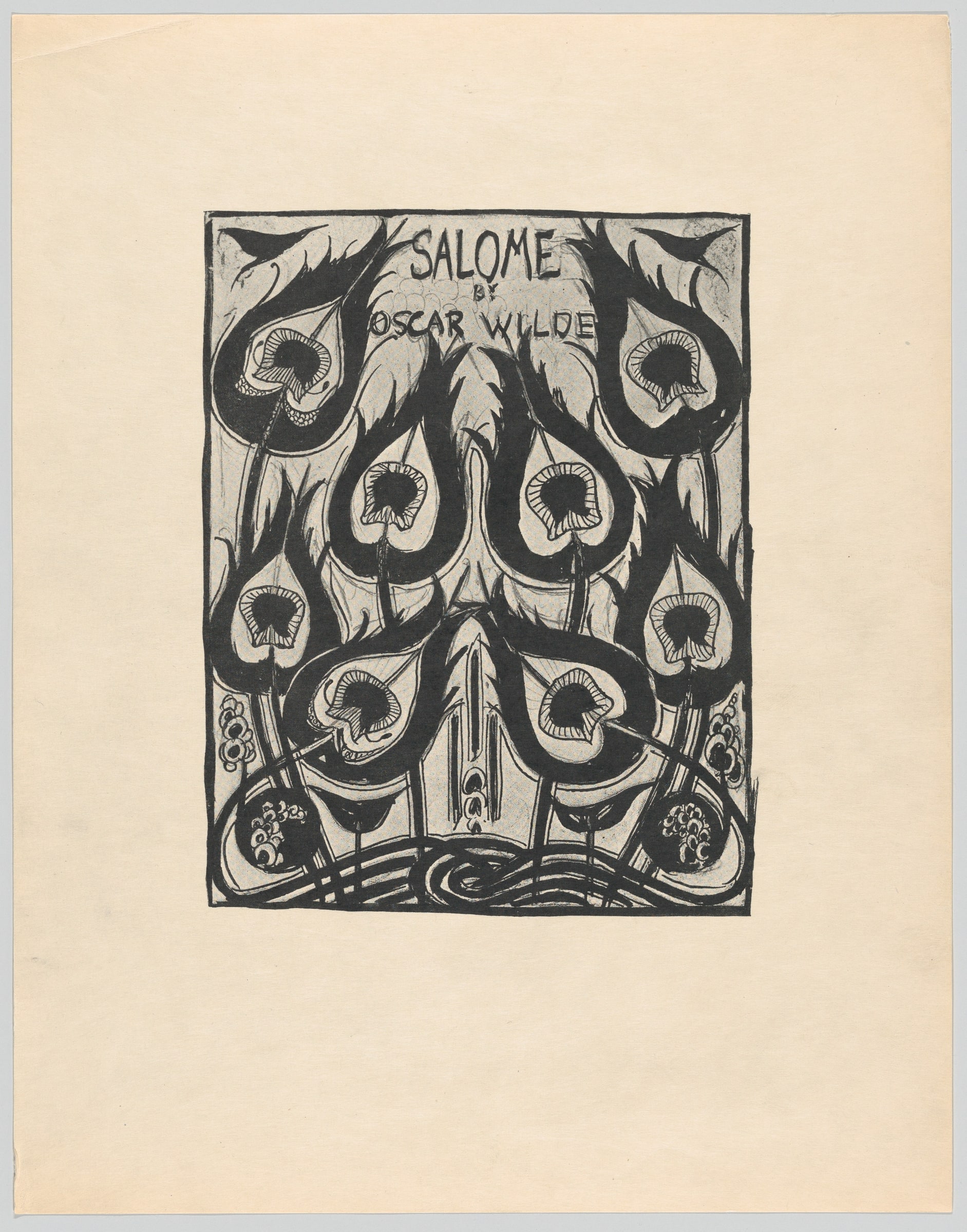
Aubrey Beardsley created his illustrations for Oscar Wilde’s play Salome using sharp pen lines and stark contrasts of black ink and white space. Published in 1894 for the English edition of the play, these drawings relied on photomechanical reproduction to combine delicate hair-thin linework with bold black blocks, creating images that challenged Victorian morality and traditional book illustration.
Early Career and Graphic Beginnings
Beardsley attended Bristol Grammar School for four years, where he drew caricatures of teachers and illustrated the school journal, Past and Present. His career moved forward after an uninvited visit to the studio of painter Sir Edward Burne-Jones. Burne-Jones spotted Beardsley's sister Mabel because of her red hair and admitted them into the studio. Impressed by the drawings in Beardsley's portfolio, Burne-Jones advised the young artist to attend evening classes at the Westminster School of Art.
In the early 1890s, Beardsley produced illustrations and covers for Sir Thomas Malory's Le Morte d'Arthur. This long project required more than three hundred illustrations and ornaments. Inspired by the Kelmscott Press, Beardsley framed pages with large decorative borders. As he grew frustrated with the extended project, his designs departed more and more from the source text, introducing entirely unrelated imagery. The decorative borders became filled with abstract tension and grotesque forms.
The Collaboration with Oscar Wilde
Beardsley met Oscar Wilde in 1893, a meeting that proved decisive for his career. Wilde had written his play Salomé in French, altering the biblical story from the New record. In the original gospel account, Salome asks for the head of John the Baptist at her mother's request. In Wilde's rewrite, Salome asks for the head herself because the saint spurns her sexual advances. This theme of sexual passion and bizarre behaviour held strong appeal for British decadent writers and artists.
Wilde's play was published in French in 1893. When an English translation by Lord Alfred Douglas was prepared for publication in 1894, Beardsley produced the black and white illustrations. Beardsley felt enthusiasm for the project and got involved in the translation process. In response, Wilde presented Beardsley with a dedicated copy of the play. However, Wilde's approval of the artwork diminished once the illustrated edition appeared in print.
Wilde complained that Beardsley's Art Nouveau style showed too much Japanese influence, which he believed was inappropriate for a Byzantine play. In addition, Wilde was concerned about the impact of the drawings on his own work. Beardsley's illustrations were visually independent from the text, leading Wilde to feel that the graphic art eclipsed the author's writing.
Visual Influences and Public Outrage
Beardsley's graphic technique incorporated elements from several artistic traditions. He combined influences from Japanese graphic arts with details from the prints of Albrecht Dürer and French Rococo artists. The explicit erotic content in his work was partly inspired by volumes of Japanese erotic prints, known as Shunga, which circulated among collectors in Europe and America. By joining these visual sources with a disregard for Victorian morality, Beardsley produced work that flouted social conventions.
The drawings contained allusions to female sexual desire that caused outrage in the British press. Beardsley straddled the boundary between fine art and commercial illustration. Unlike artists who produced self-published albums, publishers commissioned most of Beardsley's work for books and literary magazines. The degree to which Beardsley conformed to the role of a traditional illustrator remains a subject of debate among art historians and literary scholars.
Technical Execution and Stylistic Shift
Beardsley's pen and ink style was suited to the photomechanical method of reproduction used by publishers in the 1890s. This process allowed him to employ extremely delicate, hair-thin lines alongside solid, dramatic blocks of black and white. His work for Salome shows a rapid development from his earlier Morte d'Arthur illustrations. In drawings such as The Climax, Beardsley abandoned conventional background settings, dropping any attempt to locate his figures within physical interiors or outdoor scenes.
In The Climax, Salome floats in the upper half of the frame, presented as if transcendent in her moment of victory. Behind her head, a cloud of black circular forms evokes the energy of her internal desires. Below Salome, blood dripping from the severed head of John the Baptist forms a dark pool. White areas in the drawing suggest a glistening liquid surface, out of which a strange flower emerges.
Symbolism and Compositional Detail
The sinuous forms of evil flowers in Beardsley's drawings indicate a connection to French Symbolism and Baudelaire's text Les Fleurs du Mal. A copy of Baudelaire's book is explicitly drawn on the dressing table in Beardsley's illustration Toilet of Salome I. This inclusion demonstrates how Beardsley stretched the conventions of book illustration, as the toilet scene does not correspond to any event written in Wilde's play.
The Climax itself was a reprise of an illustration Beardsley published in The Studio magazine in 1893, an image that secured him the commission for the Salome book. In the illustration, Salome holds the severed head of John the Baptist to take the kiss denied to her while he lived. Although dead, the severed head continues to project disdain. John's snakelike hair and Salome's octopus coif transform the figures into Medusa-like images driven by hatred.
The Frontispiece and Textual Departure
The dark pool of blood beneath John's head nourishes phallic plants that slither around Salome like vines. Beardsley used this plant motif to reinforce the decadent theme of the scene. The confrontation takes place within a flat, abstract composition where curvilinear lines twist in rhythmic patterns. At certain points in the drawing, the thin ink line almost disappears entirely into the surrounding white space.
The frontispiece to the volume, titled The Woman in the Moon, further demonstrates Beardsley's departure from simple textual illustration. The drawing features a caricature of Oscar Wilde's face as the moon looking down on a pair of figures. These figures are identified as the Young Syrian who loves Salome and the Page who loves the Young Syrian. The ambiguous identity of the moon figure matches the internal contradictions found throughout Wilde's text.


