


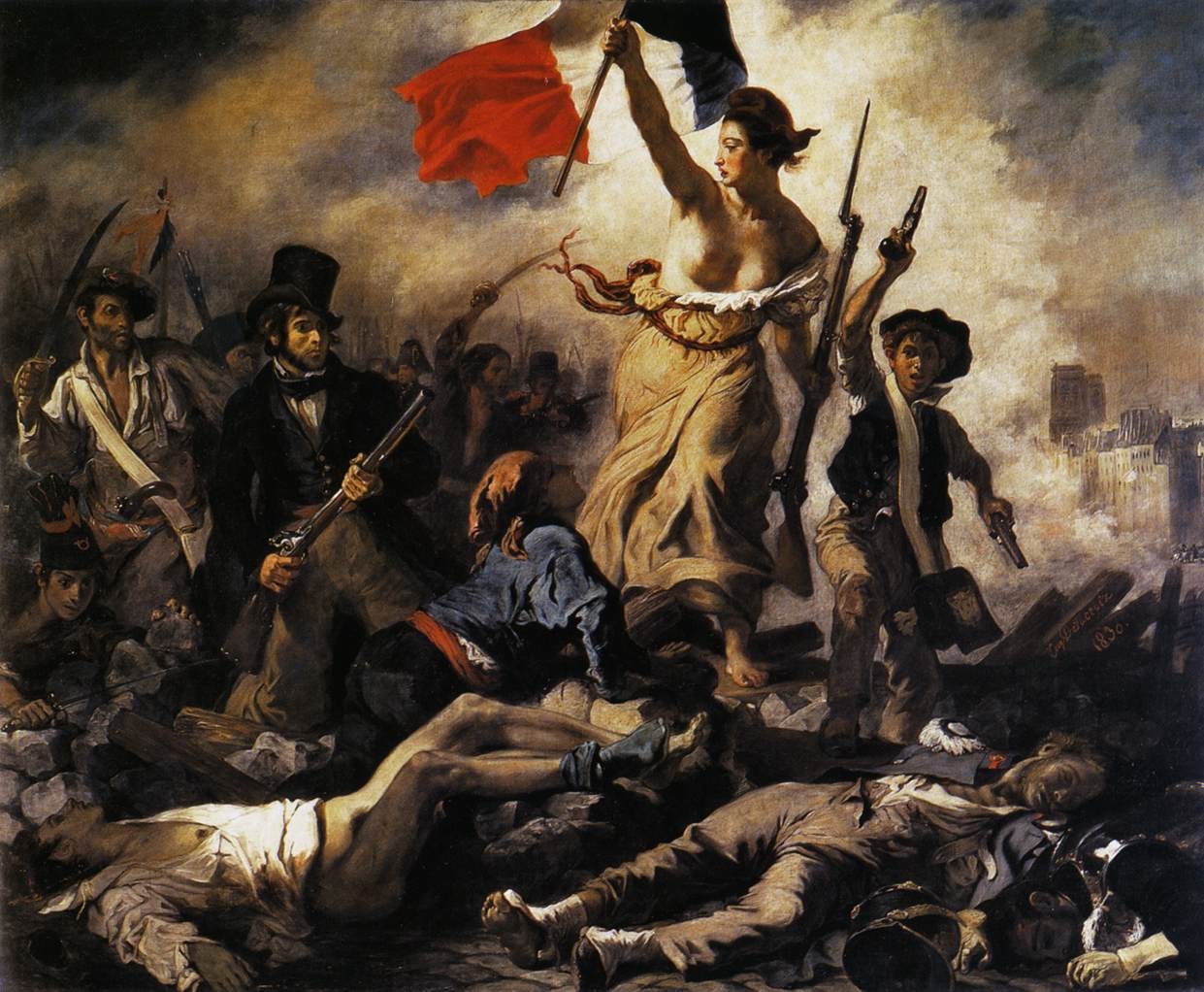
In 1830, Eugène Delacroix painted Liberty Leading the People to capture the spirit of the July Revolution in Paris. The large canvas balances contemporary historical facts with allegorical figures, portraying the armed uprising that overthrew King Charles X and established the July Monarchy under Louis-Philippe.
The Context of the July Uprising
During the final days of July 1830, Parisian citizens took to the streets in response to restrictive royal decrees issued by King Charles X. The monarch sought to reinstate absolute authority, violating the existing constitution. Over three days of heavy street fighting, known as the July Revolution, insurgents erected stone barricades across Paris and forced Charles X to abdicate. The rebellion concluded with the ascension of Louis-Philippe, Duke of Orléans, to the throne, ending the period of the Bourbon Restoration.
Although Eugène Delacroix did not take up arms during the rebellion, he observed the three days of street combat from the sidelines between 27 July and 29 July. Writing to his brother shortly after the event, Delacroix noted that while he had not fought directly for his country, he would paint for her instead. Coming from a Bonapartist family background, the artist welcomed the return of the tricolour flag, which represented republican principles to many French citizens.
Delacroix completed the large canvas, measuring 260 by 325 centimetres, in the autumn of 1830. His friend Alexandre Dumas observed that the artist possessed a sensitive and spiritual temperament that kept him back from participating in popular political movements directly. Nevertheless, Delacroix viewed historical shifts as sweeping events that relieved individuals from the monotony of daily routine, prompting him to document the uprising through a major artistic project.
Allegorical Form and Symbolism
At the centre of the composition stands the figure of Liberty, portrayed as a muscular woman stripped to the waist. She wears a red Phrygian cap, a traditional emblem derived from classical antiquity where it designated a freed slave. In her right hand, she holds the tricolour flag aloft against the battle haze, while her left hand grips a musket fitted with a bayonet. Her stride carries her forward over the stone barricade as she turns her head to encourage the fighters following her.
Delacroix synthesised classical iconography with direct realism in his portrayal of Liberty. Her powerful physique and fluttering yellow drapery recall Baroque compositions, including works by Peter Paul Rubens such as The Consequences of War. Rather than representing a detached classical ideal, Delacroix gave the figure bare breasts, introducing a maternal and physical presence to political art. The art critic Charles Blanc later argued that the artist intended to pay tribute to intellectual freedom rather than purely political realignment.
Contemporaries responded strongly to this unconventional combination of allegorical ideal and physical reality. Writing in 1831, the German poet Heinrich Heine described Liberty as a bold young woman whose features mixed the characteristics of a classical goddess and a market woman. Unlike historical paintings by contemporary artists such as Jean-Victor Schnetz, who avoided symbolic devices in depicting the same uprising, Delacroix deliberately relied on Baroque allegory to drive his narrative.
Compositional Structure and Palette
The artist arranged the crowd within a strict pyramidal structure derived from Neoclassical design. The apex of this equilateral triangle coincides with the tricolour flag held by Liberty. Unlike Théodore Géricault’s The Raft of the Medusa, which directed the viewer's eye away towards a distant rescue ship on the horizon, Delacroix projected the visual movement of his scene forward into the viewer's space. The insurgents advance towards the foreground, suggesting that their victory lies within immediate reach.
The colour palette of the painting differs significantly from Delacroix’s earlier work, such as The Death of Sardanapalus. In Liberty Leading the People, earth tones and muted greys dominate the canvas, echoing the dust and gunpowder smoke of urban combat. Delacroix restricted brilliant hues primarily to the tricolour flag itself, while scattering small accents of red, white, and blue across the garments of the fallen and advancing combatants.
The painter integrated subtle details to bind the narrative to its physical setting. On the right side of the canvas, Delacroix placed his signature and the date in bright red paint upon the fallen wooden timbers of the barricade. Through the thick haze of gunpowder smoke in the background, the recognisable twin towers of Notre-Dame Cathedral rise above the city, establishing the precise geographical location of the uprising in Paris.
Figures of the Parisian Insurrection
To demonstrate the broad social support behind the uprising, Delacroix included varied Parisian social classes within the advancing group. To Liberty's right, a young street boy brandishes two pistols, matching her forward momentum with his own enthusiastic gestures. On the left side of the canvas, a factory worker wielding a saber advances alongside an intellectual dressed in a dark coat and top hat, holding a sawed-off musket.
The figure in the top hat has often been identified as a self-portrait of Delacroix, though historical accounts differ. By placing an intellectual figure alongside manual labourers and street youths, the composition portrays a unified urban populace acting under a single impulse. Behind the top-hatted figure, another insurgent wearing a cap holds a stone, prepared to throw it at enemy forces.
At the base of the barricade, fallen bodies accentuate the human cost of the conflict. On the left, a dead soldier lies stripped from the waist down, creating a stark contrast between vulnerability and violence. Nearby, a wounded worker in a blue shirt and blue stockings drags himself upward, fixing his gaze on Liberty. The inclusion of these casualties emphasises the dangerous physical reality of street combat.
Public Response and Official Suppression
Delacroix displayed Liberty Leading the People at the Paris Salon of 1831, where it attracted widespread public attention and earned the artist the Legion of Honour. Recognising the work's connection to the new regime, the government of King Louis-Philippe purchased the canvas that same year. However, official enthusiasm quickly cooled as the new administration sought to establish order and distance itself from revolutionary unrest.
Fearing that the painting’s depiction of armed rebellion might encourage further uprisings, government authorities returned the canvas to Delacroix in 1833, removing it from public view at the Palais du Luxembourg. The painting remained hidden in storage for most of the following fifteen years. It was shown briefly to the public after the Revolution of 1848, and again during the Universal Exhibition of 1855 under Emperor Napoleon III.
The canvas eventually entered the permanent collection of the Louvre Museum, where it was placed on public view in 1874 after political conditions in France stabilised. Through its combination of contemporary historical detail, Baroque allegory, and controlled colour design, Delacroix's painting remains one of the defining works of nineteenth-century French Romanticism.


_-_WGA6177.jpg)