


Maria Sibylla Merian was a German-born entomologist and painter who established her reputation in Amsterdam. Through direct fieldwork in Suriname and meticulous printmaking, she documented the life cycles of nearly two hundred insect species, transforming natural history.
The Amsterdam Studio and Commercial Trade
Born in Germany, Maria Sibylla Merian moved to Amsterdam in 1691 after leaving her husband. In the Dutch Republic, women found opportunities to pursue art and manage independent studios. Merian established a successful commercial art trade in Amsterdam alongside her two artist daughters, Johanna Helena and Dorothea Maria. The business produced and sold natural history paintings, drawings, and botanical studies to collectors. By building a secure trade, Merian acquired financial independence. This commercial success allowed her to fund her work and purchase supplies for extensive research into natural history.
In Amsterdam, Merian integrated into networks of scholars, civic leaders, and collectors. She formed friendships with prominent local figures, including Nicolaas Witsen, who served as mayor of Amsterdam, and Frederick Ruysch, a doctor and collector. Her studies focused on observing living insects and recording their transformation over time. Merian avoided relying on speculative theories, choosing instead to collect caterpillars and raise them to record every phase of development. Her reputation as a meticulous painter of insects and plants grew rapidly within Dutch scholarly and artistic circles.
Scientific Expedition to Suriname
In 1699, Merian took an unprecedented step for a European natural scientist by travelling to South America. Accompanied by her daughter, she sailed to Suriname, located at the north-easterly point of the continent. This trip was one of the earliest European scientific voyages organised specifically for fieldwork rather than commercial trade or colonial expansion. Merian financed the entire journey herself using profits from her Amsterdam studio business. Upon arrival, she established a working environment where she could study living tropical organisms directly within their natural habitats.
Merian worked in Suriname under demanding environmental conditions. Together with her daughter, she collected specimens from the jungle, observing life cycles and insect interactions with native plant species. Her studies documented plants and insects previously unknown to European scholars. She made drawings of caterpillars, chrysalises, and adult butterflies on their native host plants. Serious illness eventually forced Merian to cut her research short and return to the Netherlands, but she brought back an extensive collection of sketches, preserved specimens, and scientific notes.
Publication of Metamorphosis Insectorum Surinamensium
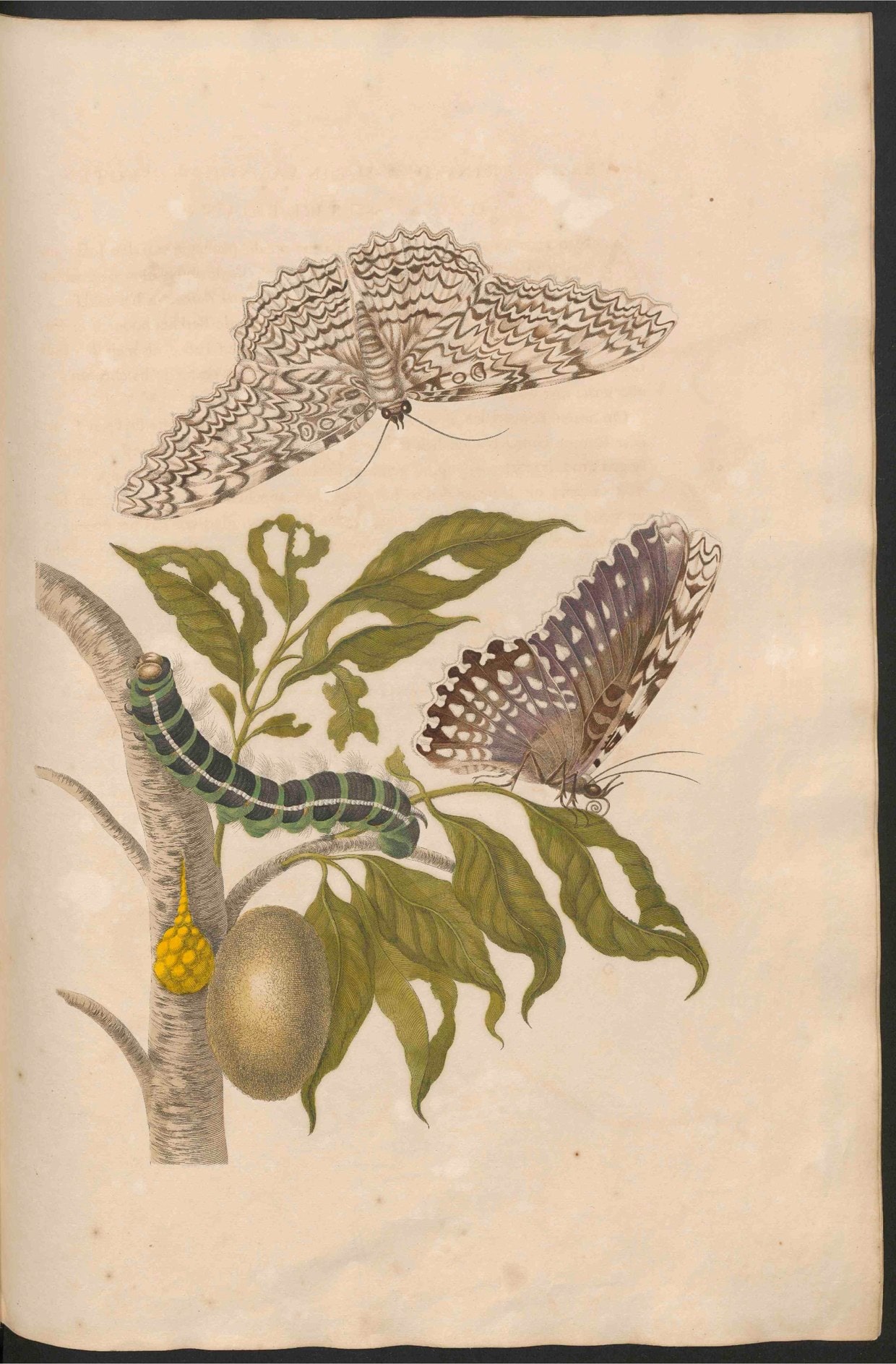
After returning from South America, Merian re-established her art business in Amsterdam and compiled her fieldwork into a major published study. In 1705, she released Metamorphosis insectorum Surinamensium in both Latin and Dutch. The volume contained sixty detailed scientific illustrations accompanied by written observations. Merian's plates illustrated complex biological processes, showing plants like the pomegranate tree with its flowers, fruit, caterpillars, chrysalises, and mature butterflies. Other compositions featured native species like pineapples alongside German and Australian cockroaches, as well as reptiles such as crocodiles.
Merian's published work provided clear evidence of insect metamorphosis for nearly two hundred species. European scholars acknowledged the detail of her observations and the accuracy of her illustrations. The writer Johann Wolfgang von Goethe later consulted her works for his scientific research. Through her publication, Merian recorded ecological interactions between insects and plants, documenting feeding habits and developmental stages. Her daughter assisted in reproducing and colouring the prints, maintaining high standards of production across the published editions.
Visual Identity and Studio Iconography
Merian’s professional achievements were recorded in artistic literature of the period. Arnold Houbraken included her in his biographical publication on Dutch painters. The biography contained a studio portrait print engraved by Jacob Houbraken after a drawing by Georg Gsell. The composition depicts Merian in her workspace, surrounded by her artist tools, books, a globe, and precise drawings of natural specimens. A cloth of honour hangs overhead, placing her within a tradition of scholarly portraiture reserved for accomplished intellectuals.
The studio portrait contains distinct symbolic elements that reflect Merian’s personal and political background. Behind her hangs the Merian coat of arms, which shows a stork holding a serpent in its beak. Nearby figures include a miniature statue sounding a trumpet to denote fame, alongside a helmeted Maid of Holland holding a pike and Hat of Liberty. The imagery links her scientific contributions to civic pride. Furthermore, Merian’s earlier membership in the Labadist religious community, founded by Jean de Labadie, connects her to a broader network of scholarly women in the Netherlands.
Empirical Observation and Recognition
During the Dutch Golden Age, scientific inquiry moved away from relying on classical texts toward direct empirical observation. Earlier writers treated insects as minor subjects, citing them primarily to illustrate moral or biblical lessons. Merian’s systematic research contributed to replacing these traditional texts with empirical records. Her focus on insect life cycles helped establish entomology as a rigorous scientific discipline. Today, scholars consider her one of the founders of modern zoology because of her precise records of metamorphosis and habitat dynamics.
Although respected during her lifetime, Merian’s contributions were largely overlooked after her death in 1717. Her work remained unacknowledged in mainstream scientific literature until the nineteenth century. Full recognition of her achievements returned during the 1970s and 1980s through British and German studies. Interest in her work expanded further in 2017 when Metamorphosis insectorum Surinamensium was republished on the three-hundredth anniversary of her death, confirming her place in the history of natural history illustration.


