


The ancient Egyptian Book of the Dead was an illustrated collection of spells and prayers created during the New Kingdom. Placed inside tombs, these papyrus scrolls provided deceased individuals with the necessary knowledge and legal arguments to pass divine judgment, survive the underworld, and achieve eternal life alongside the gods.
Origins and Evolution of Funerary Spells
During the Old Kingdom, Egyptian funerary texts were carved directly onto royal tomb walls. The Pyramid Texts of King Unis, who ruled during the Fifth Dynasty around 2341 BCE, represent the earliest surviving examples of these resurrection incantations. Inscribed inside his pyramid at Saqqara, these early spells were designed specifically to assist the pharaoh in rising to join the celestial deities.
Beliefs surrounding the afterlife expanded significantly during the Middle Kingdom. Non-royal elites began adopting royal burial prayers, which scribes adapted into inscriptions on wooden coffins known as the Coffin Texts. By the Eighteenth Dynasty of the New Kingdom, these collected prayers were compiled into papyrus scrolls known today as the Book of the Dead. Over two hundred distinct spells were recorded across various surviving scrolls.
The production of papyrus scrolls allowed a wider segment of Egyptian society to purchase funerary texts. Anyone with sufficient financial resources could commission a scroll from a scribal workshop. Relatives placed the completed papyrus scroll directly inside the coffin or wrapped it within the mummy bandaging itself to protect the deceased on their journey through the netherworld.
Narrative Structure on Papyrus Scrolls
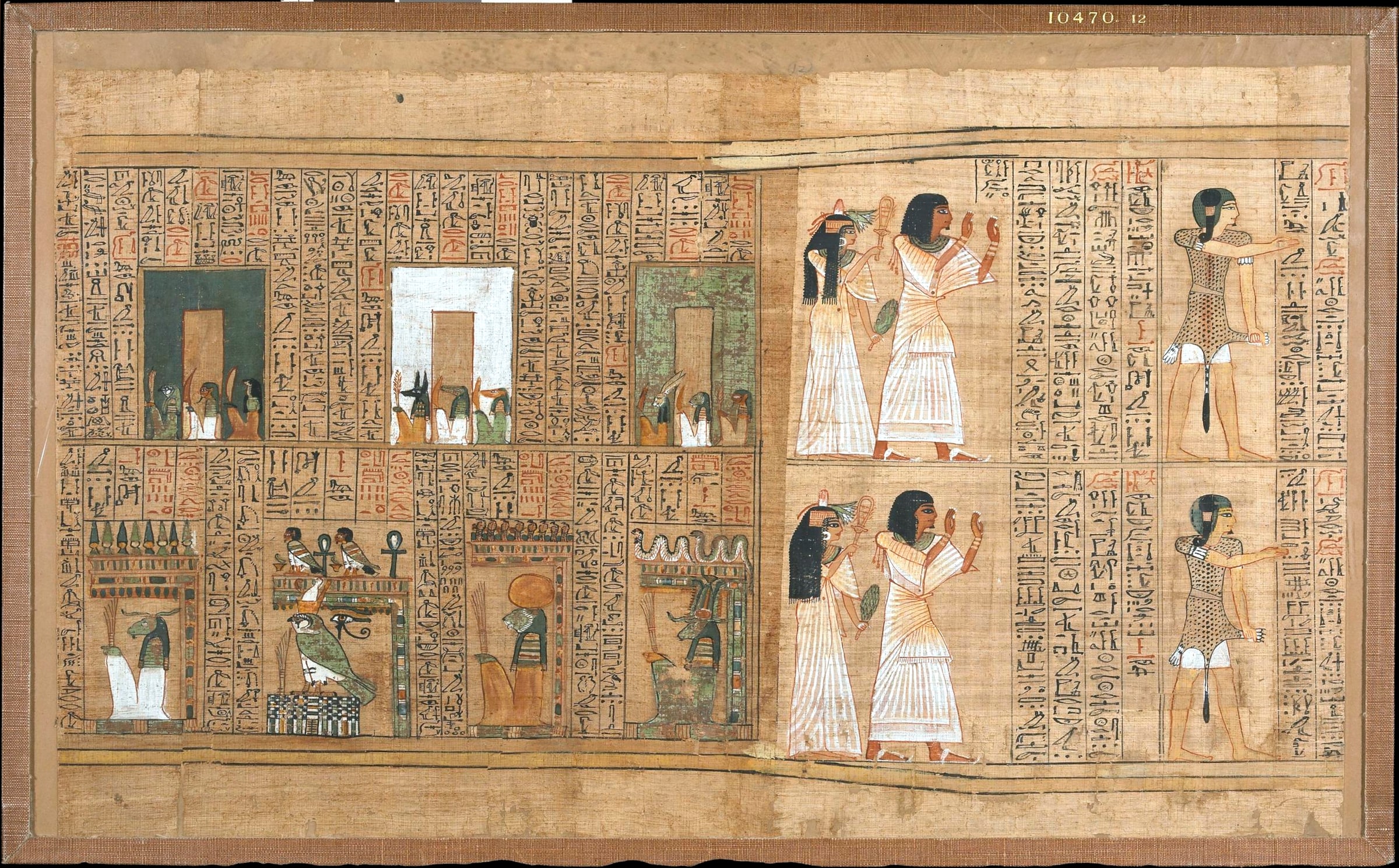
Scribes recorded the Book of the Dead on long scrolls manufactured from papyrus reeds. The visual style derived directly from traditional Egyptian tomb wall painting, but artisans adapted the imagery to fit the continuous horizontal band of the papyrus surface. The visual scenes accompanied the written incantations to guide the soul through each underworld trial.
The papyrus scrolls used a continuous narrative format. Scribes and painters depicted the central figure multiple times across successive scenes without using dividing architectural frames. Notable examples include the scroll commissioned for the royal scribe Hunefer around 1285 BCE and the Papyrus of Ani from the Eighteenth Dynasty, both preserved in the British Museum in London.
In these scrolls, text and visual illustration worked together as a functional unit. The written incantations explained the precise spoken responses required of the deceased, while the illustrations provided clear visual representations of the deities and judgment halls. This combined format ensured that the deceased possessed both the recited knowledge and visual recognition needed for safe passage.
The Trial of the Soul and the Scale
The central ritual depicted in these papyrus scrolls is the weighing of the heart. The jackal-headed god Anubis leads the ka, representing the active soul of the deceased, into the Hall of the Two Truths while holding an ankh, the symbol of life. The deceased person was required to swear to forty-two deities overhead that they had lived a righteous life in accordance with ma'at.
At the balance scales, Anubis weighs the heart of the deceased, which is contained in a small jar, against the feather of truth representing Ma'at. The ibis-headed god Thoth, acting as the court scribe, stands nearby to record the judgment outcome on a tablet. The heart had to remain light enough not to outweigh the ostrich feather of Ma'at.
Ammut, a monster composed of a crocodile head, lion forelegs, and hippopotamus hindquarters, stands watching the scales greedily. If a heart weighed more than the feather due to unjust living, Ammut devoured the soul, denying it an afterlife. If the deceased passed the test without evil deeds recorded against them, Ammut went hungry and the soul proceeded forward.
Presentation Before Osiris
Once declared true of voice, the deceased was escorted by the falcon-headed god Horus to face Osiris. To gain entry into paradise, the dead person recited memorised prayers, which were also written on scroll leaves or coffin lids. Osiris sits in a pavilion floating above a lake of natron, the salt compound used for preserving the physical body during embalming.
Osiris holds the emblems of Egyptian kingship and wears a white mummiform shroud. His wife Isis, goddess of life, and her sister Nephthys stand behind his throne. Nephthys is recognised as the mother of Anubis and a protector of the dead, while Ma'at hovers overhead to confirm that the deceased lived in ethical harmony.
In front of Osiris, the four miniature sons of Horus stand upon a white lotus blossom, which acts as a symbol of rebirth. These four gods represented the cardinal directions and protected the internal organs removed during the embalming process. Their placement on the lotus blossom confirmed that the deceased had achieved spiritual resurrection.
Concepts of the Soul and Paradise
Ancient Egyptian theology recognised multiple overlapping aspects of human identity after death. These included the Ba, depicted as a bird with a human head, and the Sha, an image-soul that duplicated the physical appearance of the deceased. The Ka represented the active personality surviving without the physical body, maintaining its presence near the burial place.
Upon passing all judgment tests, the deceased received offerings and gained access to Sekhet-hetepu, known as the Field of Peace. Texts such as the Papyrus of Ani record that righteous souls were granted cakes and permission to dwell in the presence of Osiris, ensuring their ongoing survival alongside the followers of Horus.
The ultimate objective of the Book of the Dead was to secure this celestial existence. By equipping the deceased with spells to satisfy the judges and pass every trial, the scrolls provided reassurance that a life lived in accordance with divine order would be rewarded with eternal life in paradise.


