


Persian miniature painting transformed the depiction of nature into an idealized vision of divine paradise. Developed across major manuscript traditions from the Mongol period to fifteenth-century Herat, these garden settings combined stylized botanical motifs, gold backgrounds, and poetic symbolism.
Lyrical Settings and Divine Paradise
An organised period in Persian manuscript painting began around 1396 with the Khwaju Kermani manuscript. This stylistic direction culminated between 1420 and 1440 in the Herat school. Timur's son Shah Rokh created an academy in Herat, which his son Baysunqur Mirza developed to codify, copy, and illustrate classical Iranian literature. Paintings from this period shifted the tone of manuscripts such as the Shah-nameh of Ferdowsi from epic narratives to lyrical compositions. Puppet-like figures engage in activities within idealized garden or palace environments, frequently positioned against backgrounds of solid gold leaf.
These rendered settings represented a divine paradise presented through the form of a royal palace or garden rather than an exact copy of the physical world. The compositions embodied themes from mystically interpreted lyrical poetry, such as the writings of Nezami, Rumi, and Hafez. While later artists repeatedly executed standardized formulas, the finest miniatures achieved a controlled lyricism that expressed a search for the divine. Illustrated manuscripts of Nezami held by the Metropolitan Museum of Art in New York demonstrate this approach, using precise execution to articulate complex spiritual ideas.
Early Compositional Conventions and Chinese Influences
In the early fourteenth century, manuscript painting in Mongol Iran introduced new conventions for depicting outdoor settings. The Small Shahnama manuscripts, including examples housed in the Freer Gallery of Art in Washington, D.C., demonstrate a synthesis of regional styles. Painters incorporated traditions from pre-Mongol Central Asia and thirteenth-century Mesopotamia alongside elements brought from Chinese pictorial art under the Il-Khanid dynasty. These compositions maintained a pattern-like appearance against gold backgrounds, using two-dimensional arrangements to construct the environment.
Specific botanical features defined the outdoor depictions in manuscripts like the Freer Small Shahnama. Artists painted green, gently sloping hillocks at the feet of standing or hunting figures to indicate grassy ground. These hillocks did not include detailed individual blades of grass or receding perspective lines to convey spatial distance. Instead, painters arranged bunches of flowers across the slopes, relying on decorative formulas derived from thirteenth-century Mesopotamian painting techniques. Different regional workshops across Ilkhanid territory adapted these imported and existing conventions in varying measures.
Botanical Motifs and Architectural Integration
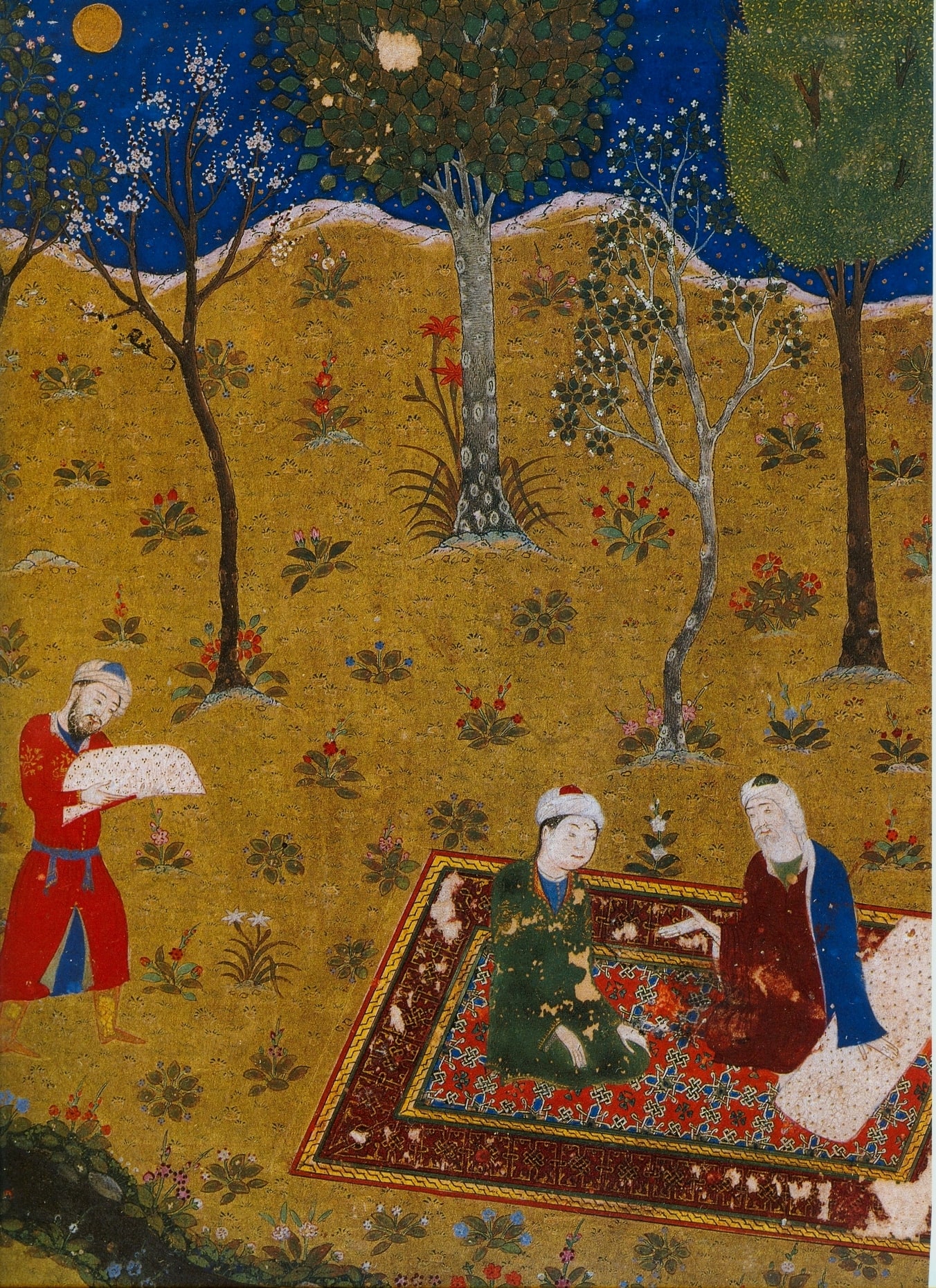
Miniature paintings established harmony between natural elements and architectural structures. Lawns of dark green suggest the presence of living water, surrounded by abundant floral motifs. Flowers appear across lawns, within foliage, and on embroidered carpets where figures sit in robes of green or red silk. Trees in bloom rise against gold backgrounds, while birds with bright plumage populate the branches. Water jets flow into porphyry vases near terraced structures, reflecting sunlight across cupolas rendered in pink, azure, or white hues.
Palace architecture within these painted gardens features enameled walls, damascened surfaces, and crystal ceilings. Porticos and light-filled gates open onto terraced courtyards where golden peacocks display emerald tails. Figures gather on embroidered carpets to listen to musicians along blue waters or consume candied flowers from small cups of coral and porcelain. Night scenes maintain visibility through illuminated architecture, preserving the light of day across white terraces and cupolas. The fine details of execution in these scenes parallel the calligraphy on delicate paper surrounding the images.
Regional Developments and Narrative Painting
The Mongol era introduced major stylistic shifts to Iranian painting, moving away from Seljuq models while establishing new forms of text illustration. Masterpieces of literature, including Ferdowsi's Shah-nameh and Nezami's lyrical poems, were systematically illustrated alongside historical chronicles. Rashid al-Din's Jami al-tawarikh, produced in the early Il-Khanid period, contains historical narrative scenes that reflect the direct impact of Chinese painting traditions introduced under Mongol rule.
Provincial workshops maintained distinct approaches to depicting natural settings. The British Library copy of Kalila wa Dimna, dated to 1307, presents natural elements without naturalistic rendering, continuing earlier Mesopotamian conventions. In scenes depicting animals, backgrounds contain tooth-shaped rocks built up in dense layers and balloon-like trees housing haloed birds. These features drew from models developed by the pre-Mongol Mosul school rather than Chinese sources, demonstrating how regional Iranian centres retained earlier Arab visual traditions while developing manuscript illustration.
Observational Detail and the Later Herat Style
A major change occurred in Persian painting during the second half of the fifteenth century at Herat under the rule of Husayn Bayqara. This transition is closely associated with the master painter Behzad. Moving away from purely idealized garden formulas, Behzad introduced realistic poses and direct observations of his physical environment into manuscript illuminations. His compositions incorporated numerous details of daily life and genre elements, altering the structural layout of painted settings.
Behzad also introduced psychological interpretation into the depicted events and figures. His work preserved the fine execution and spatial clarity characteristic of Iranian manuscript art while adding individual expression to the human figures within the scenes. Earlier pastoral works, such as Junayd's border paintings for the Diwan of Sultan Ahmad from around 1405, had established lyrical pastoral settings. Behzad expanded upon these foundation techniques, balancing decorative geometry with observed human behaviour.


