


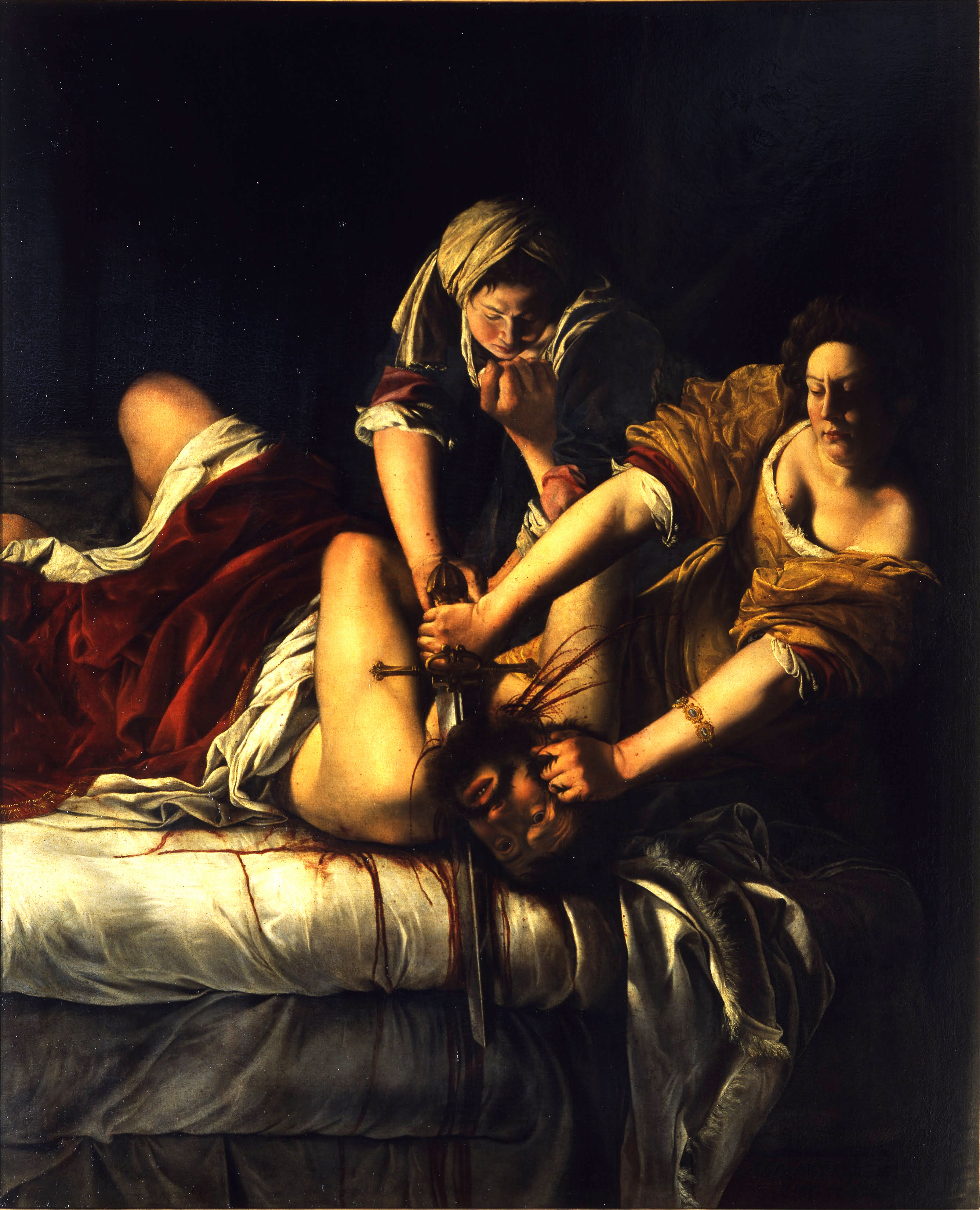
Artemisia Gentileschi painted Judith Beheading Holofernes twice. The first version, finished around 1612 in Rome, hangs today in the Capodimonte in Naples. The second, larger and more refined, was painted in Florence between 1620 and 1621 and hangs in the Uffizi. Between the two paintings she was raped by her painting tutor, gave evidence under torture in a seven-month trial, married a Florentine, and became the first woman elected to the Accademia delle Arti del Disegno.
The two Judiths are the same scene. The composition is similar. The differences are technical, and they tell a story about an artist getting better at the thing she had already done well.
The Painter at Seventeen
Artemisia was born in Rome in 1593, the daughter of the painter Orazio Gentileschi. She grew up in his studio. Her mother died when she was twelve. By the time she was seventeen she could paint at a professional level, which her brothers could not. Orazio described her as the equal of any of his pupils.
The household kept company with Caravaggio, who lived nearby and worked in a similar tenebrist style. Caravaggio's Judith Beheading Holofernes (c. 1599) hung in a Roman collection that Artemisia could have seen. The composition was something the Gentileschi circle knew well: the maid holding a bag, Judith leaning forward to do the work, Holofernes thrashing in his bed.
The Trial
In May 1611, Orazio asked the painter Agostino Tassi to teach his daughter perspective. Tassi raped her in the Gentileschi house. Orazio sued him eight months later, in March 1612, when it became clear that Tassi did not intend to marry Artemisia and so restore her honour.
The trial transcript survives. Artemisia gave evidence under sibille, the thumbscrew torture used to verify witness statements. While the cords were being tightened on her hands she said, repeatedly, that what she had said was true. Tassi was convicted and sentenced to five years' exile from Rome, a sentence he avoided through patronage.
The first Judith was finished within a year of the verdict. The painting is roughly two metres tall, the figures life-size. Holofernes lies pinned by Judith's left arm while her right drives the sword into his neck. Blood arcs across the white sheet in three jets. The maid, Abra, leans her full weight onto Holofernes's chest.
Florence
Artemisia married Pierantonio Stiattesi, a minor Florentine painter, in November 1612. The marriage was arranged within weeks of the verdict. The couple moved to Florence, where Artemisia found a more sympathetic professional environment than the Roman one she had left.
By 1616 she had been admitted to the Accademia delle Arti del Disegno, the first woman ever elected. She kept a studio, took commissions from the Medici, and corresponded with Galileo, who wrote to her about the optics in her paintings. She had four children, only one of whom (Prudenzia) survived to adulthood.
The Second Judith
The Uffizi version was probably commissioned by Cosimo II de' Medici around 1620. It is larger than the Naples version, more carefully painted, and technically more accomplished. The blood is more convincing. The figures' arms now form a stronger geometric structure. The sword has been moved into a more anatomically plausible position.
One detail in particular shows the development. In the Naples version, Holofernes's hand grips the sheets in a way that does not quite read. In the Uffizi version, the same hand pushes against Abra's bicep, a small motion that makes the violence of the scene physical in a way the first version does not quite achieve.
What Came Next
Artemisia returned to Rome around 1620, then moved to Venice in 1627 and to Naples in 1630. She visited London in 1638 to work alongside her father, who had been court painter to Charles I. Orazio died there in 1639. She returned to Naples and worked there until her death, probably around 1656.
She painted other heroines: Susanna and the Elders, Lucretia, Cleopatra, Esther. She also painted Judith again, in different compositions: Judith and Her Maidservant (Detroit Institute of Arts), and several smaller pictures of Judith with the head already in the bag. She returned to the subject through a working life of forty years.
What the Two Versions Show
The two Judiths are not a sequence of revenge paintings, though that has been the popular reading. They are the work of a painter who was given a powerful subject early in her career and who returned to it once she had the technique to handle it properly.
The first Judith is the work of a nineteen-year-old who had survived something terrible and could paint extraordinarily well. The second is the work of a twenty-seven-year-old who had become the leading female painter in Italy. Both are in major museums. Both are now considered foundational works of Italian Baroque painting. Neither is signed: Artemisia signed only a handful of pictures across her whole career.
The painter who survived the trial of 1612 made a forty-year career out of the same set of subjects. She did so by being very good at painting, and by getting better.


