


In May 1898, Vilhelm Hammershøi and his wife Ida moved into a first-floor apartment at Strandgade 30 in the Christianshavn district of Copenhagen. The building was a seventeenth-century merchant's house with high-ceilinged rooms, white panelled walls, and small north-facing windows. They lived there for the next eleven years. During that time Hammershøi painted, by recent count, approximately sixty interiors of the apartment.
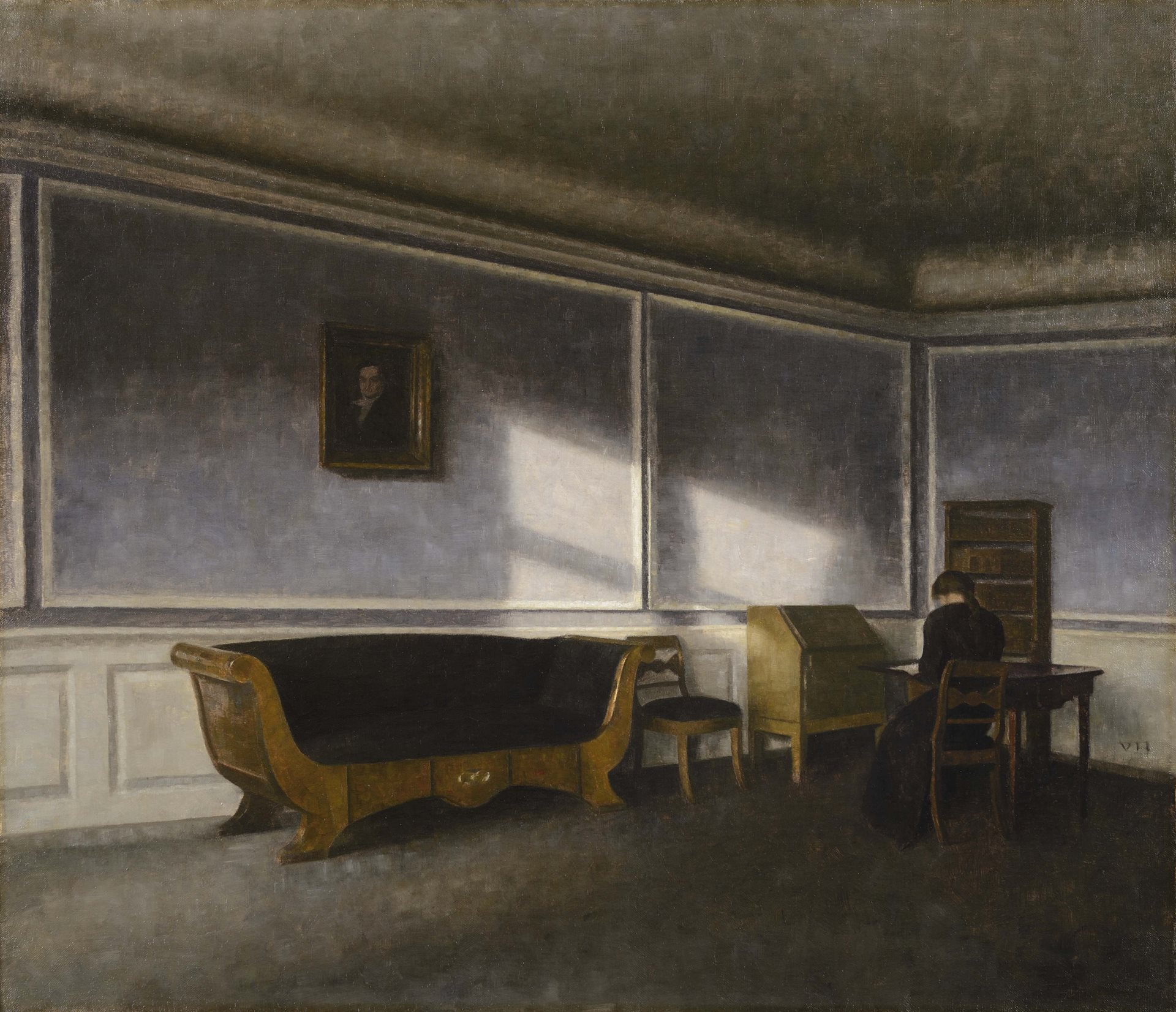
The paintings are nearly all the same: a doorway, a small section of wall, a piece of dark furniture, sometimes the back of a single figure. The figure, when present, is usually Ida. She faces away from the viewer, often in the act of leaving the room. The light is northern and grey. The walls are white-grey. The floors are dark wood. Nothing in the paintings indicates the year, the season, or any specific occasion.
Copenhagen
Hammershøi was born in Copenhagen in 1864, into a merchant family. He studied at the Royal Danish Academy of Fine Arts in the early 1880s under teachers who taught a conservative version of late nineteenth-century academic painting. He was a competent student, won prizes, and exhibited at the Charlottenborg from 1885 onwards. By the early 1890s he had begun the kind of interiors and figure paintings that would define the rest of his career.
He married Ida Ilsted in 1891. Ida was the sister of his fellow painter Peter Ilsted, and the two painters maintained a close working friendship for the rest of Hammershøi's life. Ida had been a model in his student work and continued to model for many of his mature paintings, almost always with her back turned.
What the Rooms Look Like
The Strandgade 30 apartment had a recurring set of architectural features that Hammershøi painted over and over. A doorway opening through to a back room. A small white stove. A bookcase. A windowless wall section with a single hanging picture. A polished wooden floor that caught the grey light. The whole palette of the building was within twenty values: bone white, grey-white, dove grey, soft black, mahogany brown.
Hammershøi painted these elements in different combinations across sixty canvases. Sometimes a doorway with no figure. Sometimes a doorway with Ida walking through. Sometimes a section of wall and an empty chair. Sometimes a piano with no player. The compositions are not arbitrary: each painting is built on a strict geometric grid, with the doorways aligned to specific vertical axes and the figures placed at calculated points in the visual field.
What He Was Doing
The standard reading is that Hammershøi was painting silence. The reading is correct in its way. His pictures are quiet, and the quietness is structural: the rooms are empty enough to function as compositional fields rather than as containers for action. The light is even and unmoving. The figures, when they appear, are passing through.
The more useful reading is that Hammershøi was painting the same problem repeatedly. The problem was how to balance a Vermeer-influenced understanding of light against the late nineteenth-century Whistlerian interest in tonal harmony, both inside the constraint of a single architectural setting. By restricting his subject to one apartment, Hammershøi turned the painting practice into a kind of laboratory. The variables (figure or no figure, doorway open or closed, light direction, season) could be tested against an unchanging set.
Vermeer had used a similar method 250 years earlier. Hammershøi's small interiors descend directly from Vermeer's small interiors. The connection is not historical accident: Hammershøi saw Vermeer paintings at the Mauritshuis on visits to the Netherlands in 1887 and 1897, and several of his interiors quote Vermeer compositions directly. Both painters used a single room as a study laboratory. Both painters limited their palettes. Both painters used a recurring figure (Vermeer's domestic women, Hammershøi's Ida) to anchor compositions without dramatising them.
The Reception
Hammershøi was successful in his lifetime. He exhibited regularly at the Charlottenborg, won the gold medal at the 1900 Paris Universal Exposition, and was bought by Danish and German collectors at increasing prices. His reputation was secure across northern Europe by 1905.
His reputation outside Scandinavia, however, did not survive his death. The early twentieth century moved past the kind of mood painting he produced, and his interiors looked, by the 1920s, like a kind of nineteenth-century relic. He was largely ignored by the international art-historical establishment for almost seventy years after his death in 1916.
The recovery began in the 1980s, accelerated through the 1990s, and reached a popular peak in the 2010s when a major Royal Academy retrospective in London and a Met retrospective in New York brought him to wide international notice. The pictures had not changed. The audience had become ready to see them again.
Why It Took So Long
Hammershøi's pictures resist most of the things the twentieth-century art-historical mainstream wanted from painting. They are not formally innovative in the modernist sense. They are not narratively rich. They are not politically engaged. They do not use new pigments, new techniques, or new subjects. They paint the same room with the same person across two decades.
The qualities the pictures do have (attention, patience, restraint, a refusal of drama) are difficult to argue for in a critical environment trained to look for break and innovation. The recovery of Hammershøi in the late twentieth century coincided with a wider cultural willingness to value attention as a virtue. The pictures became readable again because audiences had learned, after sixty years of art that demanded attention from them, to value art that gave attention back.
What He Left
Hammershøi died in February 1916, aged fifty-one, from throat cancer. He had moved out of Strandgade 30 in 1909 and into a slightly larger apartment, but had continued to paint variations of the same kinds of interiors there. Ida outlived him by thirty-three years and died in 1949, having looked after his estate and continued to model occasionally for his brother-in-law Peter Ilsted.
The approximately sixty Strandgade 30 interiors are now distributed across the Statens Museum for Kunst in Copenhagen, the Ordrupgaard collection outside Copenhagen, the Hirschsprung Collection, and a network of museums in Germany, France, Britain, and the United States. The Ny Carlsberg Glyptotek in Copenhagen has the largest single concentration.
The apartment itself was demolished in the 1980s. The building still stands, but the interior layout was replaced. The rooms now exist only in the paintings. They were never large or elaborate. They were not interesting in their original form. They became interesting because a man with a small palette, a methodical compositional habit, and twenty years of patience kept painting them.
Our Bedroom Art Prints selection includes an interior by Hammershøi alongside landscapes, botanical prints and abstract compositions.


