

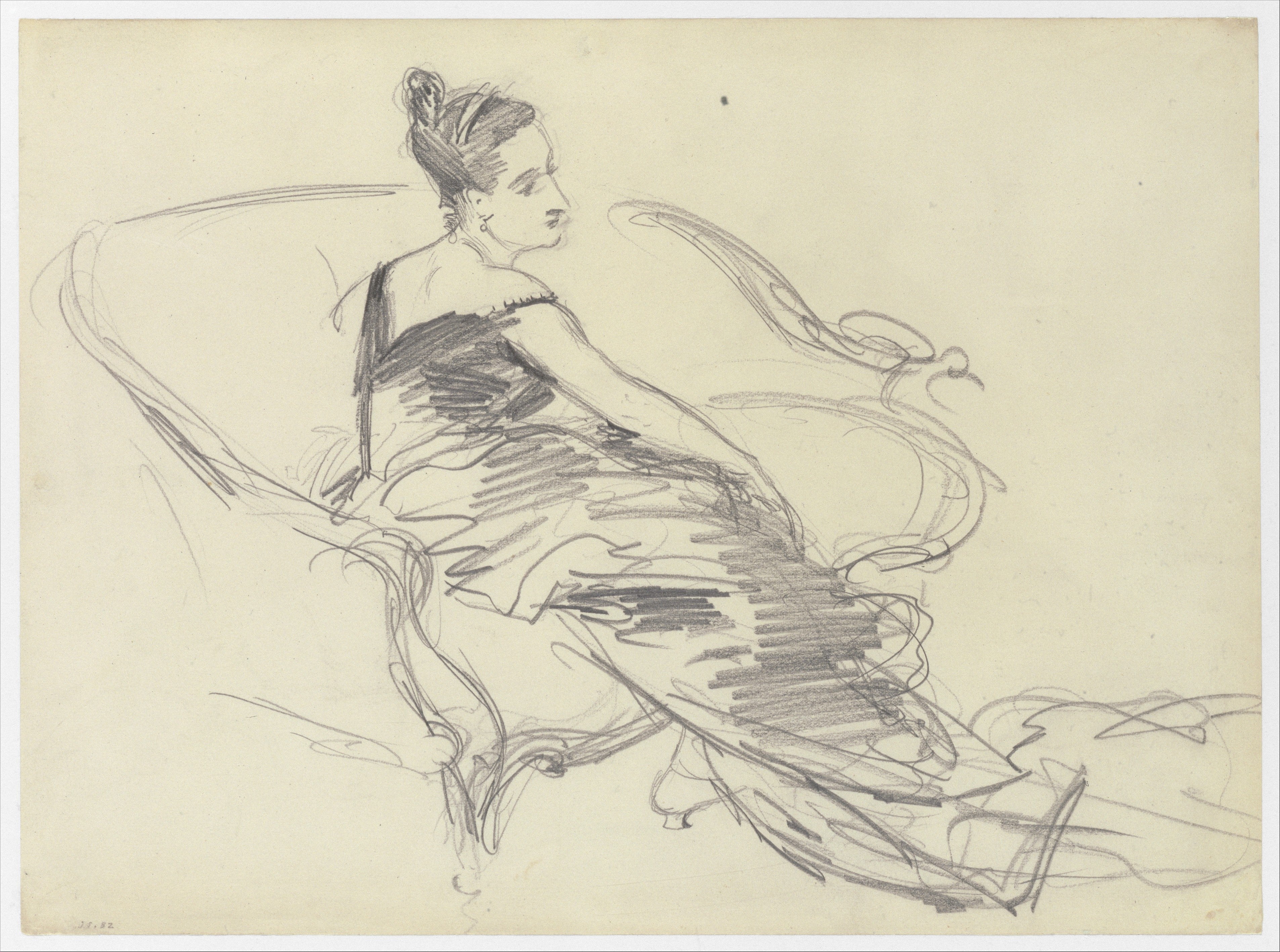
John Singer Sargent was twenty-six when he began Madame X in summer 1883. He was already a successful portrait painter in Paris, and he wanted a picture that would do for him at the 1884 Salon what Manet's Olympia had done for Manet in 1865: provide a single sensational image that would settle his reputation as an artist of the modern moment.
The sitter was Virginie Amélie Avegno Gautreau, a New Orleans-born American who had married a French banker, Pierre Gautreau, and become a fixture of Paris society. She was famously beautiful, famously vain, and famously available for portrait commissions only on her own terms. Sargent had to negotiate access through a mutual acquaintance and was eventually granted thirty sittings over the summer at the Gautreau family château in Brittany.
The First Version
The portrait Sargent submitted to the 1884 Salon showed Gautreau standing in profile, one hand resting on a small table, the other holding the back of her dress in a half-turn toward the viewer. She wore a black satin gown with a sharply cut décolletage. The right shoulder strap, jewelled and thin, had fallen off her shoulder and lay against her upper arm. Her skin, painted in cool blue-white pigment that intensified the effect, was the most exposed thing in the picture.
Sargent submitted the picture with the title Portrait de Mme. The Salon catalogue printed it as Madame ***. He had asked for anonymity, on the assumption that anonymity would protect the sitter from any controversy the painting might cause. The protection did not hold. Within an hour of the Salon's opening, Paris society had identified the sitter.
The Reaction
The reception was hostile. Reviewers attacked the painting's colour (the sitter's skin was described as cadaverous), its composition (her shoulder was held at an anatomically impossible angle), and its subject (the falling strap). Madame Gautreau's mother visited Sargent at his studio in tears and asked him to withdraw the picture. He refused.
The painting hung in the Salon for the full run. The Gautreau family considered the portrait socially ruinous. The marriage, already troubled, did not recover. Madame Gautreau never sat for another portrait by Sargent and never publicly acknowledged the painting again.
The Repaint
Sometime in the weeks after the Salon closed, Sargent took the picture back to his studio and repainted the right shoulder strap so that it lay properly across the shoulder rather than fallen against the arm. He did not repaint anything else. The visible alteration is the only structural change to the painting in its history.
The repaint did not rescue the picture's standing. The portrait remained in Sargent's possession, rolled up in his studio. He moved it from Paris to London when he relocated in 1886. He did not exhibit it publicly again for almost twenty years.
What Sargent Painted Next
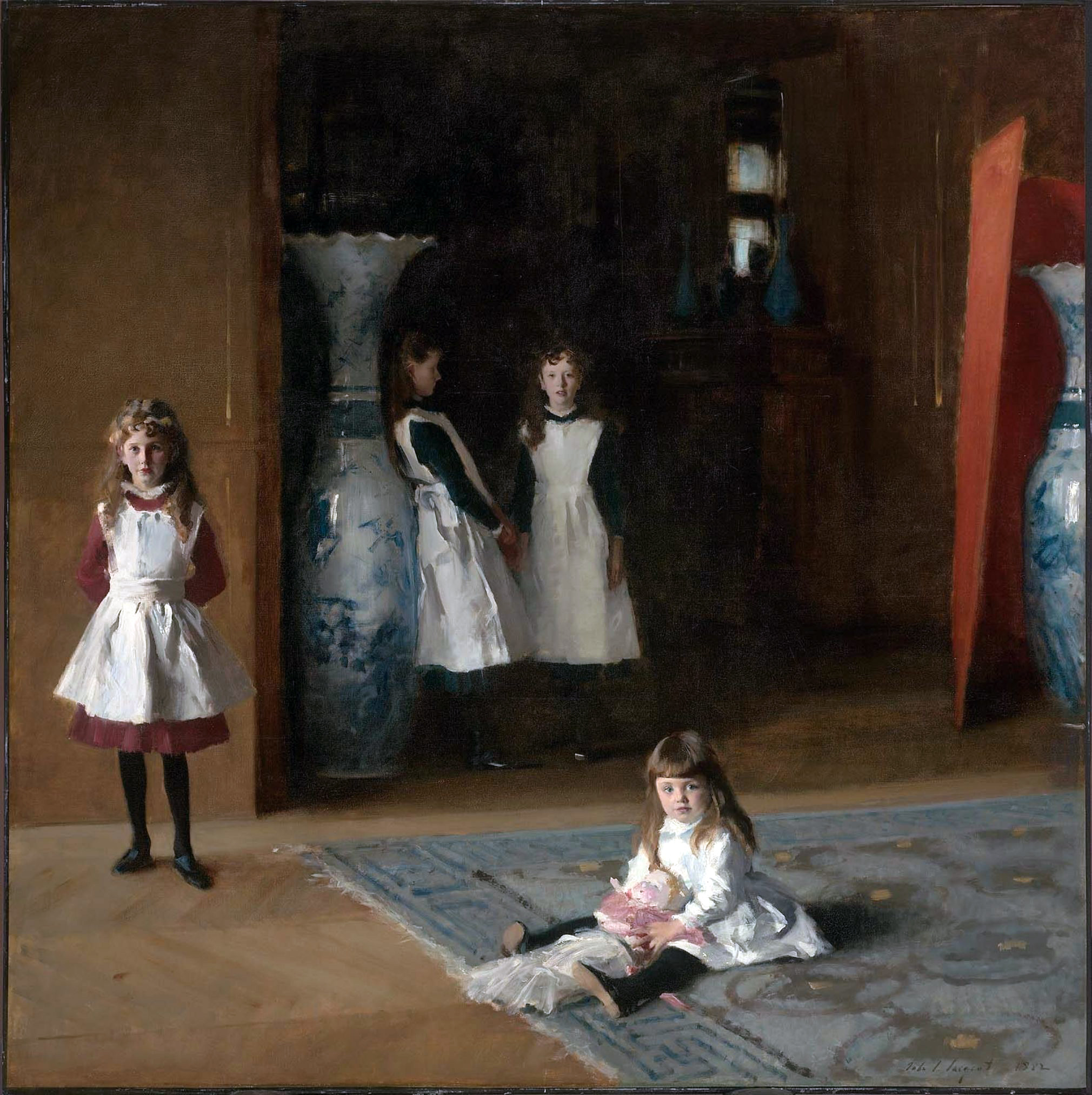
The Madame X scandal pushed Sargent out of Paris and into London. He arrived in 1886 with very few commissions and no settled studio. Within two years he had built a portrait practice serving the British upper class, the wealthy Americans who passed through London, and a smaller circle of aesthetes and writers. By 1890 he was painting forty or fifty portraits a year at fees that made him the highest-paid portraitist in Europe.
The portraits from this period are now what Sargent is most famous for: Lady Agnew of Lochnaw, the Wertheimer family series, Madame Edouard Pailleron, dozens of others. The painting style had not changed fundamentally from Madame X. The same fluency in cloth, the same icy palette, the same understanding of how a single piece of jewellery could anchor a composition. What had changed was the cultural context. London society wanted to be painted by Sargent. Paris society had decided in 1884 that he was dangerous.
The Resurrection
Sargent kept Madame X for thirty-two years. He showed it occasionally at private studio viewings, lent it to one or two exhibitions, but did not sell it. In 1905 the Metropolitan Museum of Art's director, Roger Fry, approached him about acquiring it. Sargent refused.
By 1915, the painting's reputation had begun to rebuild. Sargent told a friend that Madame X was "the best thing I have done." Madame Gautreau had died in 1915, and the social scandal that the painting represented was now a story about a vanished Belle Époque rather than a current society scandal.
In 1916, the Metropolitan Museum approached him again. This time he agreed. He sold the picture for $1,000 — far less than he was paid for ordinary portraits during the same period — on the condition that the sitter be identified only as Madame X. The Met paid in cash. The picture has hung in the museum since.
What the Painting Shows
The painting now reads differently than it read in 1884. Audiences are no longer scandalised by an exposed shoulder, and the question of whether the falling strap was lewd has stopped being an interesting question. What the picture shows now is a painter at the height of his technical capacities working out a problem in cool tones and sharp profile.
The chemistry of the skin is what stays surprising. Sargent built it from layers of underpaint with a final wash of zinc white tinted slightly blue. The effect, on a sitter who was famously powdered with rice powder and lavender water, is a kind of luminescence that no other portraitist of the period managed. The painting's claim to greatness rests on this technical achievement more than on the controversy that defined it for thirty years.
Sargent never painted another portrait at that pitch. After 1884 he settled into a more conservative manner that delivered for his sitters what they expected: flattering likeness, technical fluency, and propriety. The portrait that destroyed his Paris career was also the last one in which he was willing to risk anything.


