


Mary Cassatt was born in Allegheny City, Pennsylvania, in 1844 to a wealthy family that thought painting was a hobby for ladies, not a career. By twenty-two she was in Paris. She lived in France for most of the next sixty years, exhibited with the Impressionists at four of their group shows, and became the bridge between the French avant-garde and the American collectors who would build the great museum collections of the twentieth century.
She was the only American invited by Edgar Degas to join the Impressionists, and she took the invitation seriously. Her work hangs in the Met, the Art Institute of Chicago, and the National Gallery of Art in Washington because she made it possible for those museums to acquire French Impressionist paintings while the artists were still alive.
From Pittsburgh to Paris
Cassatt enrolled at the Pennsylvania Academy of the Fine Arts in 1860, at sixteen, against her father's wishes. The academy admitted women but treated them as a separate class. They were not allowed to draw from the nude model. The instruction was conservative and the social atmosphere was uncongenial. Cassatt left after four years and persuaded her family to let her study in Europe.
She arrived in Paris in 1866 and entered private studios, since the Ecole des Beaux-Arts did not admit women until 1897. She copied old masters at the Louvre, studied with Jean-Leon Gerome briefly, and travelled through Italy, Spain, the Netherlands, and Belgium looking at painting. By 1872 the Paris Salon had accepted one of her submissions. She kept exhibiting at the Salon for several years, with mixed success.
The Degas Invitation
In 1877, Degas saw a Cassatt painting in a Paris dealer's window and asked to be introduced. He invited her to exhibit with the group then called the Independents (and later, by their critics, the Impressionists). She accepted, withdrew her work from the Salon, and showed eleven paintings and pastels at the fourth Impressionist exhibition in 1879.
The decision was professionally risky. The Impressionists were commercially unsuccessful, frequently mocked, and politically suspect (their refusal to submit to the Salon was read as a kind of cultural anarchism). Cassatt had been on a respectable career path within the official system. She walked away from it.
The Subject Cassatt Made Her Own
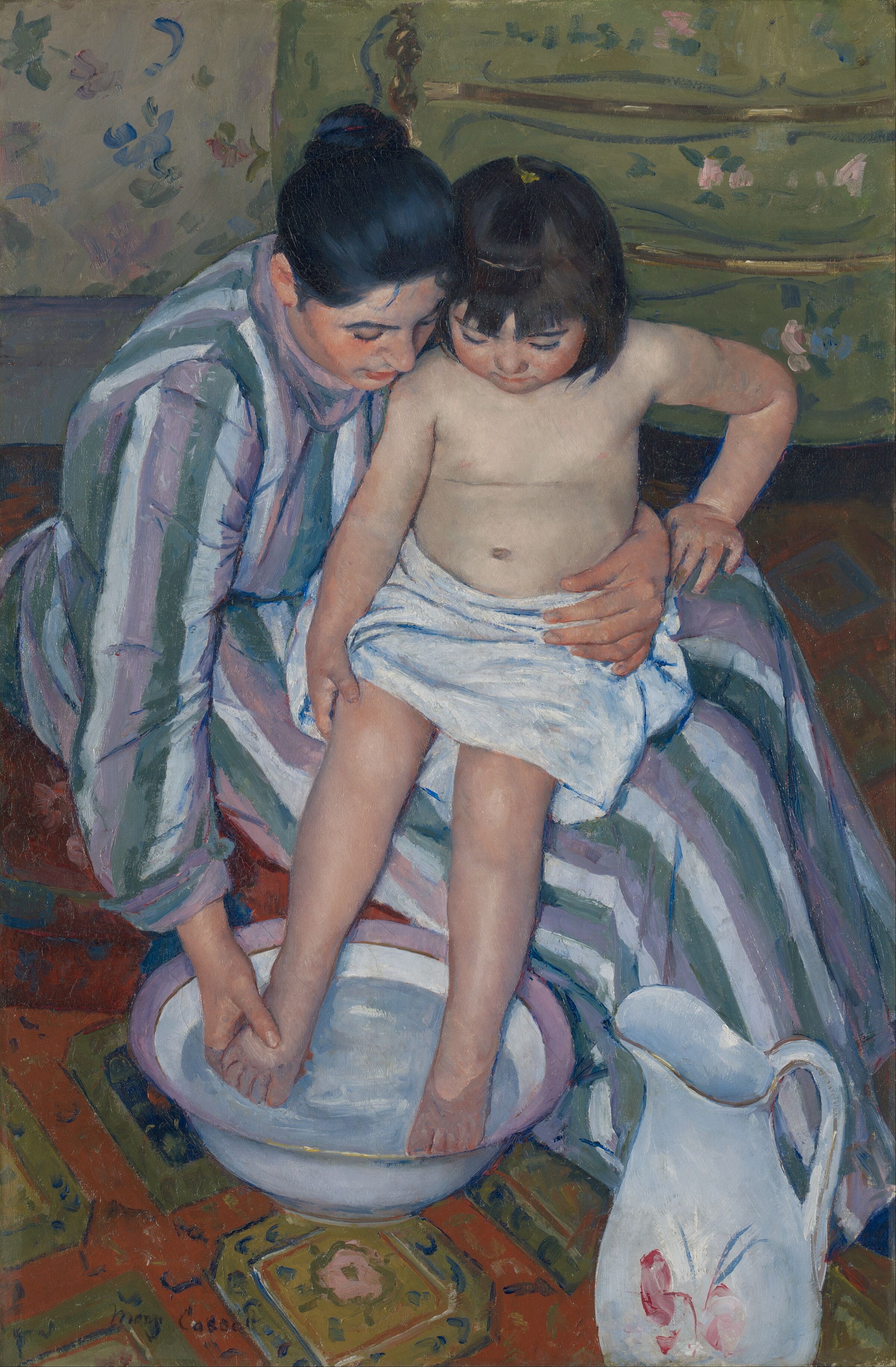
Cassatt's most distinctive subject was the relationship between mothers and children. Her contemporaries painted the same subject, but usually as sentimental genre scenes or religious mother-and-child compositions. Cassatt painted it as observation: women bathing children, dressing children, holding children, looking at children. The figures were modelled on her sister-in-law, her nieces, and the daughters of friends. The intimacy was real.
The Child's Bath (1893) is the most famous example. A woman holds a small girl on her lap; both look down at the basin where the child's feet are being washed. The composition is borrowed directly from Japanese woodblock prints: high viewpoint, flattened space, strong patterns in the wallpaper and rug. The subject is ordinary domestic life, treated with the formal seriousness usually reserved for history painting.
The Print Series
In 1890, Cassatt visited a major exhibition of Japanese prints at the Ecole des Beaux-Arts in Paris. She immediately began a series of colour aquatints that adapted ukiyo-e techniques to her own subjects. The ten prints she made between 1890 and 1891 are considered the most accomplished colour prints by any Western artist of the nineteenth century.
The prints required mastery of three or four separate plates per image, each carrying a different colour, and exact registration during printing. Cassatt did much of the technical work herself in the studio of the master printer Leopold Eustace. The prints sold poorly during her lifetime. They are now among the most valuable Cassatt works in the market.
The American Collections
Cassatt's other major contribution to American art history was as an advisor to collectors. She convinced her older brother Alexander, a railroad executive, to buy works by Degas, Monet, Manet, and Pissarro starting in the 1870s. She advised the Havemeyers, the wealthy New York couple whose collection went to the Metropolitan Museum and now constitutes the core of the Met's Impressionist holdings.
Without Cassatt, American museums would have had to acquire Impressionist paintings on the open market decades later, at prices that would have been beyond reach. The Met's Degas, Monet, and Manet rooms exist in their current form because Cassatt told a few wealthy Americans, in the 1880s and 1890s, what to buy.
The End at Beaufresne
Cassatt bought a country property north of Paris in 1894 and spent her summers there. Her eyesight began to fail in the 1900s. By 1914 she had effectively stopped painting. She died at Chateau de Beaufresne in 1926, aged eighty-two.
She had received the Legion d'honneur from the French government in 1904 but had never received a major American honour. The Pennsylvania Academy that had treated her as a second-class student in 1860 awarded her the Gold Medal of Honor in 1914. By then she could barely see the medal.
The American who stayed in Paris produced a body of work that belongs to two countries simultaneously. The French regard her as one of their Impressionists. The Americans regard her as their bridge to France. Both are correct.


