


Johannes Vermeer (1632 to 1675) produced 34 paintings that we know of. Other Dutch contemporaries left several hundred. Vermeer worked slowly because he could afford to. From around 1657 until his death, most of his output went to a single Delft patron, Pieter van Ruijven, who appears to have paid him a regular sum in exchange for first refusal on everything he made.
The arrangement was unusual for the Dutch art market, which was dominated by speculative production for open sale. Vermeer's contract gave him something most of his contemporaries lacked: the financial security to paint each canvas for as long as it took.
The Single Room
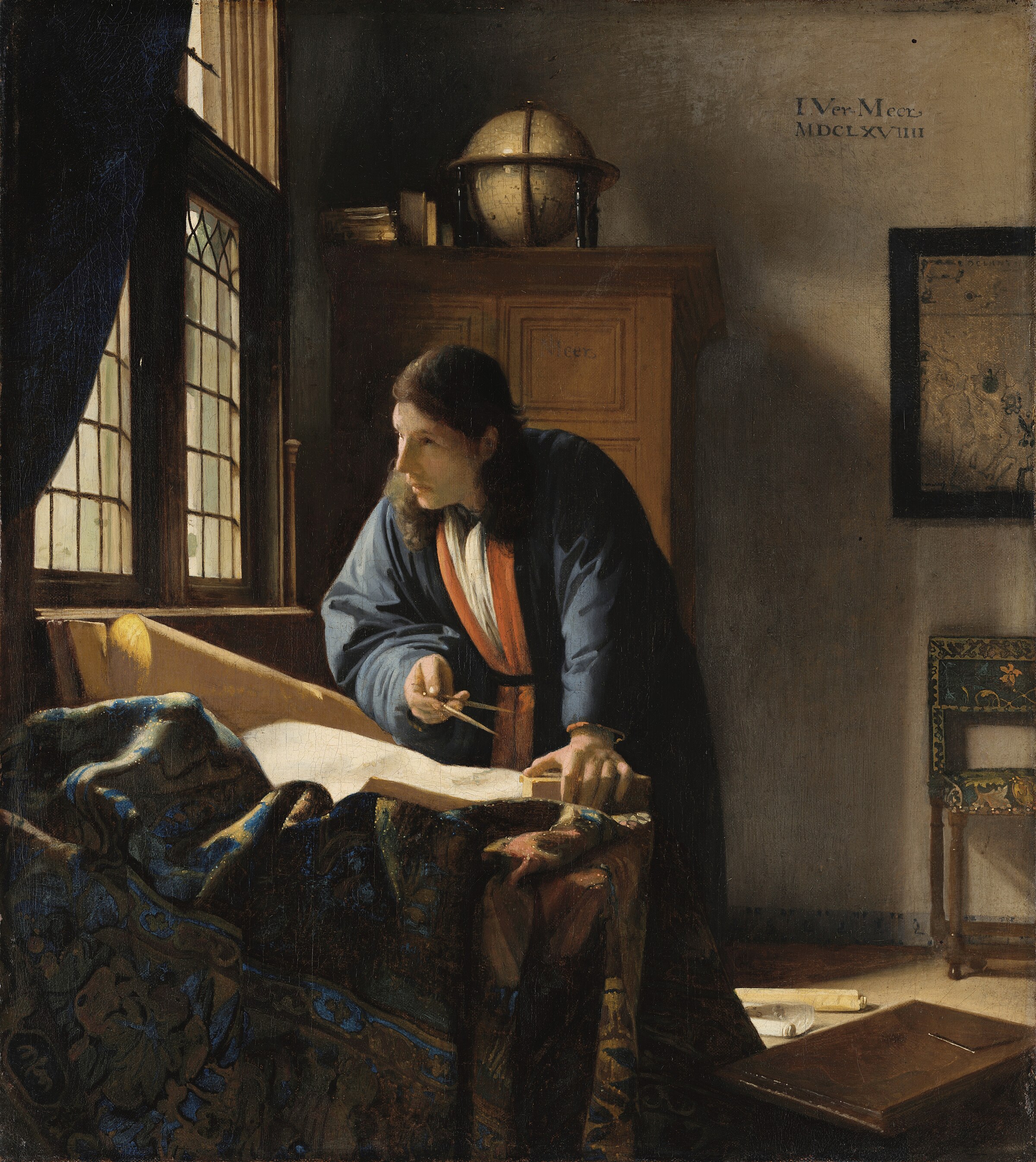
Almost every Vermeer interior was painted in the same room. The chequered tile floor, the leaded window with the ornamental glass insert, the panelled wall, the painted-leather chairs: all recur from canvas to canvas. The window is always on the left, and the light always falls in the same direction.
This was a deliberate strategy. Vermeer was studying a fixed set of conditions, and changing only the figures, the props, and the time of day. The variables were small enough that he could observe them with extraordinary precision. The recurrence of the same physical setting is part of what makes his paintings feel like a single sustained investigation rather than a series of separate works.
The Pearls and the Maps
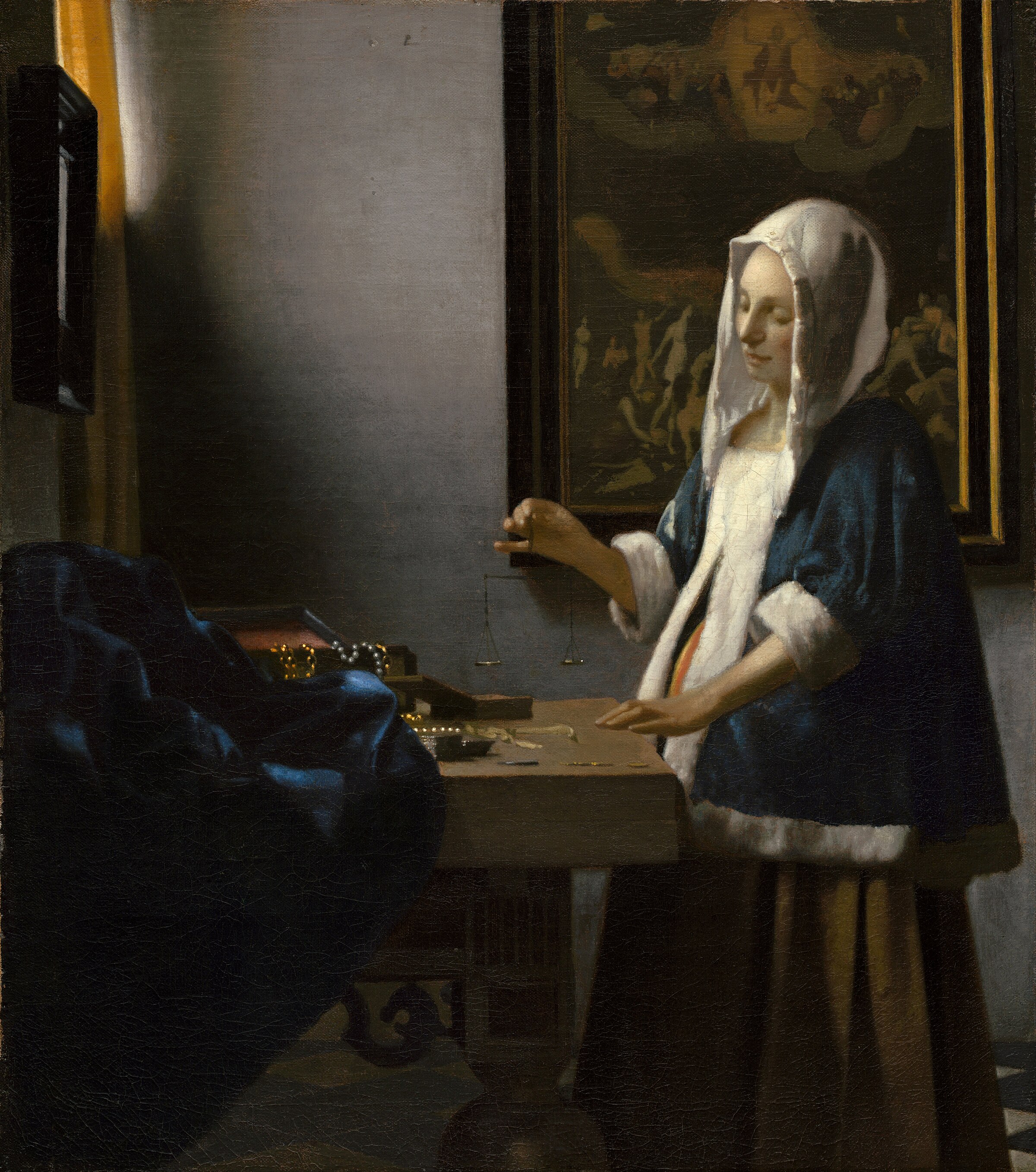
Several objects appear repeatedly across Vermeer's paintings: a yellow jacket trimmed with white fur (in five works), a particular table carpet, a Cupid painting on a back wall, several large maps, and various pieces of pearl jewellery. The yellow jacket and the pearls were both in the inventory of his estate when he died. The maps too. He owned the props.
This points to a working method that combined observation and assembly. Vermeer set up scenes from the contents of his own house, lit them with the studio window, and painted them over weeks or months. The X-ray analysis of his canvases shows extensive revision. He moved figures, changed objects, removed details. The Milkmaid originally had a basket and a wall painting that he later painted over.
The Camera Obscura Question
Several Vermeer paintings show optical effects that are difficult to explain without some kind of lens. The exaggerated foreshortening of the foreground objects in The Lacemaker, the slight blurring of highlights, the speckled dots of light on the bread crusts in The Milkmaid: all are consistent with what an artist would see by tracing an image projected through a camera obscura.
The camera obscura was a known device in seventeenth-century Delft. Vermeer's friend Antonie van Leeuwenhoek, who became his executor, was a maker of optical lenses. Whether Vermeer actually used a camera obscura, or simply painted in a way that mimicked optical effects, has been debated for decades. The technical evidence is strong; the documentary evidence is absent.
The Patron
Pieter van Ruijven (1624 to 1674) was a wealthy Delft brewer's son who collected primarily contemporary local art. The arrangement with Vermeer cannot be definitively proved, but the circumstantial evidence is strong: when Van Ruijven's collection was inventoried in 1683, it contained around 21 Vermeer paintings, more than half of the artist's known output.
The deal probably ran for about seventeen years, from around 1657 to Van Ruijven's death in 1674. Vermeer outlived his patron by only a year. After Van Ruijven's death, the income presumably stopped. Vermeer ran into debt and was dead at forty-three, leaving his widow Catharina Bolnes with eleven children and a household furniture collection that was sold to pay off creditors.
The Slow Discovery
Vermeer was not unknown in his lifetime, but his reputation collapsed for two centuries afterwards. He was rediscovered in the 1860s by the French critic Theophile Thore-Burger, who attributed and reattributed paintings until a coherent body of work emerged.
The reason Vermeer's reputation took so long to recover is partly the small number of paintings (his contemporaries with hundreds of works were easier to study) and partly the absence of any pupils, school, or surviving studio records. He worked alone, sold to one collector, and died in debt. The conditions that produced his concentration of quality also nearly erased him.
A man who painted 34 paintings in twenty years left less than a man who painted thirty in one year. But the thirty-four are still being studied, copied, and exhibited, and the man who painted forty thousand is forgotten.


