


In the palace corridors of ancient Assyria, carved stone reliefs recorded royal lion hunts as displays of absolute kingly power. These low-relief alabaster and limestone slabs functioned as official political propaganda, depicting ceremonial combats staged within royal grounds before the Assyrian court and foreign visitors.
Architectural Context and Palace Reliefs
Assyria expanded from northern Mesopotamia across territories that include modern Syria, Israel, and Iran. To mark imperial authority, Assyrian kings fortified cities and constructed stone palaces. At city gates and palace entrances, architects installed colossal sculptures of winged bulls and human-headed lions designed to intimidate all who entered. Inside the palaces, upright slabs of alabaster and gypsum lined lower mud-brick walls to protect them against wear and moisture.
These wall slabs, known as orthostats, formed continuous horizontal bands across corridor walls. The stone surfaces were carved in low relief and painted in bright colours, depicting historic battles and religious rituals. Torchlight inside the corridors illuminated these scenes, casting light across images of the king triumphing over foreign enemies or communing with deities. Supplementary cuneiform inscriptions carved onto the stone provided specific historical details regarding the royal campaigns.
The interior architecture of Assyrian palaces was designed to impress visitors through coordinated decoration. Floors in residential and reception areas were covered with enamelled clay tiles in various colours, while royal furniture was constructed from exotic woods and decorated with carved ivory inlays. By surrounding ambassadors and subjects with depictions of military force and divine support, the Assyrian state used interior art to broadcast the absolute power of the monarch.
The Evolution of the Royal Hunt
Hunting in early Mesopotamian societies originated as a practical necessity for obtaining food and defending local settlements. Early rulers engaged in field hunts to protect communal flocks and human populations from wild predators. Over centuries, as state structures formalised, the hunting of dangerous animals transformed into an exclusive activity reserved for specific social groups seeking to maintain and represent elevated social prestige.
By the Neo-Assyrian period, lion hunting was established as a strict royal monopoly. Rather than tracking wild beasts across open territory, Assyrian kings conducted staged combats on enclosed palace grounds. Royal attendants captured wild lions and transported them to the palace in wooden cages. These caged animals were then released into a square arena formed by line troops holding shields to prevent escape.
These staged events functioned as symbolic rituals rather than unpredictable sports. Within the arena, the king confronted the released lions from a chariot, on horseback, or on foot. The lion was regarded in Mesopotamian culture as a representation of destructive chaos and evil. By publicly defeating the beast in a controlled setting, the king ritually demonstrated his physical strength and provided a metaphor for his ability to defeat external military foes.
Ashurnasirpal II at Nimrud
King Ashurnasirpal II, who ruled from 883 to 859 BCE, built the Northwest Palace at Nimrud, also known as Calah in ancient times. To decorate the walls of his residence, the king commissioned alabaster and limestone orthostats depicting military actions and ceremonial hunts. Among these reliefs, panels depicting the royal lion hunt achieved a level of dramatic storytelling that distinguished them from static campaign records.
In one relief panel from Nimrud, Ashurnasirpal II is depicted riding in a chariot with a drawn bow, aiming at a lion that attacks from behind. His chariot horses gallop forward, their heavy hooves and wheels crushing a fallen lion on the ground. The attacking lion leaps toward the rear of the vehicle with open jaws, while attendants attempt to protect the monarch with weapons.
The sculptor focused on capturing physical energy and motion in the animal forms. The lion attacking the chariot displays muscular tension, while a second lion on the right lies dying in visible agony. Rather than rendering the animals as passive targets, the artist portrayed the wounded lions with dramatic force. This realistic depiction of the beast's power elevated the physical threat, thereby emphasising the king's victory over a formidable adversary.
The Nineveh Reliefs of Ashurbanipal
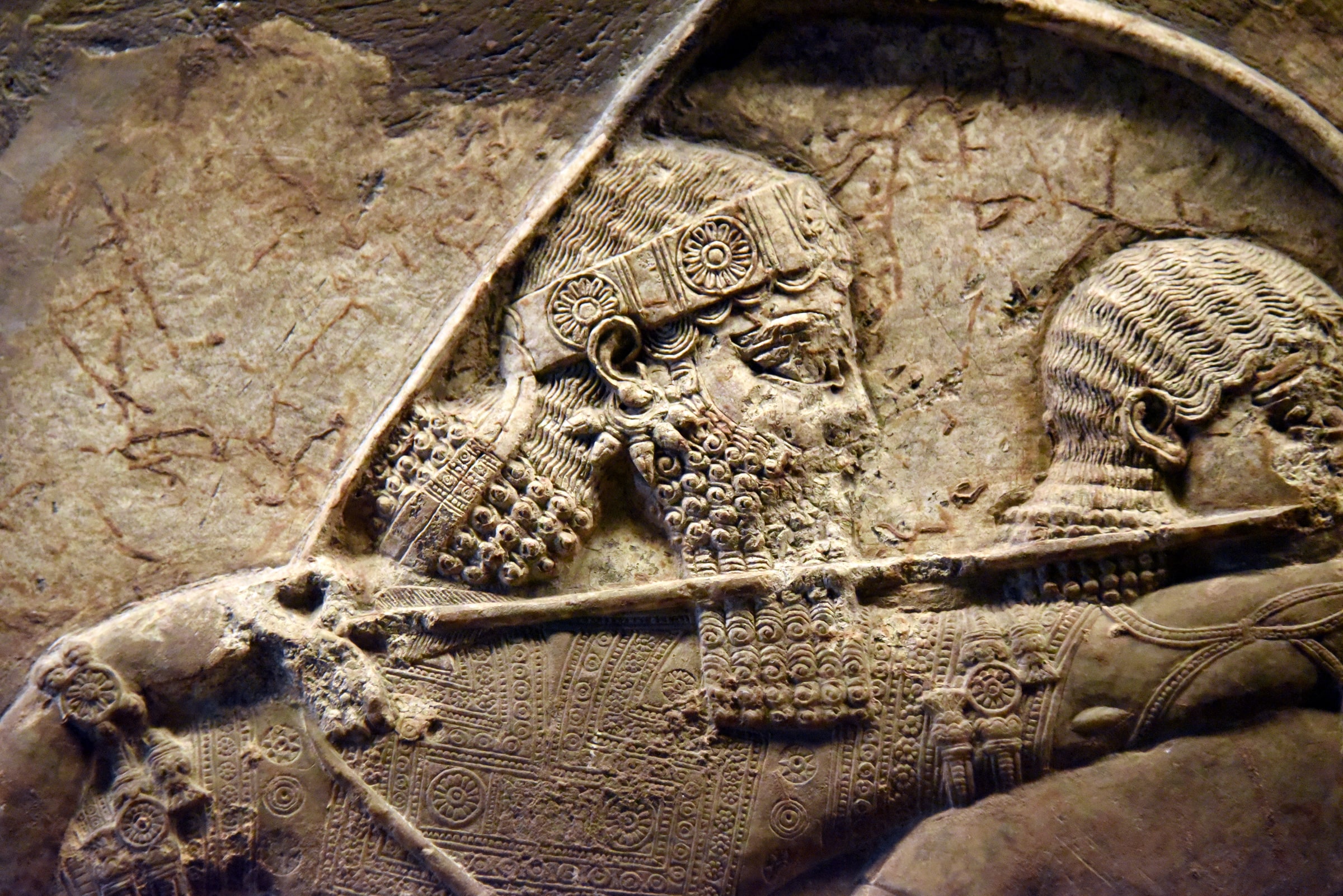
King Ashurbanipal reigned from 668 to 627 BCE and rebuilt the North Palace at Nineveh. Around 645 BCE, sculptors installed a series of refined alabaster reliefs along the palace corridors depicting the royal lion hunt. These panels demonstrate detailed anatomical observation, showing lions with tousled manes and snarling mouths scattered across the floor of the arena.
The Nineveh carvings contain precise stylistic details that identify the status of the human figures. Ashurbanipal and his royal attendants are rendered with tightly curled beards, patterned tunics, armlets, and earrings. While human figures maintain stylised, formal poses derived from traditional Near Eastern artistic conventions, the figures of animals exhibit fluid movement and naturalistic detail.
In one prominent panel, Ashurbanipal drives his chariot forward while shooting arrows into a leaping lion. Attendants plunge spears into the chest of the wounded beast as it leaps toward the vehicle. The lion's body forms a clean diagonal line across the slab, with its claws spread and mouth open in pain. By contrasting the contorted forms of the slain lions with the upright posture of the king, the sculptor created a clear visual hierarchy.
Visual Narrative and Relief Conventions
Assyrian relief sculptors developed visual conventions designed to make complex events clearly readable to viewers. In narrative panels depicting military campaigns, such as the siege and sack of the Elamite city of Hamanu, artists presented multiple events simultaneously. Soldiers are shown using crowbars and pickaxes to demolish fortifications, while fallen timbers drop through the air, and other troops march down wooded paths carrying plundered goods.
In these campaign reliefs, artists interspersed natural features with human figures without adhering to unified perspective or consistent scale. For example, in a panel showing fugitives fleeing across a river on inflated animal skins, figures are drawn large relative to the surrounding water and distant fortified city walls. Accuracy of scale was sacrificed to ensure that descriptive historical facts, such as troop movements and local geography, were fully legible.
In contrast to the dense narrative details of military campaigns, the lion hunt reliefs focused directly on the ruler. The continuous band format led the viewer along the corridor, repeating key imagery to build an impression of inevitable royal victory. Through precise carving in alabaster and limestone, Assyrian sculptors created a visual record that converted ritualised hunting into a permanent assertion of political dominance.


