


Atalanta agrees to marry the man who can outrun her, while defeated suitors face death. Hippomenes wins with Aphrodite’s golden apples, but the couple are later changed into lions after sex in a sacred place, with sources differing over whether Cybele or Zeus punishes them.
Cybele Punishes Atalanta and Hippomenes
Atalanta wished to remain a huntress and a virgin like Artemis, but many men sought her in marriage. At her father’s urging, she agreed to marry the man who could outrun her. She declared that defeated suitors would die, and many failed to escape this penalty. Hippomenes accepted the challenge despite the danger. Some sources call him Melanion. His parentage also varies. One account makes him a great-grandson of Poseidon, while other sources give him a different descent.
Hippomenes asked Aphrodite for help. She gave him golden apples. One source says that they came from her sanctuary on Cyprus, while another connects them with the garden of the Hesperides. During the race, Hippomenes threw the apples aside one after another. Atalanta stopped to retrieve each of them. The delay caused by the last apple allowed Hippomenes to reach the finish first. He therefore won the race and married Atalanta.
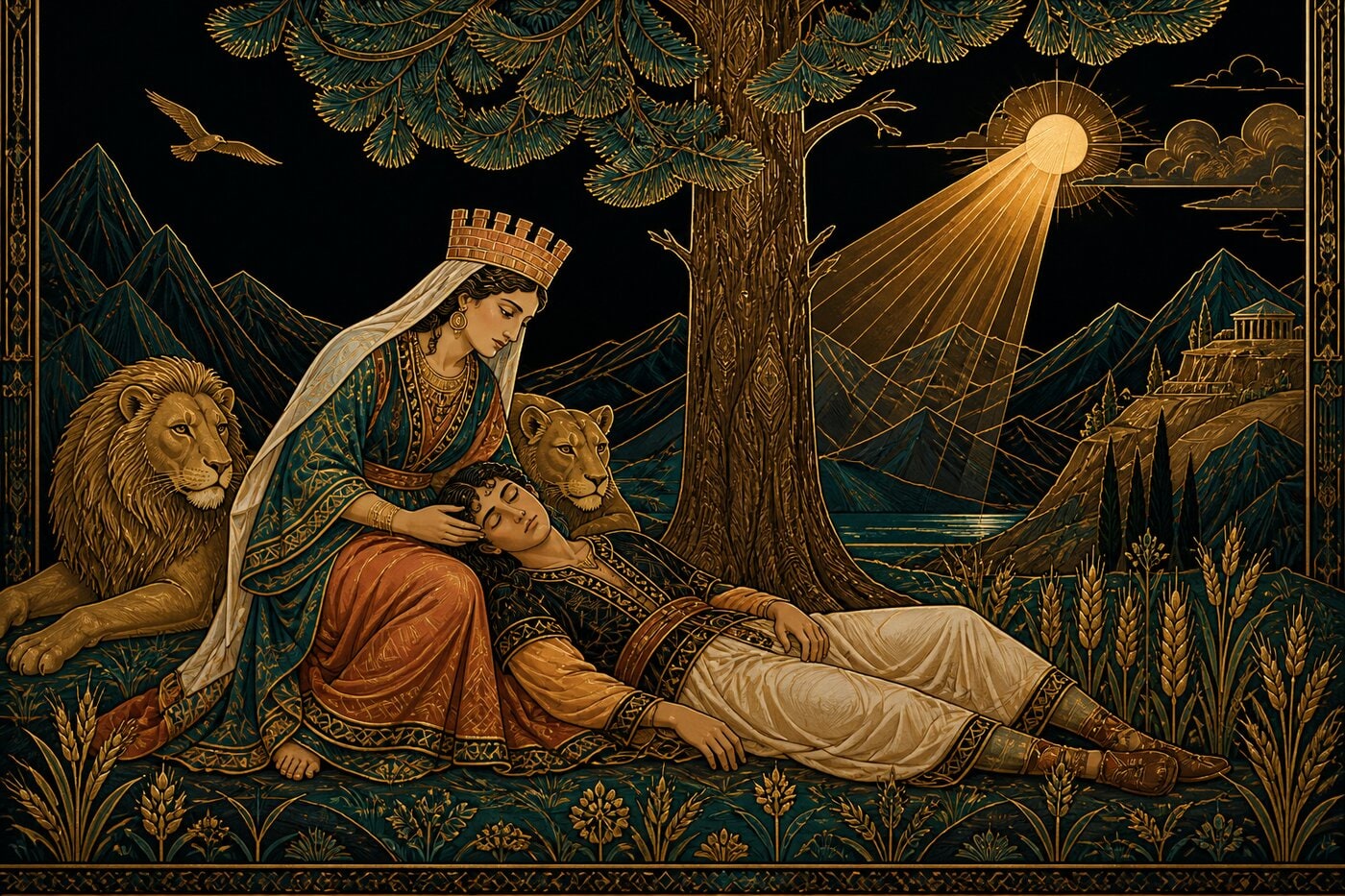
In Hyginus’s account, Aphrodite became angry because the couple failed to honour her for this help. She caused them to have sex in Cybele’s temple. Cybele punished the violation by changing Atalanta into a lioness and Hippomenes into a lion. She then harnessed them to her chariot. They became the lions shown with the goddess in images.
Ovid gives a different account in the Metamorphoses. The couple had sex in a precinct of Zeus, and Zeus changed them into lions because they had defiled his sacred place. Since lions are said not to mate with lions, the transformation prevented Atalanta and Hippomenes from enjoying each other again.
Cybele Mourns and Preserves Attis
At Attis’s wedding, Cybele appeared in place of his intended bride. Attis was driven into madness. He castrated himself beneath a pine tree and died from the loss of blood. Arnobius preserves an account in which Cybele mourned him and appealed to Zeus to preserve what remained of his body.
Zeus granted that Attis’s body should never decay. Attis became immortal and was linked with the pine tree beneath which he had died. His death and preservation formed the basis of later rites in which the pine represented Attis. These ceremonies were held at the spring equinox. The festival came to include his death, burial, and return to life.
Attis had been born after an unusual chain of events. A drop of Zeus’s semen fell upon the ground, and the earth produced Agdistis, a being with male and female reproductive organs. The gods feared Agdistis’s power and cut off the male organ. Agdistis was then left as a female goddess, Cybele. An almond tree grew from the severed organ. Its fruit fell into the lap of Nana, the daughter of a local river god, and Nana gave birth to Attis.
Attis grew into a handsome young man. Cybele fell in love with him, but he did not return her affection. His death was later connected with the evergreen pine and with annual resurrection rites. The pine brought into the festival was decorated with violets and woollen bands, and an effigy of Attis was attached to it. His resurrection was also understood through the growth of corn, as grain wounded by the reaper, buried, and restored when sown in the ground.
Cybele in the Agdistis and Attis Legend
Diodorus Siculus records that a drop of Zeus’s semen fell upon the ground. After some time, the earth produced Agdistis, a powerful deity with male and female reproductive organs. Fearing this being, the gods cut off the male organ. Agdistis was left as a female goddess, Cybele. An almond tree grew from the severed organ. Its fruit fell into the lap of Nana, the daughter of a local river god. Contact with the fruit made Nana pregnant, and she gave birth to a handsome boy called Attis.
When Attis grew up, Cybele fell in love with him. He did not return her affection. On the day of Attis’s marriage, Cybele came to the wedding ceremony in place of the bride he intended to marry. Attis was driven into a state of madness and castrated himself.
Cybele asked that Attis be made immortal. Her request was granted, and Attis was transformed into a pine tree. In this tradition, Agdistis’s transformation into Cybele, Nana’s contact with the almond fruit, and Cybele’s unreturned love for Attis lead directly to his self-castration and transformation.


