


Loki approached Brísingamen in seal form, but Heimdall followed in the same guise and fought him on Vágasker. Heimdall recognised Loki, stopped the theft, and returned Freyja’s necklace, while related accounts connect the ornament with Hâma in Beowulf and with Loki’s later deception.
Heimdall Reclaims Brísingamen
Loki slid towards Brísingamen on the sea rock Vágasker, also called Singasteinn, the ornament rock. The necklace lay there glittering above Ægir’s realm. Freyja had worn it while seeking Svipdag and finding him beneath the waves. She and the necklace had remained for a time in the sea, which gave Brísingamen the epithet fagrt hafnýra, “the fair kidney of the sea”. Its light over the water also explains Freyja’s name Mardöll, “the one diffusing a glimmering in the sea”.
Loki took the shape of a seal. A seal climbing onto the skerry would cause no suspicion. He moved towards the necklace, but another seal came after him. Heimdall had seen the attempt and assumed the same shape. The two fought on Vágasker. Their disguises could not conceal their eyes, and Heimdall recognised the cunning descendant of Farbauti. Loki withdrew without completing his theft. Heimdall recovered Brísingamen and returned it to Freyja.
Other accounts preserve related versions. In the saga of Olaf Tryggvason, Loki entered Freyja’s locked bower as a fly, found a minute opening beneath the roof, then bit her cheek after changing into a flea. When she turned, he resumed his own shape and unclasped the necklace. The saga names the smiths Alfrig, Dvalin, Berling and Grer, and says that Loki acted after telling Odin how Freyja had obtained it.
In Beowulf, Heimdall appears as Hâma and brings Brosingamene to Asgard. The poem calls it the finest ornament under heaven. Hâma later falls into Eormenric’s snares. This has been compared with Saxo’s traps for Liserus, identified with Heimdall, and Hadding.
Freyja Teaches Seiðr
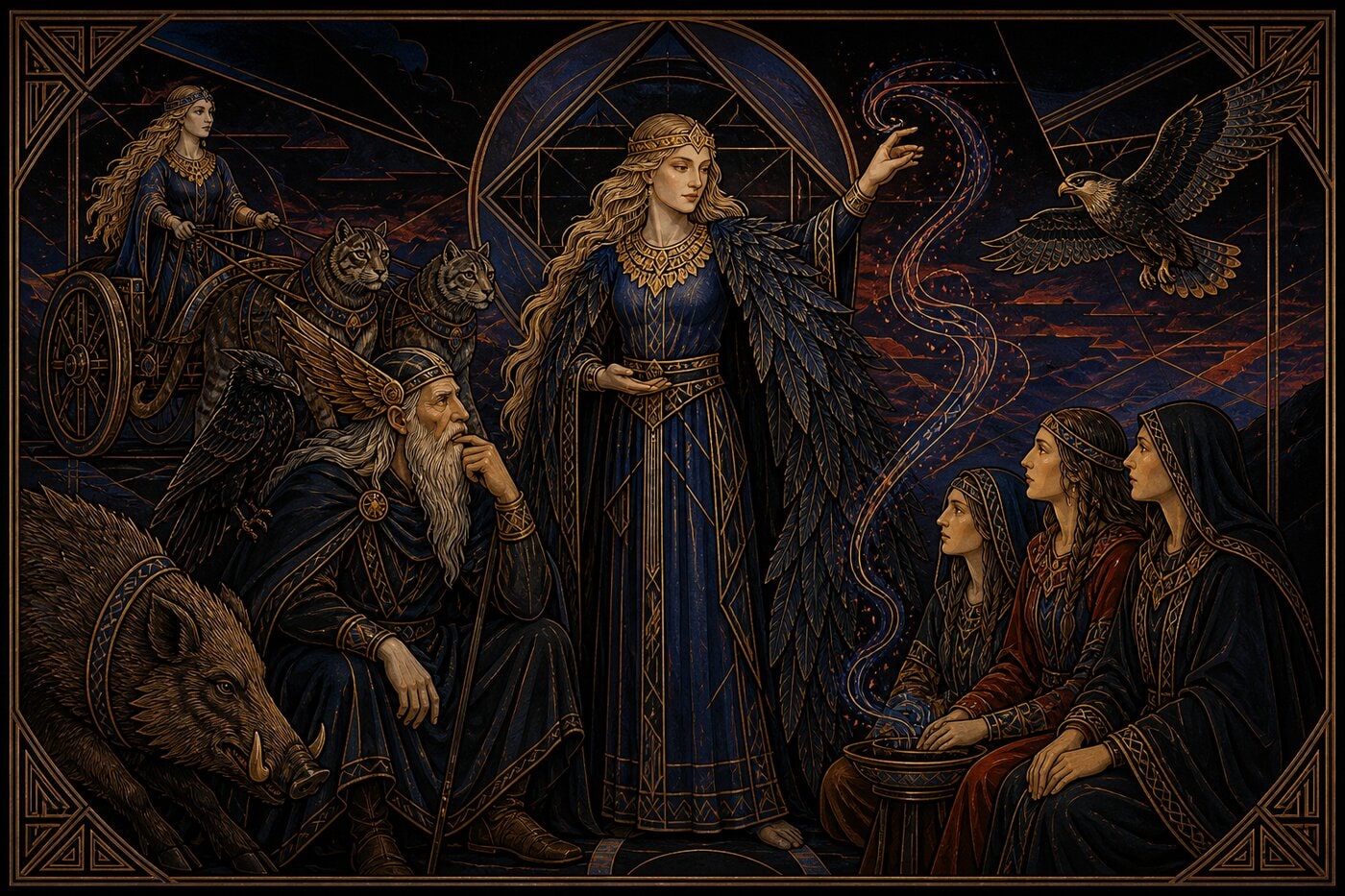
Freyja taught seiðr to the Æsir. She was Njörðr’s daughter and a blótgyðja, a priestess of sacrifices. The Ynglingasaga says that she was the first to teach the practice to the Æsir, as it had been customary among the Vanir. This account presents her teaching as the introduction of sorcery among the gods. Another source describes Freyja as the first to practise sorcery in Ásgarðr. It also connects the spread of these arts with Gulveig-Heið, and names Aurboda among the giantesses who attended Freyja. Óðinn learned seiðr from Freyja and became its supreme master. The Ynglingasaga places this statement within a longer account of his powers. Óðinn could change his shape. His body could lie as if asleep or dead while he appeared as a bird, an animal, a fish, or a serpent. In that form, he could travel to distant lands in a single moment, for his own errands or those of other people. He could also use words to put out a fire and calm the sea. The account distinguishes these powers from the practice of seiðr while describing them together. Freyja could also appear in bird form. She chose half of the slain warriors each day and received them in Fólkvangr. Later accounts mention völur, or seeresses, and seiðmenn, male sorcerers. A passage in Hyndluljóð traces völur to Viðólfr, vitkar to Vilmeiðr, and seiðberendr to Svarthöfði.
Freyja Threatens Hyndla
Freyja rode through the night on Battle-hog, a boar with golden bristles made by the dwarfs Dain and Nabbi. Óttar, her protégé, was disguised as the boar. He needed knowledge of his ancestry to defend his claim to an inheritance against Angantyr. Freyja brought him to the giantess Hyndla and asked her to recount the lineages of princes descended from the gods.
Freyja called Hyndla her sister and tried to persuade her to help. Hyndla answered with insults and accused Freyja of taking Óttar on the road to Valhall. Freyja denied this and praised Battle-hog. Hyndla suggested that one of her wolves should race beside the boar. Freyja replied that her excellent steed should not be overloaded. She then urged Hyndla to sit with her and discuss the ancestry Óttar needed.
Hyndla settled down and recounted Óttar’s ancestors, but refused to ride with Freyja to Valhall. The poem turns briefly to another prophecy before returning to the conversation. Freyja asks for memory-ale, so that Óttar can remember the words spoken and repeat them on the third morning, when he and Angantyr compare their lineages. Hyndla refuses. She says that she wants to sleep and that Freyja will get little from her.
Freyja threatens to surround Hyndla’s dwelling with fire from the troll-woman, leaving her no escape. Hyndla sees fire burning and the earth aflame. She asks that the beer placed in Óttar’s hand be mixed with much poison, so that it will bring him misfortune. Freyja rejects the curse and says that it will have no effect. She prays that the gods will aid Óttar and declares that he will drink precious liquor. The ale gives him what he needs to remember the genealogical account and support his claim against Angantyr.


