

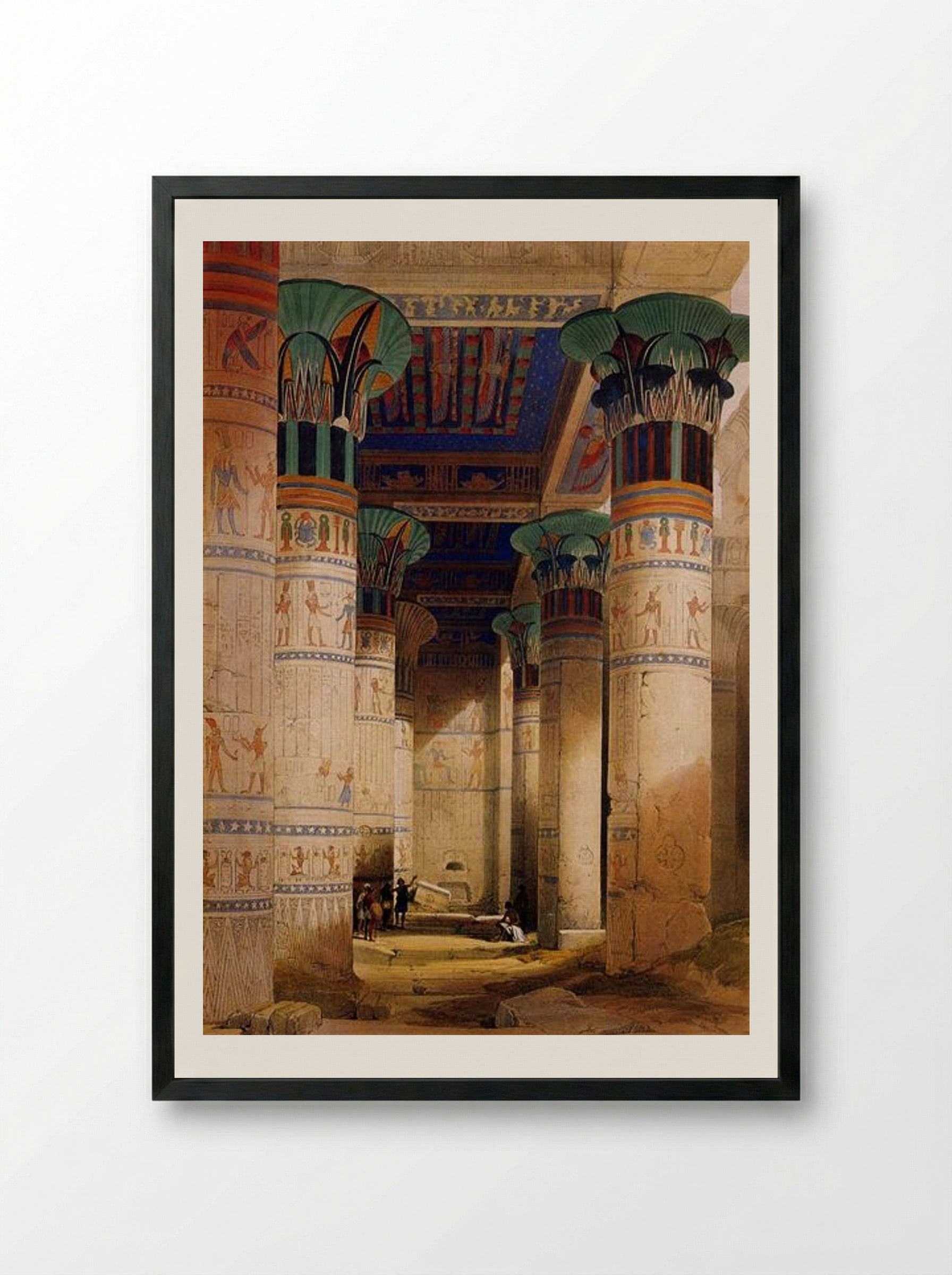
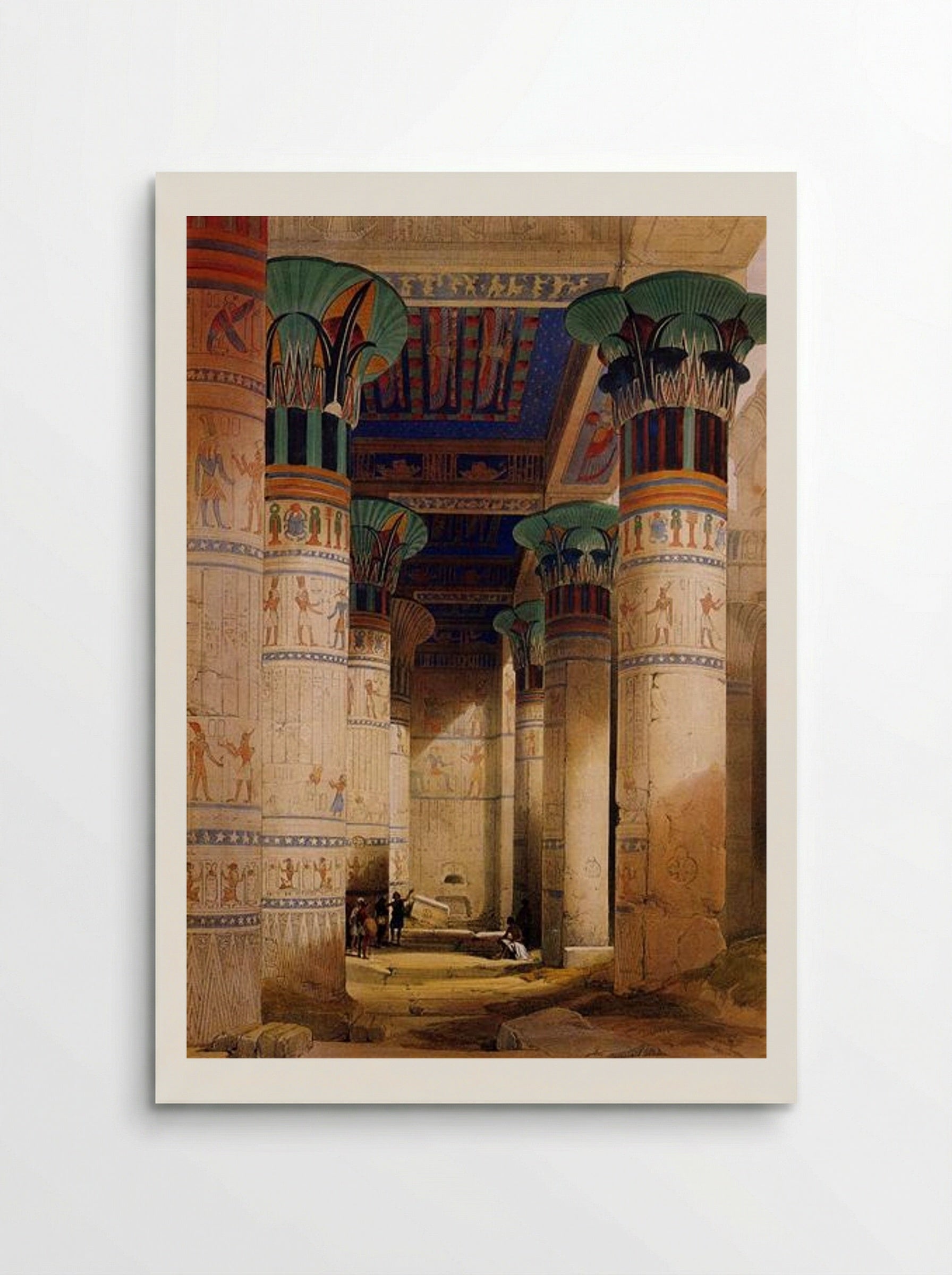
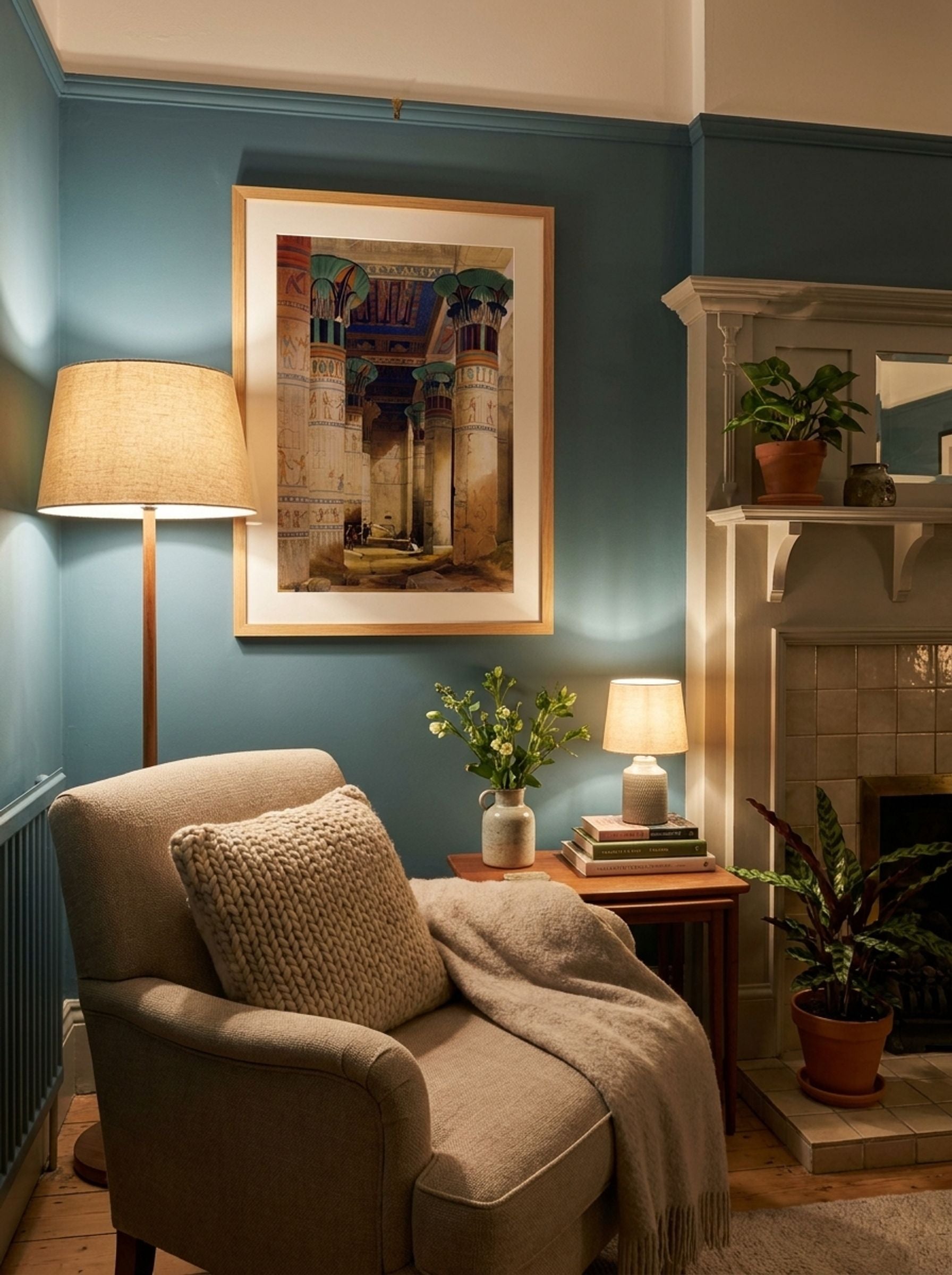
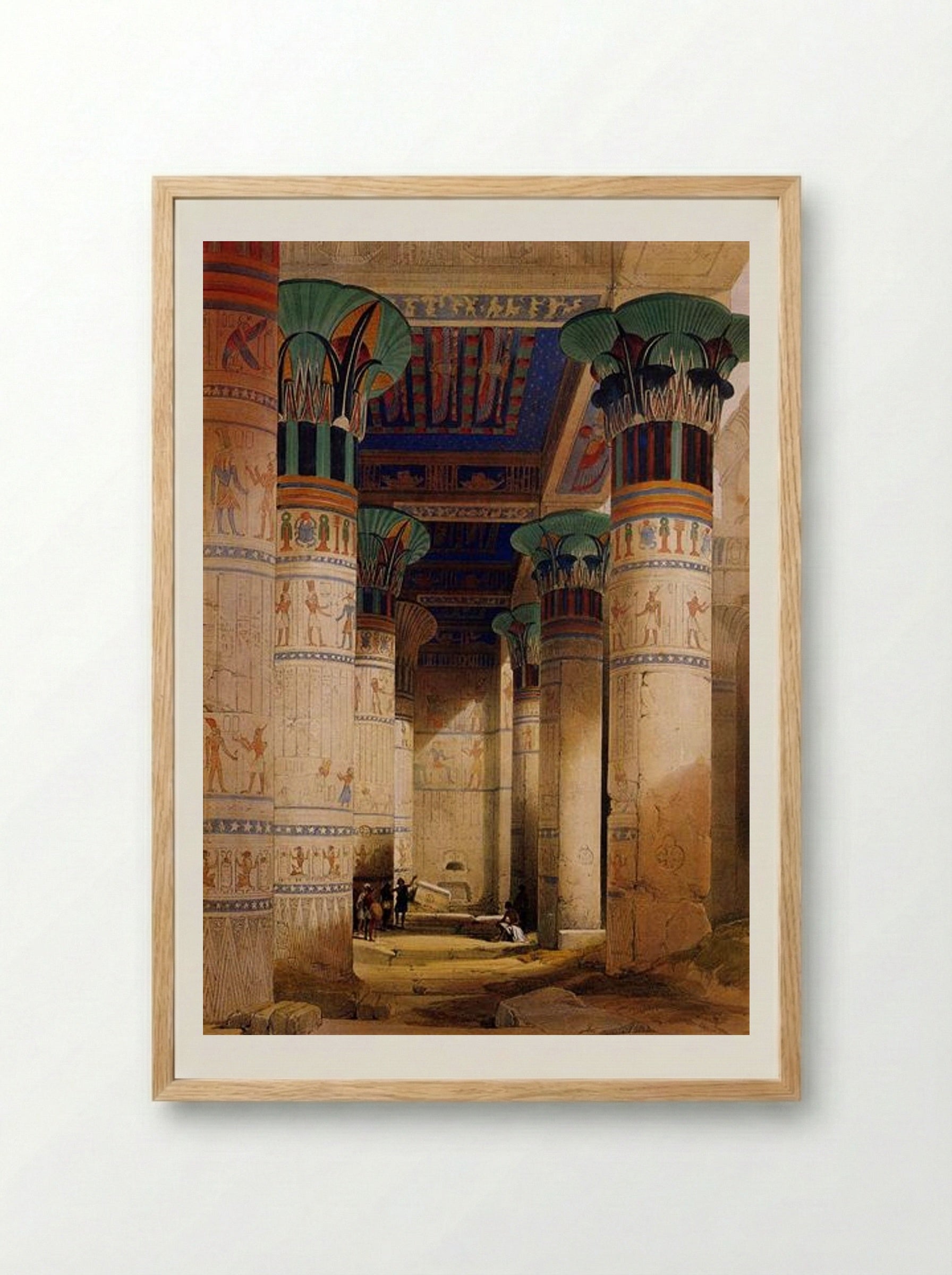
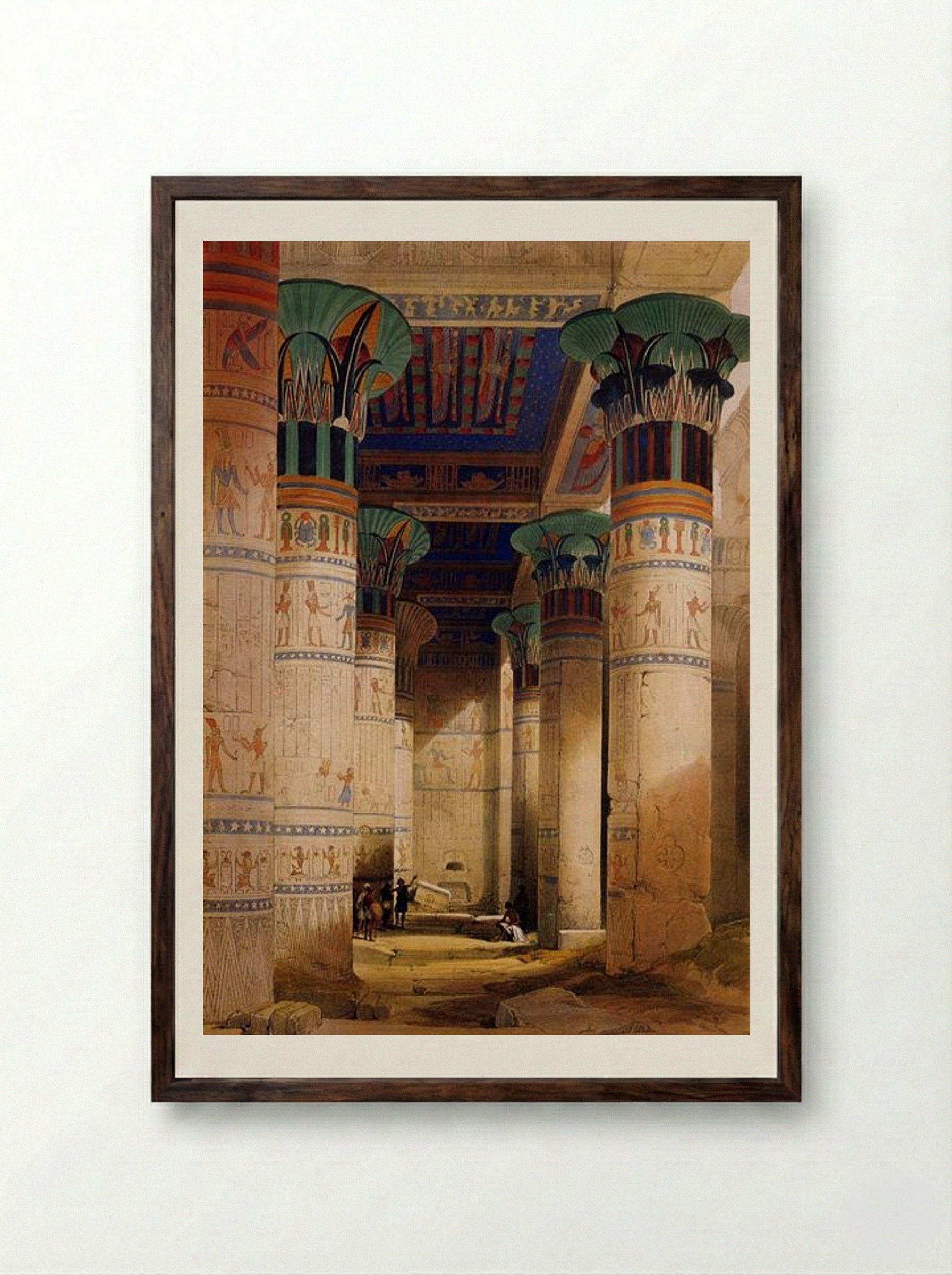
Portico of the Temple of Isis at Philae - David Roberts
Archival giclée
Frames arrive ready to hang
Secure checkout
Made to order
Description
A colour lithograph by David Roberts depicting the Temple of Isis at Philae, capturing the monumentality of the ancient Egyptian architecture with meticulous detail and warm light.
David Roberts, a Scottish painter and printmaker, is celebrated for his detailed architectural depictions and travel scenes. He journeyed extensively throughout Europe and the Middle East, documenting historical sites and cultures with precision. His work, often produced as lithographs, brought distant lands to audiences in Britain and beyond. Roberts was elected to the Royal Academy in 1841. His prints are valued for their documentary accuracy and artistic skill. 'Portico of the Temple of Isis at Philae' exemplifies Roberts's talent for capturing the grandeur of ancient architecture. The print shows the colonnaded hall of the Temple of Isis, with its massive columns adorned with hieroglyphics and elaborate capitals. The scene is bathed in warm light, which accentuates the texture of the stone and the details of the carvings. Figures in the foreground provide a sense of scale, emphasising the monumentality of the temple. The colour lithograph medium allows for a nuanced rendering of the architectural details and atmospheric effects.
Return policy
Because every print is made to order, we don't offer change-of-mind returns, refunds or exchanges. If your order arrives faulty, damaged or incorrect, we'll replace it free of charge — just contact us within 48 hours of delivery. See our refunds page for full details.
Shipping
We ship worldwide, printing at the production hub nearest to your delivery address. Delivery times and costs vary by destination — you'll see the options available to you at checkout.
Manufacturing
Each print is produced to order using 12-colour giclée printing on FSC-certified archival paper. Designed in Britain and printed at your nearest production hub to reduce waste and speed up delivery.
Care and materials
Specific Features
Every Solis piece is made to order with archival, gallery-quality materials built to last.
- Museum-grade giclée printing for rich, fade-resistant colour
- Archival matte fine-art paper, FSC-certified
- Multiple sizes and framing options available
- Frames in black, natural wood, dark wood or white
- Framed prints arrive ready to hang
Care & Cleaning
To keep your artwork looking its best:
- Dust gently with a soft, dry cloth
- Avoid prolonged direct sunlight
- Never use liquid cleaners on the print or canvas surface
- Keep in a dry, room-temperature space
- Handle prints with clean, dry hands
Materials & Sizing
Museum-grade giclée on FSC-certified archival matte paper, with framed and canvas options.
- Paper sizes: A4, A3, A2, A1, A0 and B2 (50×70 cm)
- Canvas: XS (20×30 cm) to Large (60×90 cm)
- Frames: black, natural wood, dark wood or white
Portico of the Temple of Isis at Philae - David Roberts

Artist Biography
David Roberts
In 1838 he sailed for Egypt and spent the next two years travelling through the Middle East, filling sketchbooks with drawings of temples, mosques, ruins and desert landscapes that almost no British artist had recorded before. To enter the mosques he had to shave off his sideburns, leave his hog-hair brushes behind (the pig being unclean), and wear traditional Arab clothing while he worked. He was one of the first Europeans allowed to paint inside a mosque.
The sketches became The Holy Land, Syria, Idumea, Arabia, Egypt and Nubia, a series of 247 lithograph plates produced in collaboration with the printer Louis Haghe between 1842 and 1849. He funded the project through advance subscriptions, soliciting them personally. Queen Victoria was subscriber number one. Her complete set is still in the Royal Collection.
The lithographs gave Europeans their first detailed visual record of the ancient Near East. They were bought as art, used as reference by scholars, and shaped the Western imagination of Egypt and Palestine for the rest of the century.
His personal life was less composed. His wife Margaret became an alcoholic and in 1831 he sent her back to Scotland to be cared for by friends. He raised their daughter Christine largely alone. He was elected to the Royal Academy in 1841, a considerable achievement for a man who had started painting houses, and worked steadily until his death in 1864.
Why Choose Us ?
Damage-free delivery guarantee
Fast Shipping
Museum-Quality Materials
You May Also Like