

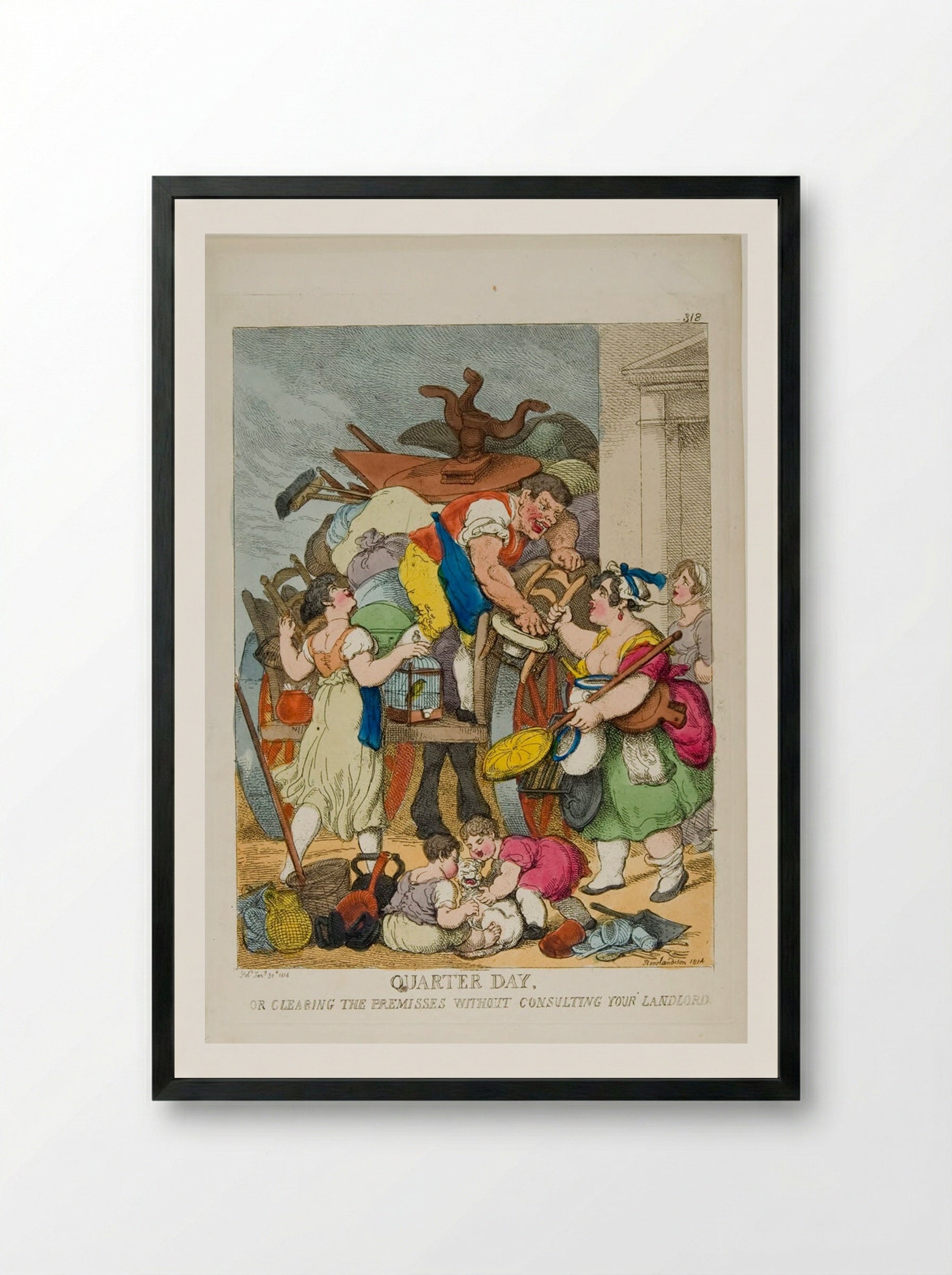
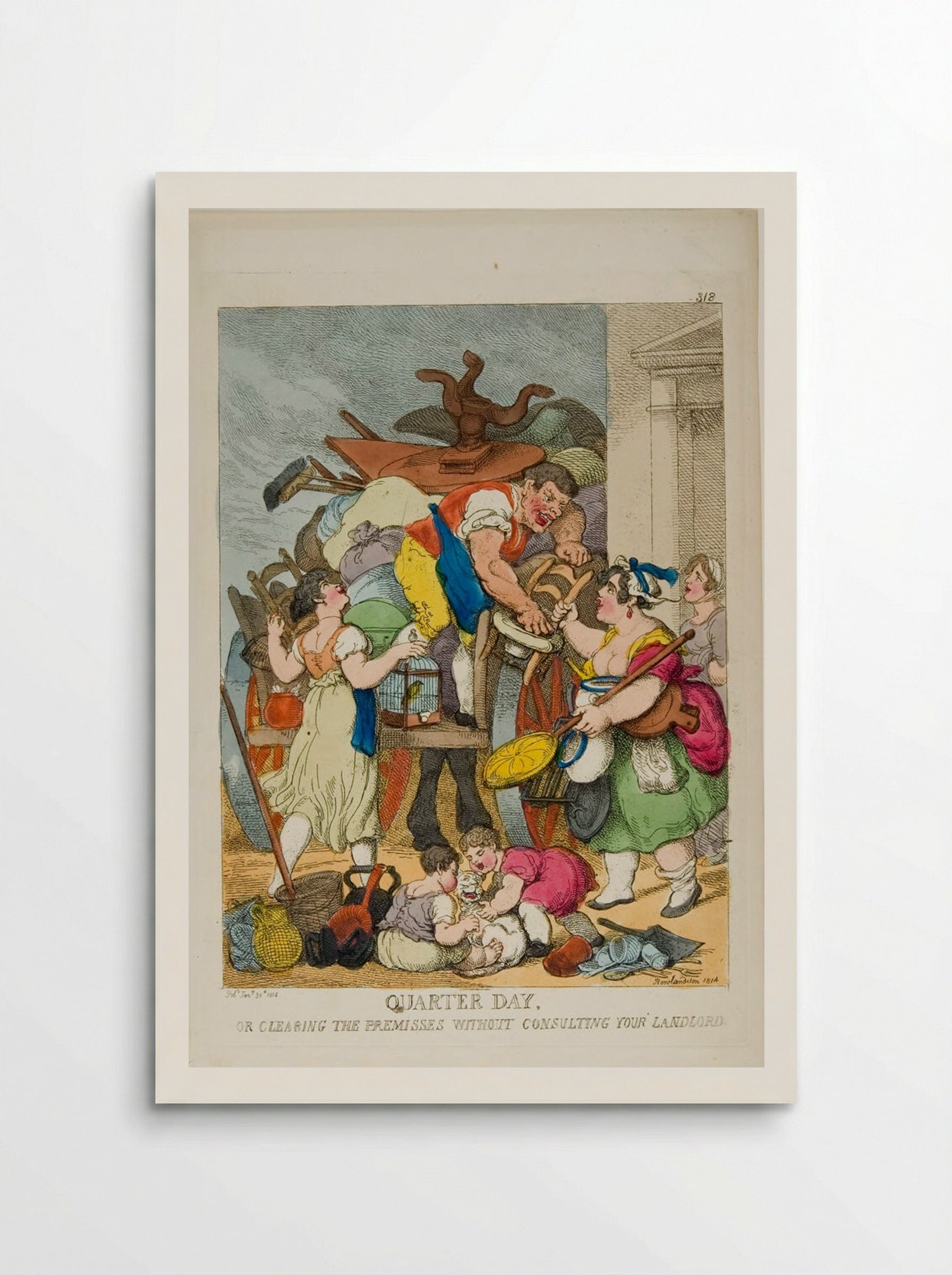

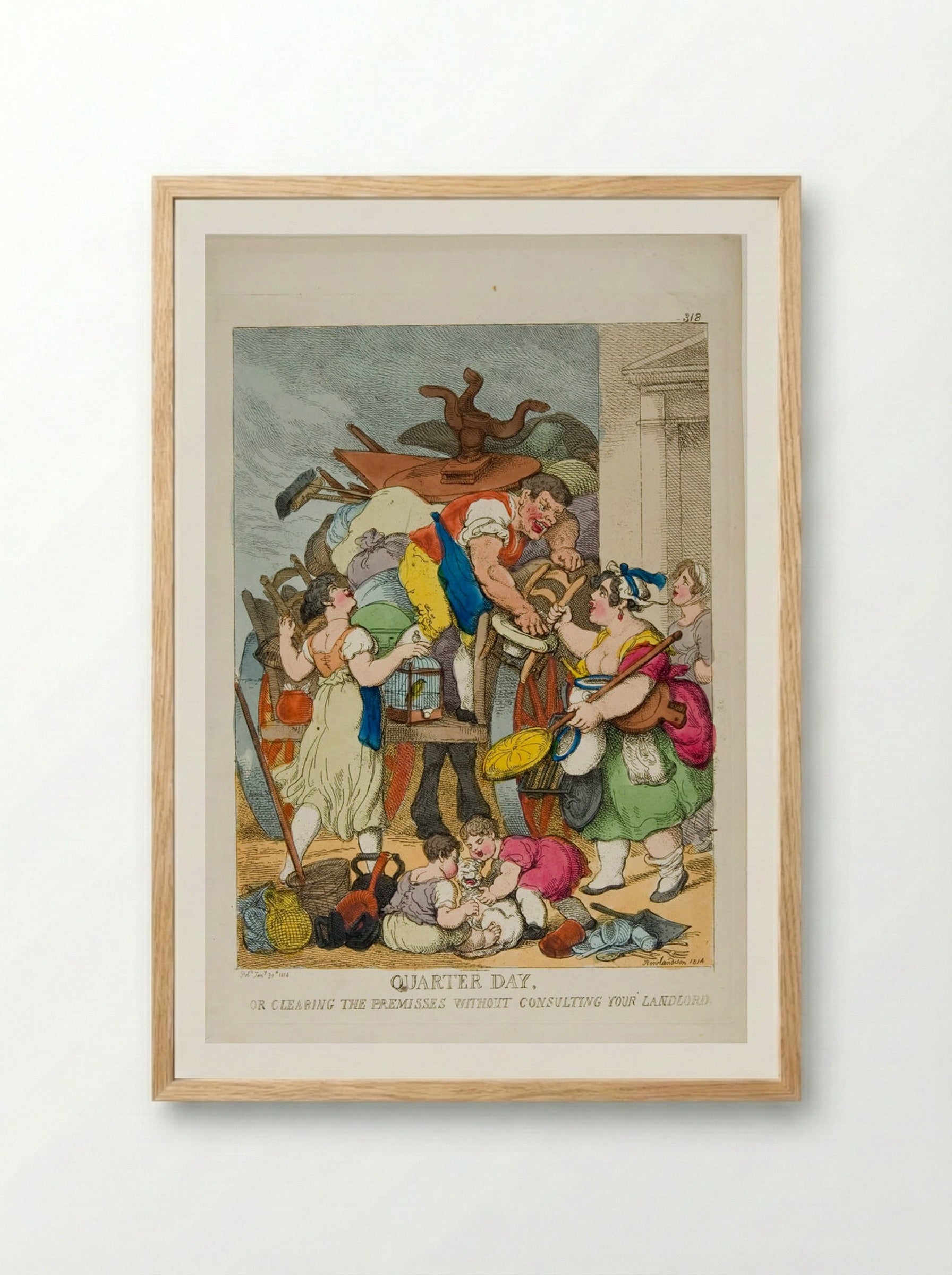

Quarter Day, or Clearing the Premises without Consulting Your Landlord - Thomas Rowlandson
Archival giclée
Frames arrive ready to hang
Secure checkout
Made to order
Description
A hand-coloured etching by Thomas Rowlandson from 1814, "Quarter Day, or Clearing the Premises without Consulting Your Landlord" depicts a chaotic eviction scene with Rowlandson's characteristic satirical wit and dynamic composition.
Thomas Rowlandson's "Quarter Day, or Clearing the Premises without Consulting Your Landlord" is a hand-coloured etching from 1814. Rowlandson, a prominent British caricaturist and printmaker, is known for his satirical depictions of 18th- and early 19th-century English society. His works often employ humour and wit to comment on social issues and human foibles. This print captures the chaotic scene of a family being evicted from their home. Household goods are piled precariously onto a cart, with figures struggling to manage the load. The composition is dynamic, filled with exaggerated expressions and gestures that amplify the sense of upheaval. Rowlandson's use of line is characteristically fluid, and the hand-colouring adds depth and character to the scene. The image offers a glimpse into the realities of tenant life and the disruptions caused by eviction during this period. The artist's satirical eye transforms a potentially grim situation into a humorous, if pointed, social commentary.
Return policy
Because every print is made to order, we don't offer change-of-mind returns, refunds or exchanges. If your order arrives faulty, damaged or incorrect, we'll replace it free of charge — just contact us within 48 hours of delivery. See our refunds page for full details.
Shipping
We ship worldwide, printing at the production hub nearest to your delivery address. Delivery times and costs vary by destination — you'll see the options available to you at checkout.
Manufacturing
Each print is produced to order using 12-colour giclée printing on FSC-certified archival paper. Designed in Britain and printed at your nearest production hub to reduce waste and speed up delivery.
Care and materials
Specific Features
Every Solis piece is made to order with archival, gallery-quality materials built to last.
- Museum-grade giclée printing for rich, fade-resistant colour
- Archival matte fine-art paper, FSC-certified
- Multiple sizes and framing options available
- Frames in black, natural wood, dark wood or white
- Framed prints arrive ready to hang
Care & Cleaning
To keep your artwork looking its best:
- Dust gently with a soft, dry cloth
- Avoid prolonged direct sunlight
- Never use liquid cleaners on the print or canvas surface
- Keep in a dry, room-temperature space
- Handle prints with clean, dry hands
Materials & Sizing
Museum-grade giclée on FSC-certified archival matte paper, with framed and canvas options.
- Paper sizes: A4, A3, A2, A1, A0 and B2 (50×70 cm)
- Canvas: XS (20×30 cm) to Large (60×90 cm)
- Frames: black, natural wood, dark wood or white
Quarter Day, or Clearing the Premises without Consulting Your Landlord - Thomas Rowlandson

Artist Biography
Thomas Rowlandson
He trained at the Royal Academy Schools in London and may have spent time in Paris, though the often-quoted two years at a Parisian academy has been narrowed by recent scholarship to a few weeks at most. His technique was fast, fluent, and populated by figures who bulge, lurch, stumble and grope their way through Georgian England. The line is always in motion. Fat men eat. Thin women flirt. Horses rear. Coaches overturn. The world in a Rowlandson drawing is always on the verge of falling over.
He drew for the satirical press, illustrated books (including the Dr Syntax series, which sold well enough to keep him solvent for several years), and produced erotica for a private clientele that was never published in his lifetime. Unlike James Gillray, whose satire was ferocious and politically targeted, Rowlandson's humour was broader and warmer. He drew human beings as comic animals: vain, greedy, amorous and fundamentally absurd.
His subjects included Vauxhall Gardens, the races at Brighton, country fairs, and the particular chaos of London streets. He drew the city as a place where everyone is either trying to sell something, steal something, or seduce someone, often simultaneously. He died in 1827, aged seventy, having drawn everything he saw and gambled most of what he earned.
Why Choose Us ?
Damage-free delivery guarantee
Fast Shipping
Museum-Quality Materials
You May Also Like