

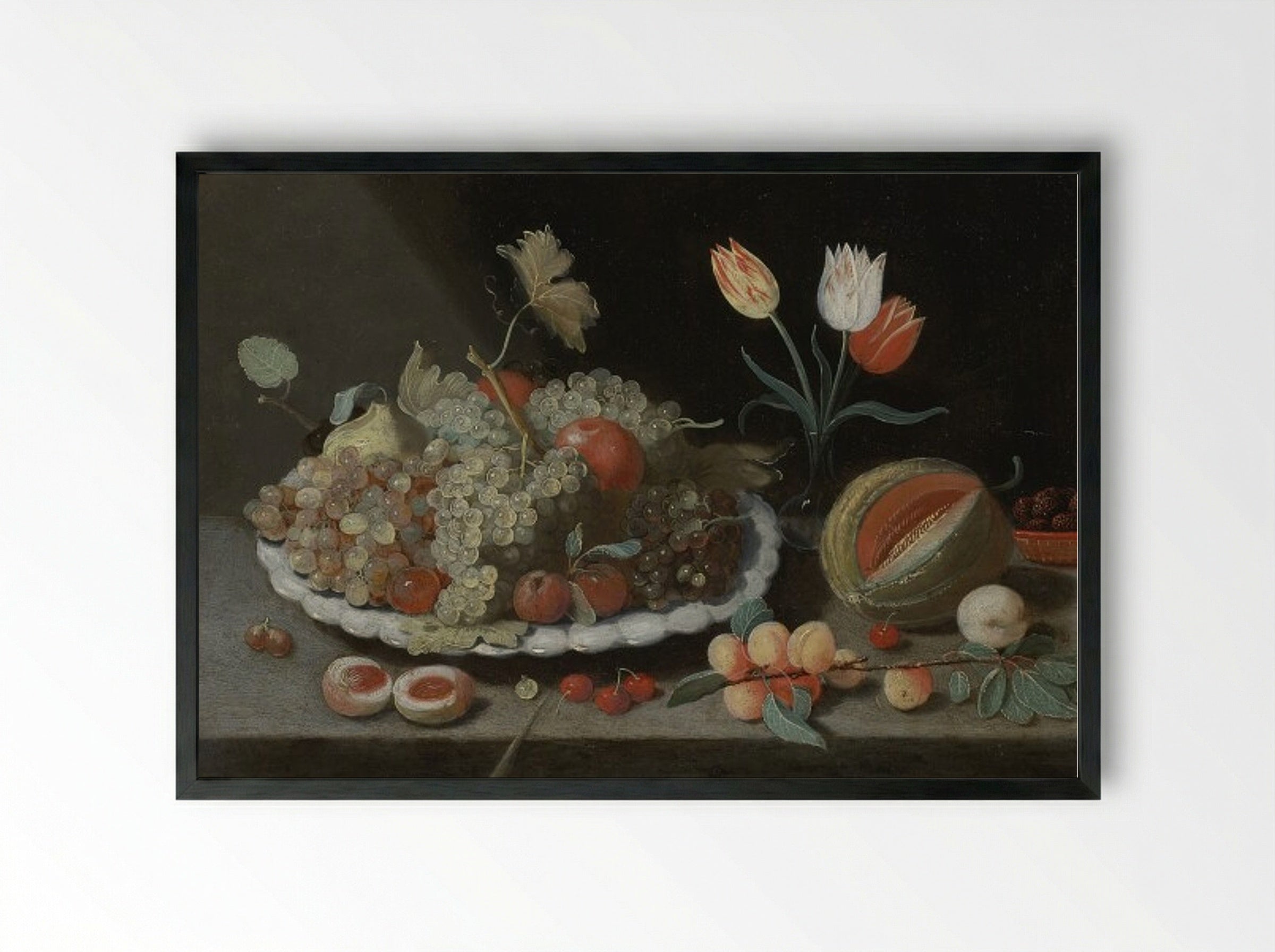


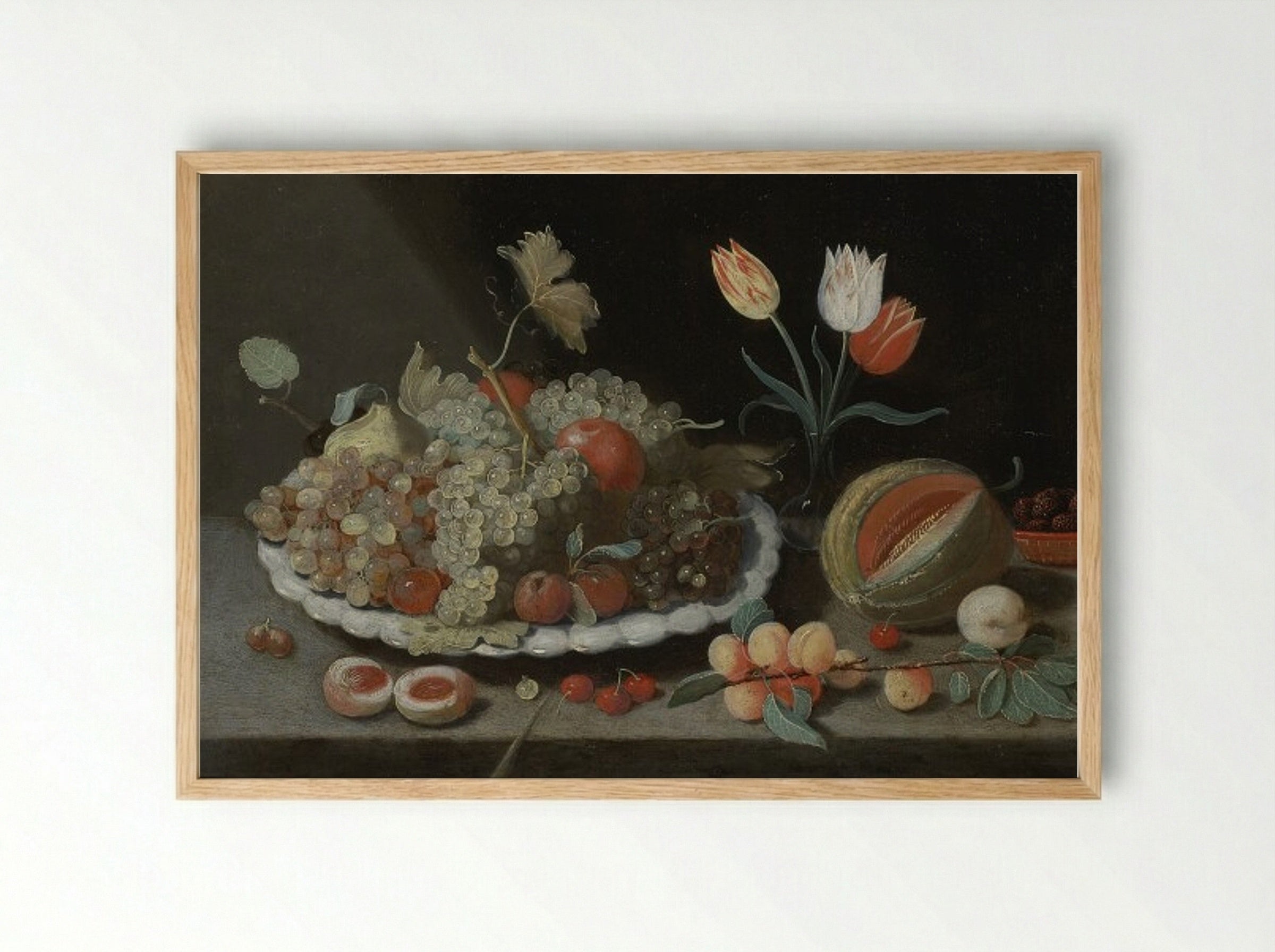
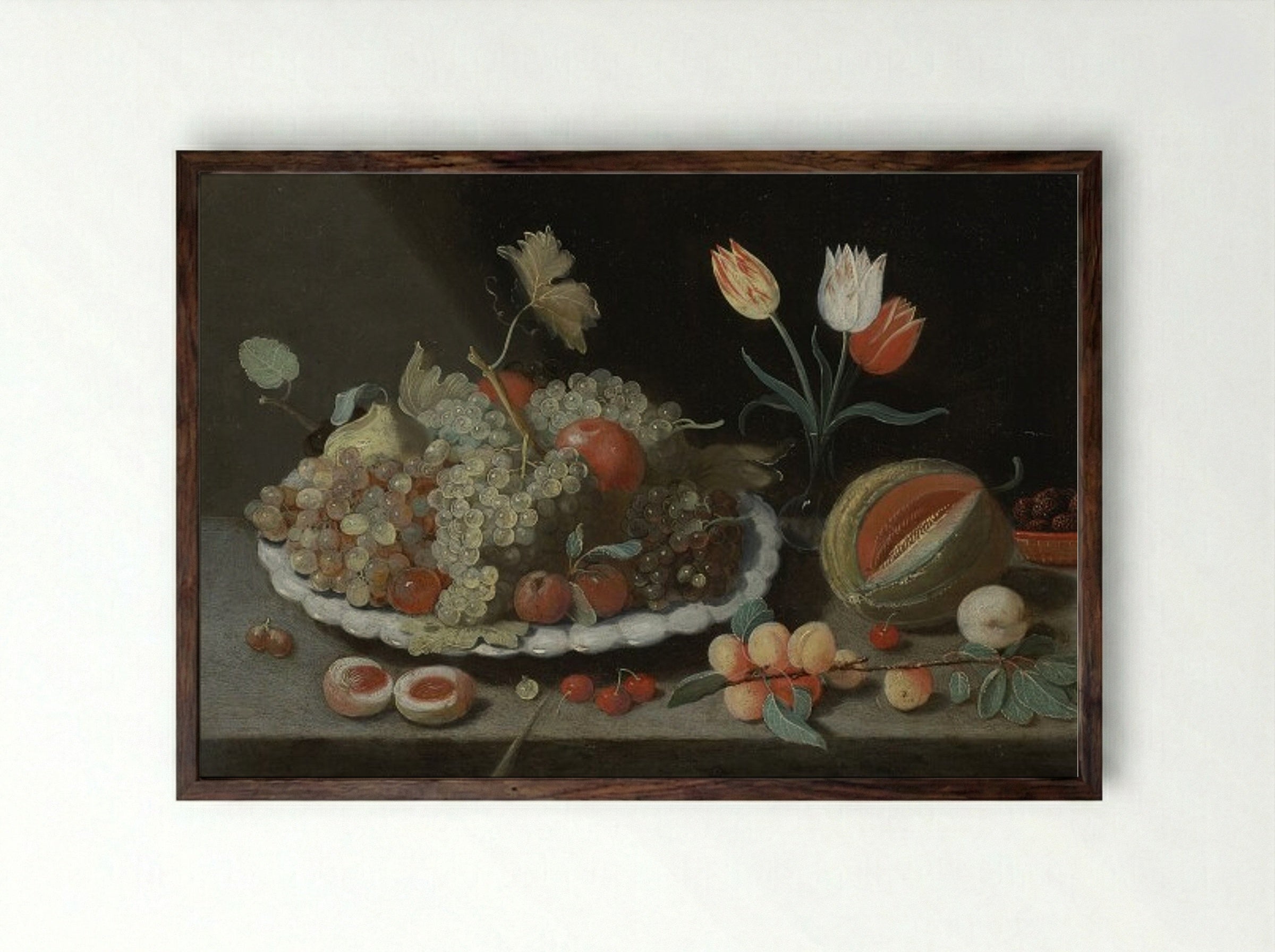
Still life with grapes and other fruit on a platter, a glass vase with tulips, a melon, apricots, cherries and other fruit, all on a ledge - Jan van Kessel the Elder
Archival giclée
Frames arrive ready to hang
Secure checkout
Made to order
Description
A lavish still life by Flemish artist Jan van Kessel the Elder, featuring a variety of fruits and flowers arranged on a platter and ledge. The painting showcases the artist's meticulous attention to detail and his ability to capture the beauty of the natural world.
This still life painting by Jan van Kessel the Elder (1626-1679), a Flemish artist known for his detailed depictions of nature and scientific subjects, presents a lavish display of fruit and flowers. Executed in oil on panel, the composition features a variety of fruits, including grapes, melon, apricots, and cherries, arranged on a platter and ledge. A glass vase holding tulips adds a touch of elegance to the scene. Van Kessel's meticulous attention to detail is evident in the textures and colours of the fruit, as well as the delicate rendering of the tulips. The arrangement of the objects creates a sense of abundance and visual harmony. The dark background enhances the luminosity of the fruits and flowers, drawing the viewer's eye to the central arrangement. The composition reflects the Dutch tradition of still life painting, which often carried symbolic meanings related to vanitas, or the transience of life. Van Kessel's work demonstrates his skill in capturing the beauty and detail of the natural world. His still life paintings were popular among collectors and reflect the growing interest in natural history and scientific observation during the 17th century. This particular work exemplifies the artist's ability to combine scientific accuracy with aesthetic appeal, creating a visually engaging and intellectually stimulating image.
Return policy
Because every print is made to order, we don't offer change-of-mind returns, refunds or exchanges. If your order arrives faulty, damaged or incorrect, we'll replace it free of charge — just contact us within 48 hours of delivery. See our refunds page for full details.
Shipping
We ship worldwide, printing at the production hub nearest to your delivery address. Delivery times and costs vary by destination — you'll see the options available to you at checkout.
Manufacturing
Each print is produced to order using 12-colour giclée printing on FSC-certified archival paper. Designed in Britain and printed at your nearest production hub to reduce waste and speed up delivery.
Care and materials
Specific Features
Every Solis piece is made to order with archival, gallery-quality materials built to last.
- Museum-grade giclée printing for rich, fade-resistant colour
- Archival matte fine-art paper, FSC-certified
- Multiple sizes and framing options available
- Frames in black, natural wood, dark wood or white
- Framed prints arrive ready to hang
Care & Cleaning
To keep your artwork looking its best:
- Dust gently with a soft, dry cloth
- Avoid prolonged direct sunlight
- Never use liquid cleaners on the print or canvas surface
- Keep in a dry, room-temperature space
- Handle prints with clean, dry hands
Materials & Sizing
Museum-grade giclée on FSC-certified archival matte paper, with framed and canvas options.
- Paper sizes: A4, A3, A2, A1, A0 and B2 (50×70 cm)
- Canvas: XS (20×30 cm) to Large (60×90 cm)
- Frames: black, natural wood, dark wood or white
Still life with grapes and other fruit on a platter, a glass vase with tulips, a melon, apricots, cherries and other fruit, all on a ledge - Jan van Kessel the Elder

Artist Biography
Jan Van Kessel The Elder
He was born in Antwerp in 1626, the grandson of Jan Brueghel the Elder through his mother Paschasia. He studied under Simon de Vos and later received instruction from his uncle and godfather Jan Brueghel the Younger. He became a master in the Guild of Saint Luke in 1644 as a flower painter, though flowers were only one of his subjects. He painted garlands, bouquets, marines, river landscapes, paradise scenes, allegories and genre subjects, but he is best known for tiny, jewel-like paintings of insects and shells on copper, depicted against light backgrounds with scientific exactitude.
He worked from nature and from illustrated scientific texts, blending direct observation with published sources. His small insect panels were sometimes produced in pairs or as series designed to decorate the fronts of cabinet drawers where collectors stored actual specimens. The paintings served as both art and catalogue.
He used two different signatures depending on the size of the painting: a cursive, decorative version for larger formats and a more compact form for miniatures. The practice was later misinterpreted as evidence that two different painters were at work. He spent time in Spain as court painter to Philip IV and as a captain in the King's army, probably in the late 1640s. He married Maria van Apshoven in 1647; of their thirteen children, Ferdinand and Jan the Younger also became painters. He died in Antwerp in 1679.
Why Choose Us ?
Damage-free delivery guarantee
Fast Shipping
Museum-Quality Materials
You May Also Like