



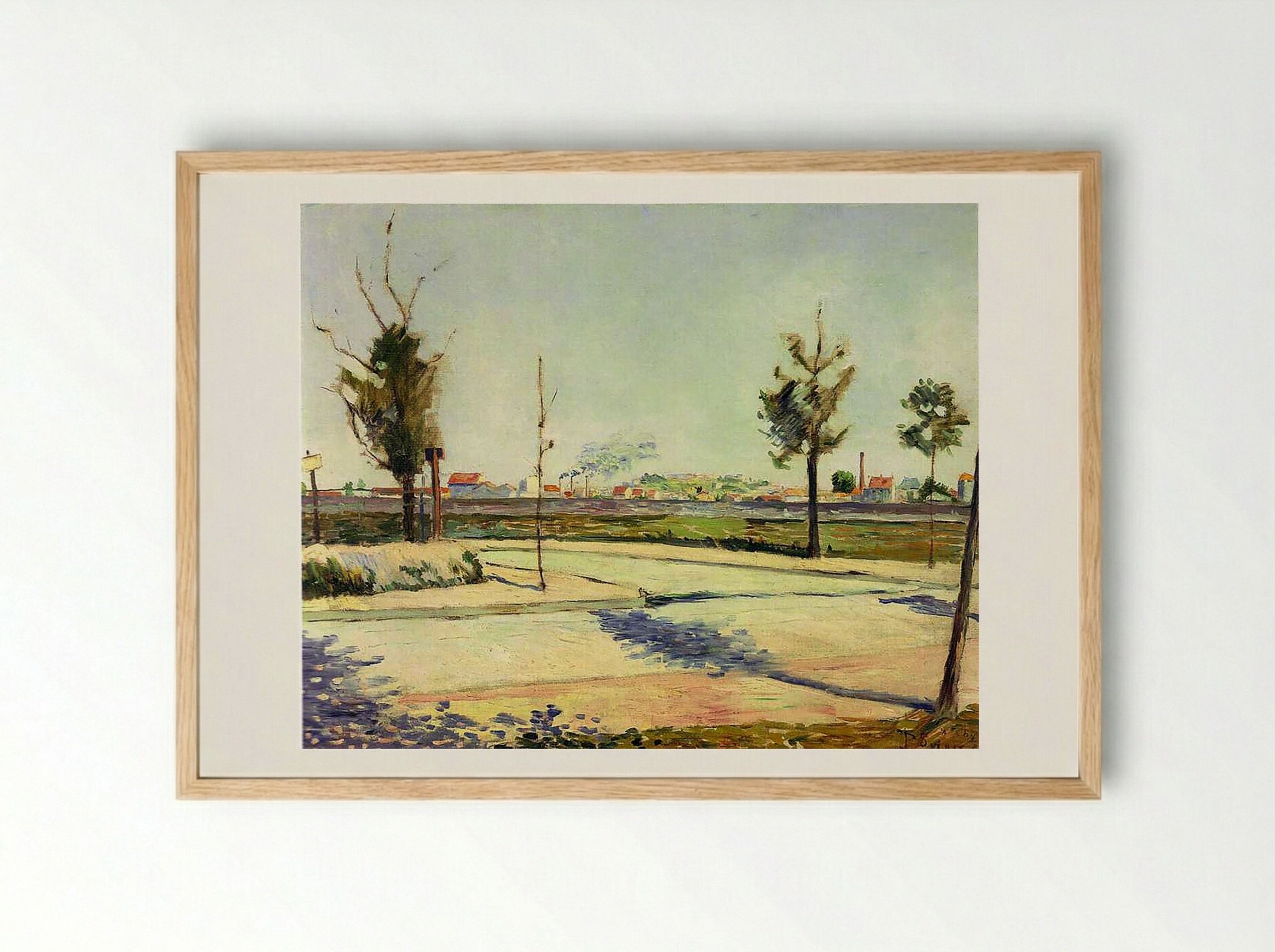

The Road to Gennevilliers - Paul Signac
Archival giclée
Frames arrive ready to hang
Secure checkout
Made to order
Description
A landscape by Paul Signac depicting the road to Gennevilliers, an industrial suburb of Paris. This oil painting captures the light and atmosphere of the scene with loose brushwork and a subdued palette.
Paul Signac's painting, 'The Road to Gennevilliers', presents a view of the industrial outskirts of Paris. Signac, a leading figure in the Neo-Impressionist movement, employed a pointillist technique, though less rigorously than some of his contemporaries. The painting depicts a road leading towards the town of Gennevilliers, with factories and buildings visible in the distance. The scene is framed by trees, some bare and others with sparse foliage, suggesting a transitional season, perhaps early spring or late autumn. The road itself is rendered in broad strokes of colour, with blues and purples indicating shadows. The sky is a pale, hazy blue, typical of the industrial areas surrounding Paris. The composition is relatively simple, with a focus on capturing the light and atmosphere of the scene. Signac's work often explored the relationship between urban and natural environments, and this painting is a good example of his interest in depicting the changing face of the French suburbs during the late 19th and early 20th centuries. The painting's subdued palette and loose brushwork create a sense of quiet observation, inviting the viewer to contemplate the beauty in the everyday.
Return policy
Because every print is made to order, we don't offer change-of-mind returns, refunds or exchanges. If your order arrives faulty, damaged or incorrect, we'll replace it free of charge — just contact us within 48 hours of delivery. See our refunds page for full details.
Shipping
We ship worldwide, printing at the production hub nearest to your delivery address. Delivery times and costs vary by destination — you'll see the options available to you at checkout.
Manufacturing
Each print is produced to order using 12-colour giclée printing on FSC-certified archival paper. Designed in Britain and printed at your nearest production hub to reduce waste and speed up delivery.
Care and materials
Specific Features
Every Solis piece is made to order with archival, gallery-quality materials built to last.
- Museum-grade giclée printing for rich, fade-resistant colour
- Archival matte fine-art paper, FSC-certified
- Multiple sizes and framing options available
- Frames in black, natural wood, dark wood or white
- Framed prints arrive ready to hang
Care & Cleaning
To keep your artwork looking its best:
- Dust gently with a soft, dry cloth
- Avoid prolonged direct sunlight
- Never use liquid cleaners on the print or canvas surface
- Keep in a dry, room-temperature space
- Handle prints with clean, dry hands
Materials & Sizing
Museum-grade giclée on FSC-certified archival matte paper, with framed and canvas options.
- Paper sizes: A4, A3, A2, A1, A0 and B2 (50×70 cm)
- Canvas: XS (20×30 cm) to Large (60×90 cm)
- Frames: black, natural wood, dark wood or white
The Road to Gennevilliers - Paul Signac

Artist Biography
Paul Signac
Signac embraced Pointillism after encountering Seurat's *A Sunday on La Grande Jatte* in 1884. Captivated by the scientific approach to colour and light, he became a devoted follower and, later, a leading advocate of the style. Following Seurat's untimely death in 1891, Signac stepped into the role of the movement's champion, ensuring its continued influence on the avant-garde. His own works, such as *The Red Buoy* and *Antibes, Evening*, showcase his mastery of the technique, using vibrant dots of pure colour to create luminous and harmonious compositions.
Beyond his artistic output, Signac was also a dedicated writer and theorist. His book, *From Eugène Delacroix to Neo-Impressionism*, remains a seminal text on the subject, providing invaluable insights into the principles and philosophy behind Pointillism. Signac's passion for sailing also profoundly influenced his art, with many of his paintings depicting coastal scenes and harbours across France. He died in 1935, leaving behind a legacy as both a talented artist and a key intellectual force within the Neo-Impressionist movement.
Why Choose Us ?
Damage-free delivery guarantee
Fast Shipping
Museum-Quality Materials
You May Also Like