

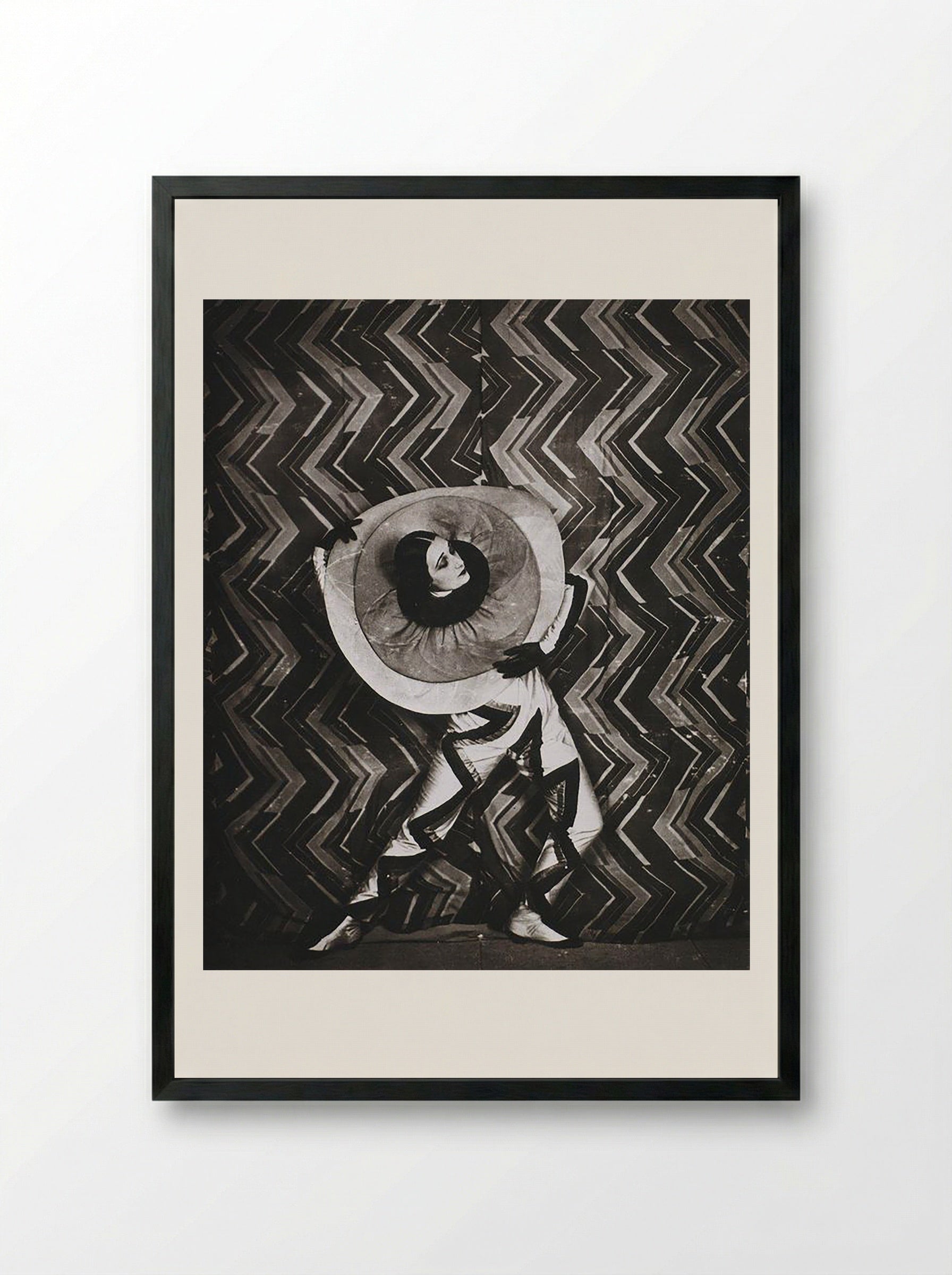


Wearing the Pierrot-Éclair Costume - Sonia Delaunay
Archival giclée
Frames arrive ready to hang
Secure checkout
Made to order
Description
A gelatin silver print of a performer in Sonia Delaunay's 'Pierrot-Éclair' costume for the film *Le P’tit Parigot*. The geometric design and monochrome palette highlight Delaunay's innovative approach to costume and set design.
This gelatin silver print captures a performer wearing the 'Pierrot-Éclair' costume, designed by Sonia Delaunay for René Le Somptier’s film *Le P’tit Parigot*. Delaunay, a key figure in the Parisian avant-garde, was known for her pioneering work in Orphism, an early abstract movement that explored colour and geometric forms. Her artistic practice extended beyond painting to include textile design, fashion, and set design, reflecting a desire to integrate art into everyday life. The photograph presents a striking visual composition. The performer, adorned in a geometrically patterned costume, stands against a backdrop featuring a similar zigzag motif. The costume includes a large, circular element framing the face, drawing attention to the performer's elegant pose and expression. The monochrome palette accentuates the interplay of light and shadow, enhancing the graphic quality of the design. This image exemplifies Delaunay's innovative approach to costume design, blending artistic principles with theatrical expression.
Return policy
Because every print is made to order, we don't offer change-of-mind returns, refunds or exchanges. If your order arrives faulty, damaged or incorrect, we'll replace it free of charge — just contact us within 48 hours of delivery. See our refunds page for full details.
Shipping
We ship worldwide, printing at the production hub nearest to your delivery address. Delivery times and costs vary by destination — you'll see the options available to you at checkout.
Manufacturing
Each print is produced to order using 12-colour giclée printing on FSC-certified archival paper. Designed in Britain and printed at your nearest production hub to reduce waste and speed up delivery.
Care and materials
Specific Features
Every Solis piece is made to order with archival, gallery-quality materials built to last.
- Museum-grade giclée printing for rich, fade-resistant colour
- Archival matte fine-art paper, FSC-certified
- Multiple sizes and framing options available
- Frames in black, natural wood, dark wood or white
- Framed prints arrive ready to hang
Care & Cleaning
To keep your artwork looking its best:
- Dust gently with a soft, dry cloth
- Avoid prolonged direct sunlight
- Never use liquid cleaners on the print or canvas surface
- Keep in a dry, room-temperature space
- Handle prints with clean, dry hands
Materials & Sizing
Museum-grade giclée on FSC-certified archival matte paper, with framed and canvas options.
- Paper sizes: A4, A3, A2, A1, A0 and B2 (50×70 cm)
- Canvas: XS (20×30 cm) to Large (60×90 cm)
- Frames: black, natural wood, dark wood or white
Wearing the Pierrot-Éclair Costume - Sonia Delaunay

Artist Biography
Sonia Delaunay
She was born Sara Stern in 1885 in Hradyzk, Ukraine. At five, her wealthy uncle Henri Terk adopted her and took her to St Petersburg. She grew up with access to art collections, European travel, and a good education. She studied in Karlsruhe, moved to Paris in 1905, and absorbed the Fauvists and Post-Impressionists. After meeting Robert, they developed what Guillaume Apollinaire named Orphism: a variant of Cubism built on pure colour, geometric abstraction, and dynamic movement. Their shared foundation was Chevreul's colour theory of simultaneous contrast, where adjacent colours alter each other's appearance.
In 1913, she sewed the simultaneous dress by hand from scraps of men's tailoring cloth, velvet, silk, and fur. It was designed to match the energy of the foxtrot and tango at Le Bal Bullier, a popular Parisian dance hall. Apollinaire urged readers to visit the Bal Bullier on Thursdays when the Delaunays arrived wearing her creations. The same year, she collaborated with Blaise Cendrars on La Prose du Transsiberien, a two-metre vertical fold-out combining his poem with her abstract colour panels. It is described as the first complete fusion of poetry and painting.
She treated painting, textiles, and fashion as a single practice. She set up a studio in their apartment, opened a fashion house called Sonia, and had her textile line picked up by one of Europe's biggest fabric manufacturers. In 1964, she became the first living woman to have a retrospective at the Louvre. She was seventy-nine. She died in 1979, aged ninety-four.
Why Choose Us ?
Damage-free delivery guarantee
Fast Shipping
Museum-Quality Materials
You May Also Like