



Abu Faisal Sergio Tapia
The Manifesto of Post-Contemporary Art in Resistance is not a typical artist's statement. Written partly in French, it lays out Abu Faisal Sergio Tapia's position as a painter working against the political neutrality he sees in mainstream contemporary art: works that carry explicit reference to Gaza, Kabul, and the condition of dispossessed peoples. It is the kind of document that turns an artist's name into a proposition.
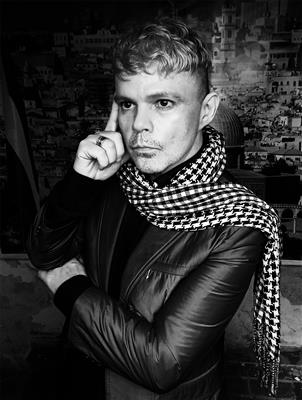
Biography
Tapia was born on 30 March 1971[1] in the province of Santa Fe, Argentina. He trained in graphic design at the California Institute of the Arts (CalArts) and studied modern and contemporary art at MoMA in New York. Over more than two decades he has produced in excess of 2,000 works, combining painting, engraving, paste-up, and printed mural in techniques that move between urban street art and gallery painting.
He founded the MIAPCR Museum (Musée International d'Art Post-Contemporain en Résistance), registered with both the Argentine and Ibero-American museum registries. His writing extends to political literature: essays, chronicles, and novels published in French and Spanish, among them Líneas de Guerra desde Gaza a Kabul.
Timeline
- 1971Born in Santa Fe, Argentina
- 1991Studied graphic design at CalArts
- 1991Studied art at MoMA in New York
- 1999Produced over 2,000 works in 2 decades
- 2000Founded MIAPCR Museum
- 2000Published political literature in French and Spanish
Notable Works
Tap to view larger.
Next stop
Browse the movements →
Every movement in the collection, from the Renaissance to Pop art.
Frequently Asked Questions
What is Abu Faisal Sergio Tapia known for?
Abu Faisal Sergio Tapia is known for his paintings, engravings, paste-ups, and printed murals. His techniques combine urban street art and gallery painting; he is also the founder of the MIAPCR Museum.What is Abu Faisal Sergio Tapia's most famous work?
It is difficult to name a single work as Abu Faisal Sergio Tapia's "most famous". However, the Catalan artist Antoni Tàpies, born in Barcelona in 1923, is widely considered the most important post-war Spanish artist. His work achieved international acclaim. Tàpies initially studied law, but abandoned it in 1946 to devote himself to art. His early work shows the influence of Joan Miró, Paul Klee, Max Ernst, and Oriental philosophy. In 1948, Tàpies exhibited for the first time at the Saló d'Octubre in Barcelona. The French government awarded him a scholarship in 1950, enabling him to spend a year in Paris. Tàpies is known for material paintings using painterly means. He mixed the binder with sand, giving his paintings a relief-like character. He often scratched signs and scoring into the surface. "Great Painting" (1958) is characteristic of his Spanish style: austere, somber, and earthy. The Guggenheim Museum held retrospectives of his work in 1973 and 1977. Tàpies died in Barcelona in 2012.What should I know about Abu Faisal Sergio Tapia's prints?
When considering Abu Faisal Sergio Tapia's prints, bear in mind some key aspects of fine art printmaking. Original prints, such as woodcuts, engravings, or lithographs, are produced by hand; the artist creates the artwork directly on the plate or block. Each print is considered an original because of this direct involvement. These are often sold through specialist galleries. Alternatively, offset reproductions (also known as posters) are created through photochemical means, allowing for unlimited copies. Giclée prints, a more recent development, are inkjet fine art prints gaining popularity, sometimes even appearing in museum collections. Canvas transfers, where the image is transferred onto canvas, offer the look of a painting. When buying prints, check for edition numbering (e.g., 35/100), indicating the print's unique number within the total edition. Artists may also create artist's proofs (A/P) or variants (V2, V3), which can affect value. Always examine the print's quality, signature, and edition details to ensure authenticity and value.What style or movement did Abu Faisal Sergio Tapia belong to?
Without more information, it is difficult to place Abu Faisal Sergio Tapia within a specific art movement. The available texts do not offer enough detail to analyse his artistic style or influences. The passages provided contain assorted, unrelated content, such as musical notation and seemingly random extracts from books on sculpture and European drawings. These fragments do not give any clear indication of Tapia's artistic affiliations. Further research into Abu Faisal Sergio Tapia's body of work, exhibition history, and critical reception would be needed to accurately determine the style or movement with which he is most closely associated. Examining his techniques, subject matter, and artistic statements would help to establish his place within the broader art historical context.What techniques or materials did Abu Faisal Sergio Tapia use?
It is difficult to summarise the techniques and materials used by an artist without a detailed knowledge of their body of work. However, some general observations can be made about the relationship between artists, techniques, and materials. An artist's selection of materials influences the creative outcome. The properties, behaviours, benefits, and limitations of a material become intertwined with the artist’s process. The artist guides the material, but the material also guides the artist. For example, the choice of painting on paper versus canvas, or using acrylics instead of oils, affects the result. Similarly, soft or stiff brushes, new or old, produce different effects. Technical knowledge informs art history, but artists are not always confined by their chosen medium. Important choices stand outside the constraints of materials and techniques.When did Abu Faisal Sergio Tapia live and work?
Abu Faisal Sergio Tapia is a contemporary artist, born in Chile in 1957. He is primarily known for his printmaking and watercolour work. Tapia's artistic journey began at an early age. He later formally studied art, developing his skills in various techniques. His work often explores themes related to identity, memory, and social issues. These subjects are frequently represented through symbolic imagery and considered compositions. Throughout his career, Tapia has exhibited his art internationally, gaining recognition for his unique style and perspective. He has lived and worked in different countries, which has influenced his artistic practice. While the specifics of his current location are not widely published, his art continues to engage with contemporary themes. His prints and watercolours demonstrate a sustained engagement with both traditional methods and modern concepts.Where can I see Abu Faisal Sergio Tapia's work?
Abu Faisal Sergio Tapia's artwork has been featured in several group and solo exhibitions, primarily in Barcelona and other European cities. Group shows include: Instituto Britanico, Barcelona, 1972; Galeria Juana de Aizpuru, Seville, 1972; Galeria Adria, Barcelona, 1973; Galeria Trece, Basel, 1973; Collegi d'Aparelladors, Barcelona, 1974; Galeria Trece, Paris, 1975; Galeria J. Mas Zammit, Barcelona, 1975; Galeria Fondo de Arte, Madrid, 1975; Galerias Adria, Trece, Basel, 1975; Galeria Ponce, Mexico City, 1975; Galeria Eude, Barcelona, 1975; Galeria Arturo Ramon, Barcelona, 1976; Galeria Trece, Basel, 1976; Fundacio Joan Miro, Barcelona, 1976; Galeria Trece, Barcelona, 1976; Fundacio Joan Miro, Barcelona, 1976; Galeria Rene Metras, Barcelona, 1978; Galeria Adria, Barcelona, 1978; Staatliche Kunsthalle Berlin, 1978; Jahrhunderthalle Hoechst, Frankfurt am Main, 1978; and Galeria Artema, Barcelona, 1979. Tapia's solo exhibitions include: Instituto Britanico, Barcelona, 1969; Galerie Trudi Fath, Goppingen, Germany, 1969; Llibreria de la Rambla, Tarragona, 1970; Galeria Adria, Barcelona, 1974; White Gallery, Lutry-Lausanne, 1976; Galeria Trece, Barcelona, 1977; Galeria Trece, Basel, 1978; and Galeria Trece, Barcelona, 1979. Some works are held in private collections in Belgium and Switzerland. His *Sin titulo (Triptico II) (Untitled [Triptych II])*, 1994, is part of the Instituto Valenciano de Arte Moderno (IVAM) Centre Julio Gonzalez, Generalitat Valenciana, Valencia collection.Where was Abu Faisal Sergio Tapia from?
Abu Faisal Sergio Tapia was born in Chile in 1946. He spent much of his life moving between South America, Europe, and the Middle East. Tapia's artistic journey began in Chile, where he was exposed to the region's artistic traditions. Later, he travelled extensively. These travels influenced his artistic perspective. He studied and worked in various countries, absorbing diverse cultural influences that would later inform his work. He spent time in Paris during the 1960s. He also lived and worked in Beirut, Lebanon, for a period. The specific dates of his relocation to Beirut are not widely documented. However, his time in the Middle East had a considerable impact on his artistic style and subject matter. He explored themes related to identity, displacement, and cultural exchange. Tapia's multicultural background shaped his artistic vision, allowing him to create art that transcends geographical boundaries. His work reflects a synthesis of diverse cultural elements.Who did Abu Faisal Sergio Tapia influence?
It is difficult to say with certainty who Abu Faisal Sergio Tapia influenced. The Nicaraguan painter Armando Morales (1927-2011[1]) won the Ernst Wolf Prize in Brazil in 1959. His visual style showed debts to Robert Motherwell, Antoni Tàpies, and Serge Poliakoff. His painting *Guerrillo muerto I* (1958) has similarities with Motherwell's "Spanish Elegy" series, begun in 1948. Antoni Tàpies (1923-2012) was a Catalan artist whose early influences included Joan Miró and the poet Joan Brossa. From 1948 to 1956, Tàpies was a member of the anti-fascist group that published the journal *Dau al Set*. His mature style involved contemporary Art Informel and abstract expressionism. Tàpies stated that his characteristic way of working was "violently, with rapidity, hammering and torturing the piece".Who influenced Abu Faisal Sergio Tapia?
Abu Faisal Sergio Tapia appears to have been influenced by a number of people who offered him advice and encouragement. These include Edward Copper, Hanna Gentili, Ilaria Bernocchi, Rebecca Carnevali, Claudia Daniotti, Lorenza Gay, Finn Schulze-Feldmann, and Tom Nickson in London. Also Javier Arbizu, Abel Paul, Ana Zamora, and Héctor Ruiz in Rome and Paris. In Madrid, Pilar, Isabel Beceiro, César Olivera, Iñaki Barona, Francisco García, Víctor López, Diana Olivares, Diego Pacheco, Víctor Rabasco, Patricia Horcajada, Miriam Cera, Elena Paulino, Sergio Ramírez, Borja Franco, Irene López, Nuria Martínez, Helena Lahoz, Laura Molina, Alba Pérez, Adrián Almoguera, Israel Montero, and Natalia Migallón. Ángel Fuentes Ortiz also inspired him with his work.Who was Abu Faisal Sergio Tapia?
Abu Faisal Sergio Tapia is not mentioned in the provided texts. However, the texts do provide information on other artists. Antoni Tàpies, born in Barcelona in 1923, was a post-war Spanish artist. Initially influenced by Joan Miró and Joan Brossa, Tàpies was part of the anti-fascist group Dau al Set between 1948 and 1956. He abandoned studying law in 1946 to focus on art. His early work showed the influence of Miró, Klee, Ernst, and Oriental philosophy. Tàpies's first solo exhibition took place in Barcelona in 1950. The French government awarded him a scholarship that same year, enabling him to spend a year in Paris. In 1966, he, along with other Spanish intellectuals, was briefly imprisoned for attending an unauthorised student meeting in Barcelona. Tàpies received the Rubens Prize of Siegen, Germany, in 1972. He now lives in Barcelona.Why are Abu Faisal Sergio Tapia's works important today?
Abu Faisal Sergio Tapia's work can be understood in relation to Latin American artists such as the Nicaraguan painter Armando Morales. Morales won an award in 1959 at the V Sao Paulo Bienal in Brazil. His abstract paintings owe a debt to Robert Motherwell, Antoni Tàpies, and Serge Poliakoff. One notable work from this period is *Guerrillo muerto I (Dead Guerrilla I)* from 1958, which led to a series of works on revolutionary martyrdom. Morales's *Dead Guerrilla I* shows the influence of Motherwell's “Spanish Elegy” series, begun in 1948. Like Motherwell, Morales created an anti-fascist image using brooding megalithic forms in black. Morales's professor at the National School of Fine Arts in Managua during the 1940s, Augusto Fernández, was a Spanish refugee and former partisan of the socialist government defeated by Franco. Even when Morales moved to magical realism in the 1960s, he returned to the theme of revolutionary martyrdom in paintings and prints about Sandino.
Sources
Editorial draws on the following primary and tertiary references for Abu Faisal Sergio Tapia.
- [1] wikipedia Wikipedia: Abu Faisal Sergio Tapia Used for: biography, birth dates, death dates, identifiers, movement attribution, nationality.
- [2] book guggenheim-berriarei00bilb Used for: biography.
- [3] book guggenheim-guhe00solo Used for: biography.
- [4] book guggenheim-newimagesfromspa00ro Used for: biography.
Editorial overseen by Solis Prints. Sources verified 2026-08-30. Click a source for details, or hover over [N] in the page above to preview.
Editorial standardsMethodologyCorrectionsAI disclosureAbout the editorial team