



Achille Devéria
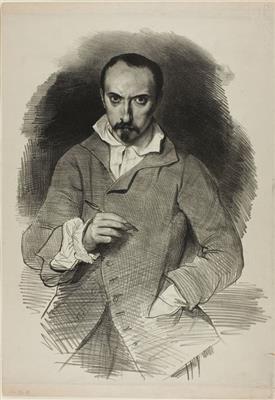
Among the leading lithographers of the French[1] Romantic movement, Achille Devéria made his name as a portraitist whose sitters read like the literary and musical roll-call of the 1820s and 1830s: Victor Hugo, Alexandre Dumas, Honoré de Balzac, Franz Liszt, and Walter Scott all passed through his studio. Charles Baudelaire, typically demanding in his critical judgements, praised Devéria's portraits as capturing all the morals and aesthetics of the age.
Biography
Born in Paris in 1800[1], he studied under Anne-Louis Girodet-Trioson and Louis Lafitte, two painters rooted in the Neoclassical tradition, before finding his own footing in the more fluid world of Romantic book illustration and lithography. He began exhibiting at the Paris Salon in 1822[1] and by 1830 had established himself as one of the city's most sought-after illustrators. His edition of Goethe's Faust in 1828 was among his most admired commissions. His younger brother Eugène, also a Romantic painter, was a frequent collaborator; together they ran an art school.
His range was wide, moving across what Baudelaire described as pseudo-historical, pious, sentimental and erotic scenes, with watercolour and lithography enabling him to excel at the vignette form that dominated Romantic book publishing.
In 1849[1] he was appointed director of the engraving department at the Bibliothèque Nationale and assistant curator of the Louvre's Egyptian collection, positions that reflected his institutional standing. He spent his final years collaborating with his son Théodule on a family portrait album, completed between 1853 and 1857[1]. He died in Paris in December 1857, aged 57.
Timeline
- 1800Born in Paris, France
- 1822Began exhibiting at the Paris Salon
- 1828Illustrated Goethe's Faust
- 1830Established as a sought-after illustrator in Paris
- 1849Appointed director at Bibliothèque Nationale and assistant curator at Louvre
- 1853Collaborated with son Théodule on a family portrait album
- 1857Died in Paris, France
Notable Works
Tap to view larger.
Next stop
Romanticism →
Explore the artists and ideas of Romanticism.
Related Artists



Frequently Asked Questions
What is Achille Devéria known for?
Achille Devéria is known for his portraits and illustrations. Charles Baudelaire praised his portraits as capturing the morals and aesthetics of the age; his 1828[1] edition of Goethe's Faust was among his most admired commissions.What should I know about Achille Devéria's prints?
Achille Devéria (1800[1]-1857[1]) was a French[1] painter and printmaker known for his lithographs and portraiture. His prints offer insight into the artistic and social milieu of 19th-century France. When considering Devéria's prints, it is useful to understand some basic print terminology. A "vintage print" is a photograph printed around the time the negative was taken. A "period print" is one made within roughly ten to fifteen years of the original shot. Prints made later are termed "old" prints, as opposed to "modern" or "contemporary" prints, which are recent printings from the original negative. An "original print" is one made by the artist or under their direct supervision. Achille Devéria's prints were created using a variety of techniques, including lithography, which allowed for relatively large print runs. The number of prints made affects their value, as does the print's condition. Factors such as fading, foxing (brown spots), and damage can impact the desirability and price of a print.What was Achille Devéria known for?
Achille Devéria (1800[1]-1857[1]) was a French[1] Romantic painter and printmaker. He is best known for his lithographs and portraits. Devéria's early work included genre scenes and historical subjects. He gained recognition for his skill as a portraitist, producing likenesses of prominent figures of his time. His portraits often captured the sitter's personality and character, rather than simply providing a realistic depiction. As a printmaker, Devéria was a master of lithography, a technique that allowed for the creation of multiple original prints from a single stone or metal plate. He used lithography to reproduce his own compositions, as well as works by other artists. These prints made art more accessible to a wider audience. During his career, Devéria also taught art and exhibited his work in the Paris Salon. Although his style shifted over time, he remained associated with the Romantic movement, which emphasised emotion, imagination, and individualism.When did Achille Devéria live and work?
Achille Devéria was born in Paris on 6 February 1800[1]. He and his brother Eugène both became painters; both were taught by Girodet. Achille exhibited at the Paris Salon from 1822[1]. He also produced lithographs and genre paintings. Devéria's work gained public favour. He became curator of prints at the Bibliothèque Nationale in 1849. He died in Paris on 23 December 1857[1]. His artistic career unfolded during a period of considerable change in France. The July Revolution occurred in 1830. Delacroix exhibited *Liberty Leading the People* in 1831. Annual Salons began that year. The Musée Historique was established at Versailles by Louis-Philippe in 1832. Baudelaire reviewed the Salon for the first time in 1845. The February Revolution led to the Second Republic in 1848.Where can I see Achille Devéria's work?
Achille Devéria's works can be viewed in several locations worldwide. In France, his art is held at the Bibliothèque Nationale (Paris), Musée du Louvre (Paris), and Musée Condé (Chantilly). In the United States, collections include the Metropolitan Museum of Art (New York), the Los Angeles County Museum of Art, the Minneapolis Institute of Arts, and the Charles Hosmer Morse Museum of American Art (Winter Park, Florida). You can also find his pieces at the Art Gallery of Ontario (Toronto). In the UK, collections include the Victoria & Albert Museum (London), the Brighton Museum & Art Gallery, the Geffrye Museum (London), the Manchester Art Gallery, and the National Museums of Scotland (Edinburgh).Where was Achille Devéria from?
Achille Devéria was French[1]. Jacques-Denis Antoine, the neoclassical architect best known for the Royal Mint (Hôtel de la Monnaie), was born in Paris. Charles-Louis Clérisseau, the French antiquarian artist, was also born in Paris. Pierre-Jean David, called David d’Angers, was born in Angers in 1788. Joseph Chinard, the French sculptor, was born in Lyon. Charles Le Brun, the French painter, was from Paris. Jean-François de Troy, the son of the successful French painter François de Troy, trained with his father and at the Académie Royale de Peinture et de Sculpture. The Van Blarenberghes, a dynasty of miniature painters, are best known for their work on snuffboxes, which includes depictions of royal châteaux, interiors of Parisian townhouses, country fêtes, scenes of street life, games and performances, and historical events of interest, such as balloon flights around Paris and the marriage of Grand Duke Paul of Russia.Who did Achille Devéria influence?
Achille Devéria's artistic connections are complex. He was part of a broad artistic network, and his influence is not always direct. Jacques-Louis David's pupils dominated the Neo-Classical school in the early 1800s. The most important was J.-A.-D. Ingres, whose impact on history painting was extensive. Ingres's success made his work the starting point for 'Troubadour' painters, who specialised in Medieval and Renaissance subjects. Ingres was also the admired prototype of the second wave of Neo-Classicism in the mid-1800s. Various pupils reinterpreted the Ingrist focus on line and form into the Neo-Classicism of the Second Empire. These included Ingres’s student, Amaury-Duval. Ingres’s cultivation of aesthetic and physical beauty had a lasting impact on younger artists of the Restauration period and the Second Empire under Napoleon III. These included Joseph-Désiré Court, Thomas Couture, Adolphe-William Bouguereau, and Paul Baudry. Ingres’s scenes of harems and seraglios affected the Orientalists, such as Horace Vernet, Alexandre Cabanel, and Paul Delaroche.Who influenced Achille Devéria?
Achille Devéria lived during a time of shifting artistic ideals. The established Académie des Beaux-Arts promoted the idea of "genius" as apparent in the finishing stages of a painting. Independent artists were adopting a newer concept of originality, apparent in the preparatory stages. Several figures offered alternatives to the Académie's exclusive focus on the Rome Prize. These included Charles Gleyre (whose pupils included Monet, Renoir, Sisley, and Bazille) and Thomas Couture (whose pupil was Manet). Couture encouraged his students to work rapidly and spontaneously. He passed on his love of the Old Masters to Manet. Other alternatives for art students included Suisse's open life studio and the Académie Julian. Horace Lecoq de Boisbaudran's classes, from 1841[1] to 1869, provided another option for drawing instruction. He invented a method of training by drawing from memory, which encouraged originality. Eugène Delacroix was regarded as an independent artist. Younger artists revered his works for their expressive colour and bold brushwork. Although Delacroix did not found a school of followers, his example was important to many younger independent artists, particularly the Impressionists.Why are Achille Devéria's works important today?
Achille Devéria (1800[1]-1857[1]) was a French[1] painter and lithographer known for his portraits and genre scenes. He achieved considerable success during the Romantic era, particularly in the 1820s and 1830s. Devéria's works offer insights into the social customs, fashions, and artistic tastes of his time. His portraits captured likenesses of prominent figures, while his genre scenes depicted everyday life, often with a focus on sentimental or romantic themes. These images provide valuable documentation of 19th-century French society. His lithographs, in particular, were widely circulated and helped to popularise Romantic aesthetics. They made art more accessible to a broader audience, contributing to the growth of visual culture. Although his reputation diminished somewhat later in the 19th century, recent scholarship has recognised his contribution to French Romanticism[1] and his skill as a draughtsman and printmaker. His works are appreciated today for their historical value and artistic qualities.What was Achille Devéria's art style?
Achille Devéria worked in the Romantic style. He excelled at the vignette form that dominated Romantic book publishing.How did Achille Devéria die?
Achille Devéria died in 1857[1] at the age of 57.
Sources
Editorial draws on the following primary and tertiary references for Achille Devéria.
- [1] wikipedia Wikipedia: Achille Devéria Used for: biography, birth dates, death dates, identifiers, movement attribution, nationality.
- [2] book Allison Lee Palmer, Historical Dictionary of Neoclassical Art and Architecture Used for: biography.
- [3] book Masterpieces of western art : a history of art in 900 individual studies from the Gothic to the present day Used for: biography.
- [4] book Neoclassicism and romanticism : architecture, sculpture, painting, drawings, 1750-1848 Used for: biography.
Editorial overseen by Solis Prints. Sources verified 2026-10-15. Click a source for details, or hover over [N] in the page above to preview.
Editorial standardsMethodologyCorrectionsAI disclosureAbout the editorial team