



Adolph de Meyer
- pictorialism
Cecil Beaton called him "the Debussy of photography," and the comparison holds: de Meyer made images that shimmered, dissolved at the edges, and seemed to exist in permanent twilight between music and light. His backlighting technique, surrounding sitters in luminous halos of soft focus, was practically his invention, and it transformed what fashion photography could aspire to.
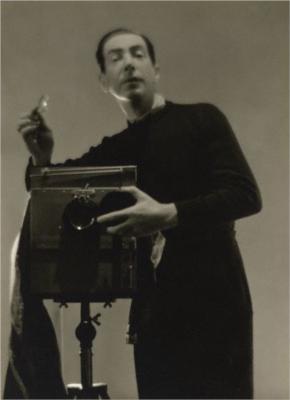
Biography
Born in Paris in 1868[1] and educated in Dresden, de Meyer moved to London in 1895[1] and entered the world of aristocratic amateur photography. In 1898 he was elected to the Linked Ring Brotherhood, the London secessionist body that positioned fine-art photography against the Royal Photographic Society's scientific establishment. Alfred Stieglitz published his photographs in Camera Work between 1903 and 1907, placing him at the centre of the international Pictorialist movement.
His most celebrated photographs were made in 1912[1], when he documented Vaslav Nijinsky in Diaghilev's L'Après-midi d'un faune. The images of Nijinsky in his faun costume, caught in the soft Pictorialist glow, remain among the period's most potent conjunctions of high culture and photographic art.
In 1913[1], Condé Nast appointed him Vogue's first official fashion photographer, a post he held until 1921. He moved to Harper's Bazaar in 1922 as chief photographer and Paris correspondent, working there until 1934. His wife Olga, whom he had married in 1899, died in 1931; by the late 1930s he had settled in Los Angeles, where he died in January 1946[1]. A Metropolitan Museum exhibition in 2017 brought forty of his works together, establishing the case for his place in photographic history.
Timeline
- 1868Born in Paris, France
- 1895Moved to London and entered aristocratic amateur photography.
- 1898Elected to the Linked Ring Brotherhood.
- 1899Married Olga.
- 1903Photographs published in Camera Work (until 1907).
- 1912Documented Vaslav Nijinsky in L'Après-midi d'un faune.
- 1913Appointed Vogue's first official fashion photographer.
- 1922Moved to Harper's Bazaar as chief photographer.
- 1931Wife Olga died.
- 1934Stopped working at Harper's Bazaar.
- 1946Died in Los Angeles, California.
Notable Works
Tap to view larger.
Next stop
Browse the movements →
Every movement in the collection, from the Renaissance to Pop art.
Related Artists



Frequently Asked Questions
What is Adolph de Meyer known for?
Adolph de Meyer is known for his backlighting technique, which surrounded his subjects in halos of soft focus. He was also Vogue's first official fashion photographer, from 1913[1] to 1921, and later worked for Harper's Bazaar.What is Adolph de Meyer's most famous work?
Adolph de Meyer was a photographer known for his association with the Photo-Secession movement and his later work in fashion photography. While it is difficult to identify one single "most famous work", some of his images are particularly well-regarded. His early photographs, often still lifes or portraits, display a soft-focus, pictorialist aesthetic. "Study in Drapery" (1907[1]) is a strong example of this period. It shows his skill in manipulating light and texture. Later, de Meyer transitioned into fashion photography, working for *Vogue* and *Harper's Bazaar*. During this period, he photographed many leading figures in society and the arts, and these images gained wide circulation. A picture of Rita Lydig from 1914 is one such example. These photographs helped to define the look of high fashion during the early 20th century. De Meyer's work is held in museum collections, including the Metropolitan Museum of Art and the National Gallery. His photographs continue to be studied for their artistic and historical value.What should I know about Adolph de Meyer's prints?
Adolph de Meyer was a photographer. Some prints by de Meyer are held in collections such as the Royal Photographic Society (RPS). To understand the context of de Meyer's prints, it is useful to consider the work of his contemporaries. Julia Margaret Cameron, for example, was a British photographer who produced prints in the 1860s and 1870s. Her works are held in collections around the world, including the National Portrait Gallery (NPG) and the J Paul Getty Museum (JPGM). Cameron's prints were sold through various vendors, including Colnaghi and William Spooner. Prints distributed by Spooner were marked with a "Registered Photograph" blindstamp. Cameron also arranged for notable sitters, such as Alfred Tennyson and John Herschel, to sign the mounts of her photographs. In 1875[1], Cameron approached the Autotype Company to make carbon prints of some of her images. These carbon prints were often marked with a stamp.What style or movement did Adolph de Meyer belong to?
Adolph de Meyer was associated with Pictorialism, an international style in photography that gained momentum in the late 19th and early 20th centuries. Pictorialist photographers aimed to have their work recognised as fine art, rather than simple mechanical reproduction. Pictorialism valued subjective expression. Photographers employed various techniques to achieve painterly effects. These included using special lenses to create optical effects, manipulating prints through handcraft processes, and favouring grainy or rough papers. Printing processes such as charcoal, gum bichromate, or fatty ink were also used. These methods allowed photographers to control the image, giving it the quality of an original work of art. Pictorialists moved away from photography's focus on imitation. They preferred traditional genres such as portraits and landscapes, often avoiding contemporary subjects to convey a sense of timelessness. In Vienna, Pictorialism developed against the backdrop of the Vienna Secession.What techniques or materials did Adolph de Meyer use?
Adolph de Meyer worked with a range of materials and techniques, often combining photography with other media. From the late 19th century, improvements in photographic technology made it easier for artists to incorporate photography into their practice. Enlarged photographs on linen were produced, and faster bromide emulsions reduced the need for specialists. Artists would paint over photographic images using oils, watercolours, or pastels. Preparatory layers, such as gelatin for oils or shellac for watercolours and pastels, were often applied. In the 1930s, manuals described methods for colouring prints, including mounting enlargements on board or canvas and applying preparatory layers of acetic acid, gelatin, glue, casein, alcohol, glycerin, and carbolic acid. Wax media were also used for colouring photographs. Recipes included combining white wax, carbon tetrachloride, turpentine, benzene, ammonia, spike oil of lavender, hard primrose soap, gum elemi, and turpentine. The use of wax was favoured for its durability and to avoid the yellowing associated with oils and varnishes.What was Adolph de Meyer known for?
Adolph de Meyer (born in Paris, 1868[1]; died in Los Angeles, 1946[1]) was a photographer. He is often considered the first fashion photographer. De Meyer's images appeared in magazines such as Vogue and Vanity Fair. He used soft-focus techniques and experimented with light and shadow. His style helped to define the look of early 20th-century fashion photography. Before his career in photography, de Meyer collected drawings, prints, and other works of art. He was a member of the Camera Club of New York and the Royal Photographic Society. He also photographed many notable figures, including members of the European aristocracy, actors, and dancers. He moved to the United States in 1914[1], where he continued to work for Condé Nast publications.When did Adolph de Meyer live and work?
Adolph de Meyer, a photographer celebrated for his contributions to fashion and portraiture, was born in 1868[1] and died in 1946[1]. De Meyer's career spanned several decades and continents. He began his photographic work in the late 19th century, gaining recognition for his artistic approach. His early work has a Pictorialist style, marked by soft focus and atmospheric effects. He became a member of the Photo-Club de Paris and the Linked Ring, artistic photography societies, in the early 1900s. De Meyer relocated to the United States during the First World War, where he worked for Condé Nast, taking photographs for *Vogue* and *Vanity Fair*. His images helped define the look of fashion photography during this period. He later worked for *Harper's Bazaar* in Paris. De Meyer's work is held in museum collections, and his photographs continue to be studied for their artistic and historical value.Where can I see Adolph de Meyer's work?
You can find examples of Adolph de Meyer's work in several collections. These include the Metropolitan Museum of Art, New York; the Museum of Modern Art, New York; the Los Angeles County Museum of Art (LACMA); the Minneapolis Institute of Arts; and the Royal Ontario Museum in Toronto. Other North American locations include the Charles Hosmer Morse Museum of American Art in Winter Park, Florida; the Virginia Museum of Fine Arts in Richmond; and the Wolfsonian at Florida International University in Miami Beach. In Europe, de Meyer's work can be seen at the Victoria & Albert Museum in London; the National Museums of Scotland, Royal Museum, in Edinburgh; and the Manchester Art Gallery. Other European museums holding his work are the Musée d’Art et d’Industrie in Roubaix, France; the Musée des Arts Décoratifs in Paris; and the Museu Calouste Gulbenkian in Lisbon.Where was Adolph de Meyer from?
Adolph de Meyer was born in Paris in 1868[1]. Some sources list his birthplace as either London or Paris; this discrepancy may be due to uncertainty about his parentage. De Meyer's mother was Scottish. His father was either German[1] or Jewish; some have speculated that he was the illegitimate son of Prince Albert Edward, later Edward VII. He spent his childhood in Dresden, Germany. He returned to Paris in the 1890s, where he became part of the artistic and literary circles. He began taking photographs around this time. In 1897[1], he moved to London. There, he became involved with the Linked Ring, a British photographic society that promoted photography as fine art. He was known for his society portraits and fashion photography.Who did Adolph de Meyer influence?
Adolph de Meyer's influence is discernible in the work of several photographers who followed him. His innovative techniques with soft focus, combined with his ability to capture elegance and atmosphere, impacted fashion and portrait photography. One notable photographer who absorbed elements of de Meyer's style was George Hoyningen-Huene. Hoyningen-Huene, working for *Vogue* and *Harper's Bazaar*, adopted a similarly refined aesthetic. Both photographers created images that elevated fashion photography to an art form. Another photographer who likely studied de Meyer's work was Horst P. Horst. Horst, also associated with *Vogue*, built upon de Meyer's approach to lighting and composition. He further refined the studio portrait, creating striking images of models and celebrities. While it is difficult to definitively measure influence, the visual connections between de Meyer's photographs and the work of these later figures suggest a transmission of ideas and techniques. De Meyer's emphasis on mood and atmosphere, alongside his technical innovations, provided a foundation for future generations of photographers working in the fields of fashion and portraiture.Who influenced Adolph de Meyer?
Adolph de Meyer's photography displays a confluence of artistic influences, most notably from the Aestheticism movement and Pictorialism. Aestheticism, with its emphasis on beauty and "art for art's sake", shaped de Meyer's approach to composition and subject matter. He prioritised atmosphere and visual harmony over strict realism. This is evident in his soft-focus techniques and carefully arranged scenes. Pictorialism, a late 19th- and early 20th-century photography movement, further informed his style. Pictorialist photographers sought to elevate photography to the status of fine art by employing techniques that mimicked painting and drawing. De Meyer embraced these methods, manipulating his prints through soft focus, alternative printing processes, and hand-applied textures. These techniques gave his photographs a painterly quality, distancing them from the sharp, documentary style of straight photography. The influence of painters like James McNeill Whistler can be seen in de Meyer's tonalist approach and interest in capturing subtle gradations of light and shadow. His work also shows an awareness of Japonisme, a Western fascination with Japanese art and design that affected many artists at the time.
Sources
Editorial draws on the following primary and tertiary references for Adolph de Meyer.
- [1] wikipedia Wikipedia: Adolph de Meyer Used for: biography, birth dates, death dates, identifiers, movement attribution, nationality.
- [2] book Jean Lahor, Art Nouveau Used for: biography.
- [3] book Brodskaya Nathalia, Brodskaya Nathalia - Symbolism Used for: biography.
- [4] book Post-impressionism : cross-currents in European painting Used for: biography.
Editorial overseen by Solis Prints. Sources verified 2026-09-22. Click a source for details, or hover over [N] in the page above to preview.
Editorial standardsMethodologyCorrectionsAI disclosureAbout the editorial team