



Adolphe Yvon
- history painting
The commission told you everything about Yvon's position in Second Empire France. In 1857[2], the French[2] government asked him to paint the capture of the Malakoff tower, the decisive action of the Crimean War. The result, "La Prise de la tour de Malakoff, 8 septembre 1855," measured six metres by nine and now hangs at the Palace of Versailles: exactly the kind of monumental, historically specific, militarily credible painting the regime required, and that Yvon knew how to deliver.
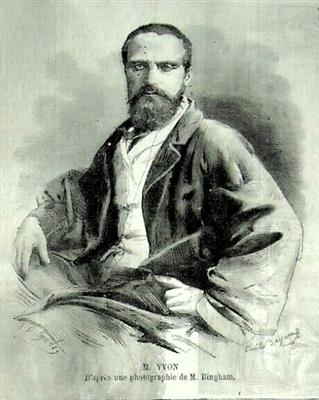
Biography
Born in Eschweiler in 1817[2], he trained under Paul Delaroche, the pre-eminent history painter of the previous generation, before establishing himself as the natural heir to that tradition during the 1850s. His subjects were the Napoleonic campaigns and their aftermath, rendered with careful attention to military costume and action. He was made an officer of the Legion of Honour in 1867[2].
From 1863[2] to 1883 he ran drawing instruction at the École des Beaux-Arts, shaping a generation of younger artists. His students included the American J. Alden Weir, the Portuguese painter Henrique Pousão, and Christian Schussele. In 1867 he published "Method of Drawing," a pedagogical text codifying his academic approach.
Yvon died in Paris in September 1893[2]. His later reputation suffered the fate of most official Second Empire painters: the regime that promoted him passed, and the critical climate shifted away from large-scale celebratory history painting[2]. His best work retains the quality of authentic military documentation, ambitious in scale and specific in detail.
Timeline
- 1817Born in Eschweiler
- 1850Established himself as heir to history painting tradition
- 1855Capture of the Malakoff tower
- 1857Commissioned to paint 'La Prise de la tour de Malakoff'
- 1863Began drawing instruction at the École des Beaux-Arts
- 1867Made an officer of the Legion of Honour
- 1867Published 'Method of Drawing'
- 1883Ended drawing instruction at the École des Beaux-Arts
- 1893Died in Paris
Notable Works
Tap to view larger.
Where to See Adolphe Yvon
1 museum worldwide.
-
 1 works
Musée Magnin
Dijon, France
Next stop
Browse the movements →
Every movement in the collection, from the Renaissance to Pop art.
Related Artists

Frequently Asked Questions
What should I know about Adolphe Yvon's prints?
Prints are categorised according to when they were made. A 'vintage print' means the photograph was printed around the time the negative was taken. A 'period print' means it was made within roughly ten to fifteen years after. If a print's age is unknown, or printed more than fifteen years after the shot, it is termed an 'old print'. A 'modern print' is one printed recently from the original negative. An 'original print' was made by the artist or under their supervision. Finally, a 'facsimile' is a print made by re-photographing a print, or using the original negative, with base and processing as close as possible to the original. In the print market, the unique print is a constant reference. The process of printing is considered a difficult operation that sometimes involves physical or chemical treatments. Some photographers did not print their own photographs; however, they were still considered original once signed. The person who took the shot acknowledges it as being in conformity with their idea by signing it.What style or movement did Adolphe Yvon belong to?
Adolphe Yvon was a French[2] artist who worked firmly within the academic tradition. This system placed history painting[2] as the highest form of artistic endeavour. It also maintained a hierarchy of genres. According to this, the most suitable subject matter included episodes from classical history, mythology, events from national history, military engagements, modern-life subjects, religious subjects, and portraits. The academic system of artistic training reinforced the position of history painting. The Prix de Rome was considered the pinnacle of success for students at the École des Beaux-Arts. Subjects for the competition were taken from classical history, mythology, or the Bible. State commissions for the decoration of public buildings were for historical subjects; either classical subjects with a moral significance or episodes from French history. The establishment of the Musée Historique at Versailles also helped to prolong the history-painting tradition.What techniques or materials did Adolphe Yvon use?
Historical sources suggest several approaches to painting were available to Adolphe Yvon. The mid-19th century saw an expansion in commercially available materials, as colour merchants diversified from selling general pharmacy and grocery items to providing a full range of artist supplies. Artists of the time could choose from a variety of techniques. Some instruction manuals focused on the colouring of photographs, recommending transparent and covering colours made from dry powdered pigments mixed with a medium of albumin, ammonium carbonate, glycerine, liquid ammonia, and water. Other articles mention the use of aniline dyes dissolved in alcohol, or the application of oils, watercolours, and pastels over a preparatory layer of gelatin or shellac. Painters also experimented with older methods, such as encaustic painting, tempera, or early oil techniques. Some artists sought to recapture the perceived secrets of Renaissance masters, though it was recognised that exact duplication was impossible due to differences in available materials.What was Adolphe Yvon known for?
Adolphe Yvon was a French[2] painter, primarily known for his large-scale history paintings, often with military themes. History painting was considered the most important form of artistic endeavour during the 19th century. It covered episodes from classical history, mythology, events from national history, military and naval engagements, modern-life subjects, religious subjects, and portraits showing a heroic aspect of the sitter. Many artists aspired to be history painters because of the prestige and salary attached to it. State commissions for the decoration of public buildings were for historical subjects, either classical subjects with a moral significance or glorious episodes from French history. Artists were sent to follow military campaigns of the period to record events for posterity. One such artist was Horace Vernet, who visited Algeria in 1833[2] to follow the French army.Where can I see Adolphe Yvon's work?
Adolphe Yvon's paintings can be viewed in museums across Europe and North America. In France, his work is held at the Musée des Beaux-Arts in Nantes, and the Musée du Louvre, Musée d’Orsay, Musée des Arts Decoratifs, and Musée du Petit Palais, all in Paris. Other French[2] museums that hold his paintings include the Musée des Beaux-Arts in Nancy, and the Musée des Beaux-Arts in Dijon. Outside of France, Yvon's art can be seen at the Musées Royaux des Beaux-Arts de Belgique in Brussels, the Art Gallery of New South Wales in Sydney, the Los Angeles County Museum of Art, the Metropolitan Museum of Art in New York, the Minneapolis Institute of Arts, and the Virginia Museum of Fine Arts in Richmond.Who did Adolphe Yvon influence?
Adolphe Yvon's artistic influence is not well documented. Some scholars suggest connections between Gustave Courbet and later artists; for example, Paul Cézanne directly quoted Courbet's compositions. Cézanne's Bridge at Maincy (1879[2]-80) invokes Courbet's Shaded Stream (1865). The photograph The Drain (1989) by Jeff Wall has iconographic roots in Courbet, via Cézanne. These artists were making art from art, informed by various pictorial sources. Other artists, such as Jules Adler, trained at the Ecole des Beaux-Arts and debuted at the Salon in 1889. His paintings of urban life have been compared to Zola's novels. Adler maintained the Naturalists' impartiality to subject matter, avoiding social commentary. Aman-Jean considered Adler's art to be 'devoid of symbols' and full of emotion, noting parallels between his work and Zola's L’Assommoir.Who was Adolphe Yvon?
Adolphe Yvon (1817[2]-1878[2]) was a French[2] artist. Daubigny favoured subjects that captured the changing character of waterscapes. His goal involved capturing momentary moods created by specific weather or light. The forms of objects took a subordinate position to this aim. Daubigny hastily applied paint, so forms appear dissolved by light. He abandoned the traditional distinction between sketches and finished paintings. From the late 1840s, the artist also worked on his paintings in the Rhone valley. The pond of Gyliau near Optévoz fascinated him; he even created an oil painting of it as late as 1869. The 1853 version was painstakingly prepared with preliminary studies. Daubigny determined the composition in small pencil sketches and noted the colours for the finished painting. The balanced composition and finely gradated greens render the atmosphere of this undisturbed place on a bright summer day. In the realistic presentation of the waterscape, Daubigny paved the way for the Impressionists.Why are Adolphe Yvon's works important today?
Adolphe Yvon (1817[2]-1893[2]) was a French[2] painter known for his historical and military scenes. He gained recognition during the Second Empire, particularly for large-scale paintings depicting battles and military events. Yvon's works offer insights into the artistic and political climate of 19th-century France. His paintings often reflect the nationalistic sentiments prevalent during that period. He received commissions from the government, which indicates his acceptance within official artistic circles. His style is characterised by realism and attention to detail, fitting within the academic tradition of his time. While not considered an innovator, his paintings provide a record of significant historical moments and the way they were perceived and presented to the public. They offer a view into the values and aesthetics of the period, and they allow us to analyse the relationship between art, power, and national identity in 19th-century France.What was Adolphe Yvon's art style?
Adolphe Yvon's art style involved careful attention to military costume and action. His best work retains the quality of authentic military documentation, ambitious in scale and specific in detail.How did Adolphe Yvon die?
Adolphe Yvon died in 1893[2] at the age of 76.
Sources
Editorial draws on the following primary and tertiary references for Adolphe Yvon.
- [1] museum Musée Magnin Used for: museum holdings.
- [2] wikipedia Wikipedia: Adolphe Yvon Used for: biography, birth dates, death dates, identifiers, movement attribution, nationality.
- [3] book Beard, Lee, 1973- author, Butler, Adam, author; Van Cleave, Claire, author; Fortenberry, Diane, author; Stirling, Susan, author, Beard, Lee, 1973- author, Butler, Adam, author; Van Cleave, Claire, author; Fortenberry, Diane, author; Stirling, Susan, author - The Art Book_ New Edition, Mini Format Used for: biography.
- [4] book Brodskaya Nathalia, Brodskaya Nathalia - Symbolism Used for: biography.
- [5] book Masterpieces of western art : a history of art in 900 individual studies from the Gothic to the present day Used for: biography.
Editorial overseen by Solis Prints. Sources verified 2026-09-16. Click a source for details, or hover over [N] in the page above to preview.
Editorial standardsMethodologyCorrectionsAI disclosureAbout the editorial team