



Adriaen van de Venne
In 1614[4], Adriaen van de Venne[7] completed Fishing for Souls[9], a satirical panorama of the Catholic and Protestant camps positioned on opposite banks of a river, each hauling nets full of converts during the Twelve Years' Truce. The painting carried Flemish Baroque[4] technical ambition in service of religious commentary; it proved popular enough that when French forces reorganised the Netherlands' collections in 1798, Fishing for Souls was transferred specifically to the National Kunst Galerie in The Hague to protect it from dispersal.
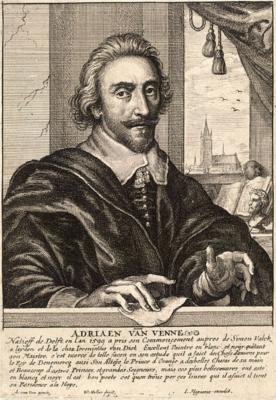
Biography
Born in Delft in 1589[7]","author":null,"year":null,"publisher":null,"type":"wikipedia","url":"https://en.wikipedia.org/wiki/Adriaen_van_de_Venne","used_for":"biography, birth dates, death dates, identifiers, movement attribution, nationality"}">[4], Van de Venne trained under a goldsmith (Simon de Valk) and an engraver (Jeronimus van Diest) before moving to Middelburg in 1614[4], where Jan Brueghel the Elder's example shaped his early work. He relocated to The Hague in 1625, joined the Guild of Saint Luke, and co-founded the Confrerie Pictura to advance the professional standing of artists. He served as the guild's dean in 1637. A long collaboration with the poet Jacob Cats produced book illustrations that circulated widely across the Dutch[4] Republic.
From 1620[4] onward he developed the grisaille technique for which he is now best known: monochrome paintings in grey and brown depicting peasants, beggars, thieves, and fools, accompanied by motto bands (spreukbanden) taken from proverbs and sayings. Anneliese Plokker's 1984 catalogue raisonné of the grisaille series and Mariët Westermann's 1999 essay on what she called the "ironic grisaille" are the main scholarly foundations for understanding this output. The grisailles made him famous during his lifetime and maintained that reputation well into the eighteenth century.
He died in The Hague on 12 November 1662[7]","author":null,"year":null,"publisher":null,"type":"wikipedia","url":"https://en.wikipedia.org/wiki/Adriaen_van_de_Venne","used_for":"biography, birth dates, death dates, identifiers, movement attribution, nationality"}">[4]. As painter, miniaturist, book illustrator, political satirist, and guild administrator, Van de Venne covered more institutional ground than almost any of his Dutch[4] contemporaries.
Timeline
- 1589Born in Delft
- 1614Completed Fishing for Souls
- 1614Moved to Middelburg
- 1620Developed the grisaille technique
- 1625Relocated to The Hague
- 1625Joined the Guild of Saint Luke
- 1637Served as dean of the Guild of Saint Luke
- 1662Died in The Hague
Notable Works
Tap to view larger.
Where to See Adriaen van de Venne
2 museums worldwide.
-
1 works
Nottingham Museums
Nottingham, United Kingdom
-
 1 works
Weston Park
Weston-under-Lizard, United Kingdom
Varies by month; generally Park & Gardens 10:30–18:00 (or 16:00) and Art Gallery 11:00–16:00 daily · £13.00 adults (Park & Gardens)
Next stop
Baroque →
Explore the artists and ideas of Baroque.
Adriaen van de Venne prints
Hand-finished archival prints from Adriaen van de Venne's body of work.
 Altogether too stupid! - Adriaen van de Venne
From £28.00
Altogether too stupid! - Adriaen van de Venne
From £28.00
 Allegory of Poverty - Adriaen van de Venne
From £28.00
Allegory of Poverty - Adriaen van de Venne
From £28.00
 Dance of Death - Adriaen van de Venne
From £28.00
Dance of Death - Adriaen van de Venne
From £28.00
 Moses Striking the Rock - Adriaen van de Venne
From £28.00
Moses Striking the Rock - Adriaen van de Venne
From £28.00
 Allegory depicting the Pacification of Ghent - Adriaen van de Venne
From £28.00
Allegory depicting the Pacification of Ghent - Adriaen van de Venne
From £28.00
 Man with Telescope - Adriaen van de Venne
From £28.00
Man with Telescope - Adriaen van de Venne
From £28.00
Related Artists


Take Adriaen van de Venne home.
See all Adriaen van de Venne prints →Frequently Asked Questions
What is Adriaen van de Venne known for?
Adriaen van de Venne[7] is best known for developing the grisaille technique from 1620[4] onward. His grisailles were monochrome paintings in grey and brown, often depicting peasants, beggars, thieves, and fools accompanied by motto bands taken from proverbs and sayings; these paintings made him famous during his lifetime and maintained that reputation well into the eighteenth century.What is Adriaen van de Venne's most famous work?
It is difficult to name Adriaen van de Venne[7]'s 'most famous work' with certainty. He was a prolific artist who produced paintings, prints, and book illustrations, and he collaborated with other artists such as Peter Paul Rubens and Jan Brueghel the Elder. His individual works include paintings such as *Village with Self-Portrait* and *The Sermon on the Mount*. He also created series of allegories, including *Allegory of the Five Senses*, comprising *Allegory of Fire*, *Allegory of Hearing, Taste, and Touch*, *Allegory of Sight and Smell*, *Allegory of Smell*, *Allegory of Spring*, and *Allegory of Touch*. Van de Venne also contributed to collaborative paintings such as *The Battle of the Amazons* and *Flora and Zephyr*.What should I know about Adriaen van de Venne's prints?
Adriaen van de Venne[7] (1589[4]-1662[4]) was a painter and draughtsman who briefly studied with Simon de Valck, a goldsmith and painter in Leiden. After 1625[4], van de Venne moved to The Hague and produced small-scale monochrome paintings known as *grouwetjes* (little greys). These paintings, admired for their novelty and skill, often included witty sayings. His audience included Constantijn Huygens, Jacob Cats, and Johan de Brune. Van de Venne's prints often depict peasants and the urban poor. Despite the low social class of his subjects, the paintings were exquisitely executed. The grisaille medium allowed van de Venne to display his mastery by eliminating colour variation, which allowed viewers to appreciate the brushwork. In 1626, van de Venne was commissioned by the King and Queen of Bohemia to create an album of watercolours. These showed the royal family playing tennis, ball, and billiards. He also provided illustrations for Gilles Jacobs Quintijn's *De Hollandsche-Lijs, met de Brabandsche-Bely* in 1629, and for Jacob Cats' *Spiegel van den Ouden ende Niewen Tijd* in 1632.What style or movement did Adriaen van de Venne belong to?
Adriaen van de Venne[7] was a Dutch[4] Golden Age painter, active during the Baroque[4] period. Dutch Baroque painting saw specialisation within genres; artists focused on still life, history painting, portraiture, and what was called genre painting: scenes of everyday life. Van de Venne's subject matter included portraits and genre scenes. Common to Baroque art was the use of allegory; this period saw a love of coded statements, which were regarded as evidence of potential significance inherent in all things as bearers of messages. Van de Venne's paintings often contained symbolic or moralising elements, in line with this Baroque characteristic. His skill in conveying an underlying message was typical of Dutch Baroque painting.What techniques or materials did Adriaen van de Venne use?
Unfortunately, the provided texts do not offer specifics about Adriaen van de Venne[7]'s artistic techniques or materials. The passages mention a wide array of artists, artworks, and literary sources related to artistic techniques in general, but they do not focus on Van de Venne himself. Without definitive information, it is difficult to provide a detailed answer. However, one can infer that, as a painter active in the 17th century, Van de Venne likely employed oil paints, a common medium at the time. He may also have created drawings using materials such as charcoal, chalk, and various inks. The preparation of panels as painting supports was a developing specialism during this period. Further research into period painting techniques and the practices of his contemporaries would be needed to offer a more complete picture of his methods.What was Adriaen van de Venne known for?
Adriaen van de Venne[7] (1589[4]-1662[4]) was a painter and draughtsman active in the Dutch[4] Republic. He is known for his small monochrome paintings called "grouwetjes" (little grays). These paintings, often featuring peasants and the urban poor, were admired for their novelty, cleverness, and skill. Van de Venne moved to The Hague in 1625[4], where he catered to a sophisticated audience that included Constantijn Huygens, Jacob Cats, and Johan de Brune. His grisailles, executed almost entirely in monochrome, became his trademark. The lack of colour variation allowed viewers to focus on the brushwork and manual skill evident in each stroke. In 1626, van de Venne received a commission from the King and Queen of Bohemia for an album of watercolours. These depicted the royal family at The Hague enjoying activities such as tennis, ball games, and billiards, capturing a sense of movement. He also provided illustrations for books, such as Gilles Jacobs Quintijn's "De Hollandsche-Lijs, met de Brabandsche-Bely" (1629).When did Adriaen van de Venne live and work?
Adriaen van de Venne[7] was active as an artist during the first half of the 17th century. While precise dates for his birth and death are not provided in the reference texts, other artists active at the same time include Peter Paul Rubens (1577-1640[4]) and Jan van de Velde. Van de Venne's contemporary Claes Jansz Visscher published *Plaisante plaetsen*, a series of landscape designs, around 1612[4]. Jan van de Velde published a series of designs, *Amoenissimae aliquot regiunculae*, in 1615, expanded in 1616. These prints mixed topographically-based scenes with imaginary elements. Van de Velde also made a drawing in Scriverius's *album amicorum*. Rubens commemorated the Twelve Years' Truce between Spain and the United Provinces with *Adoration of the Magi* for the Antwerp town hall in 1609. The truce ended in 1621.Where can I see Adriaen van de Venne's work?
Adriaen van de Venne[7]'s artworks can be found in numerous collections across Europe and North America. In the United Kingdom, his works are held by institutions such as the British Library, the British Museum, the National Gallery, the National Portrait Gallery, Tate, UCL Art Collections (University College), and the Victoria and Albert Museum, all in London; also the National Gallery of Scotland in Edinburgh; and the Walker Art Gallery in Liverpool. Elsewhere in Europe, you can view van de Venne's art in the Staatliche Museen in Berlin; the Herzog Anton Ulrich-Museum in Braunschweig; the Gemäldegalerie Alte Meister in Dresden; the Galleria degli Uffizi in Florence; the Städel Museum in Frankfurt am Main; the Niedersächsisches Landesmuseum in Hanover; the Museo Thyssen-Bornemisza in Madrid; the Staatliche Graphische Sammlung in Munich; the Musée du Louvre in Paris; the Royal Cabinet of Paintings Mauritshuis in The Hague; and the Kunsthistorisches Museum in Vienna. In the United States, notable locations include the Metropolitan Museum of Art in New York; the J. Paul Getty Museum in Los Angeles; and the National Gallery of Art in Washington.Where was Adriaen van de Venne from?
Adriaen van de Venne[7] was from Delft, a city in the province of South Holland, Netherlands. He was born there in 1589[4]. Van de Venne's artistic output included genre paintings, often depicting scenes of daily life. These paintings frequently featured peasants in interior settings. His earlier works often showed poorer households, with a muted palette. Later in his career, his palette became more colourful, and his peasant subjects were often tidier and better behaved. Jan Steen, another artist known for similar subject matter, was one of his pupils. Beyond his genre scenes, van de Venne engaged with historical and political themes relevant to the Dutch[4] Republic. He created works relating to the Batavian revolt against Rome, reflecting a broader interest in the history of the region and its significance for Dutch identity. These depictions aligned with a cultural trend that saw the Batavians, an ancient Germanic tribe, as precursors to the Dutch in their struggle for independence from foreign rule.Who did Adriaen van de Venne influence?
Adriaen van de Venne[7] (1589[4]-1662[4]) was a Dutch[4] Golden Age painter, draughtsman, and versifier. He is associated with grisaille painting, book illustration, and satirical political subjects. Van de Venne's influence is most apparent in the work of his pupils. These included Jan van de Velde the Younger (1593[4]-1641[4]), who became a printmaker, and Antonie Jansz. van der Croos (circa 1606-1662), a painter of townscapes and winter scenes. His style also affected lesser-known artists working in the Netherlands during the period. His impact is particularly noticeable in the development of Dutch genre painting. Van de Venne's paintings of peasants, soldiers, and everyday life prefigured the work of later, more celebrated artists in that field. These included Adriaen Brouwer (1605-1638) and David Teniers the Younger (1610-1690), who further popularised scenes of lower-class life. Van de Venne's influence can also be seen in the work of Pieter van Laer (1599-1642), especially his paintings of Italian peasant life. These artists built upon Van de Venne's foundations, developing their own individual styles, but his early contributions to genre painting are clear.Who influenced Adriaen van de Venne?
Adriaen van de Venne[7] (1589[4]-1662[4]) developed his artistic style through exposure to several artists and movements. He began his career studying with the goldsmith Simon de Valck in Leiden. Subsequently, he apprenticed with the painter Jeronymus van Diest in The Hague. Van Diest was a specialist in seascapes. Later, van de Venne studied with Gillis van den Valckert in Middelburg. Van den Valckert's influence is apparent in van de Venne's early paintings. These display a muted palette and subjects drawn from everyday life. His contact with Flemish art and artists in Middelburg was also important. Artists like Jan Brueghel the Elder, Pieter Bruegel the Elder, and Frans Francken the Younger helped shape his artistic vision. Their influence is visible in van de Venne's crowded compositions and attention to detail. The work of these artists provided van de Venne with a foundation in both style and subject matter. He synthesised these influences into his own distinctive approach to painting and printmaking.Who was Adriaen van de Venne?
Adriaen van de Venne[7] (1589[4]-1662[4]) was a painter and draughtsman. While he was to some extent self-taught, he studied with Simon de Valck, a goldsmith and painter in Leiden. Van de Venne is known for small monochrome paintings called "grouwetjes" (little greys). These paintings, often humorous, were admired by collectors in The Hague for their novelty and skill. The subjects included peasants, the urban poor, and the wealthy classes. These paintings often included the painter's witty sayings. Van de Venne made the tension between stylistic refinement and unrefined subject matter his trademark. He cultivated grisaille painting for a sophisticated audience that included Constantijn Huygens, Jacob Cats, and Johan de Brune. He dedicated himself to this type of art after his move to The Hague in 1625[4], where he catered to the social and political elite. In 1626, he created an album of watercolours commissioned by the King and Queen of Bohemia. These showed the royal family of The Hague playing tennis, ball, and billiards.
Sources
Editorial draws on the following primary and tertiary references for Adriaen van de Venne.
- [1] museum Weston Park Used for: museum holdings.
- [2] museum Royal Pump Rooms Used for: museum holdings.
- [3] museum Cultural Heritage Agency of the Netherlands Art Collection Used for: museum holdings.
- [4] wikipedia Wikipedia: Adriaen van de Venne Used for: biography, birth dates, death dates, identifiers, movement attribution, nationality.
- [5] book DiFuria, ArthurJ.; Levy, Dr. Allison; , Genre Imagery in Early Modern Northern Europe Used for: biography.
- [6] book Atkins, Christopher D. M., The Signature Style of Frans Hals: Painting, Subjectivity, and the Market in Early Modernity Used for: biography.
- [7] museum Adriaen van de Venne Used for: biography.
- [8] museum Adriaen van de Venne (The J. Paul Getty Museum Collection) Used for: museum holdings.
- [9] museum Fishing for Souls Used for: notable works.
- [10] museum To Each His Own Pastime (Elck Sijn Tijt-Verdrijff) Used for: notable works.
Editorial overseen by Solis Prints. Sources verified 2026-08-29. Click a source for details, or hover over [N] in the page above to preview.
Editorial standardsMethodologyCorrectionsAI disclosureAbout the editorial team