

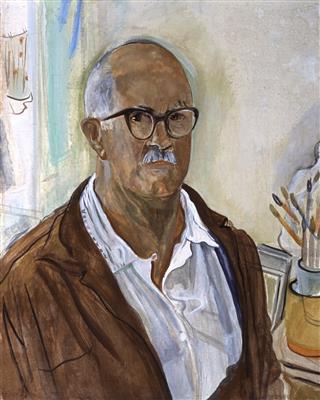
Alberto da Veiga Guignard
In 1944[1] the future President of Brazil, Juscelino Kubitschek, invited Guignard to Belo Horizonte to establish a drawing and painting programme. The school he created eventually became the Guignard University of Art of Minas Gerais, and its alumni included Ibere Camargo, who went on to become one of Brazil's most celebrated painters. That teaching legacy is the most direct mark Guignard left on Brazilian[1] art history, though his landscapes of Minas Gerais remain among the most recognisable images in the national tradition.
Biography
Born in 1896[1] in Nova Friburgo in the state of Rio de Janeiro, Guignard moved to Europe in childhood when his mother remarried, becoming the stepson of Baron Louis von Schilgen. He studied for more than two decades at the Academy of Fine Arts in Munich under Herman Groeber and Adolf Engeler, making visits to Florence before returning to Brazil in 1929[1]. The European classical training is legible in his work but never overwhelms it: the light and landscape of Minas Gerais absorbed him completely.
He came to wider attention when he participated in the 'Salao Revolucionario' of 1931[1] at the Escola Nacional de Belas Artes in Rio de Janeiro, the first annual exhibition to admit modernist work. A retrospective followed at the Museu de Arte Moderna do Rio in 1953. His standing in the Brazilian[1] art market was confirmed posthumously when his painting Vaso de Flores sold in August 2015 for R$5.7 million, a record for a Brazilian work at auction.
Guignard died in Belo Horizonte in 1962[1] and was buried in the Church of Sao Francisco de Assis in Ouro Preto, the colonial Minas Gerais city that had provided much of his subject matter.
Timeline
- 1896Born in Nova Friburgo, Rio de Janeiro, Brazil
- 1900Moved to Europe, became stepson of Baron Louis von Schilgen
- 1920Studied at the Academy of Fine Arts in Munich
- 1929Returned to Brazil
- 1931Participated in 'Salao Revolucionario' in Rio de Janeiro
- 1944Invited to Belo Horizonte to establish a drawing and painting programme
- 1953Retrospective at the Museu de Arte Moderna do Rio
- 1962Died in Belo Horizonte, Brazil
Notable Works
Tap to view larger.
Next stop
Browse the movements →
Every movement in the collection, from the Renaissance to Pop art.
Related Artists


Frequently Asked Questions
What is Alberto da Veiga Guignard known for?
Alberto da Veiga Guignard is known for his landscapes of Minas Gerais. These paintings are some of the most recognisable images in the Brazilian[1] national tradition; he is also known for establishing a drawing and painting programme that became the Guignard University of Art of Minas Gerais.What is Alberto da Veiga Guignard's most famous work?
It is difficult to identify Alberto da Veiga Guignard's single most famous work, but a survey of his output reveals recurring themes and favoured subjects. He is well known for his paintings of the Minas Gerais region in Brazil, often depicting the area's distinctive mountains and colonial architecture. Guignard also produced many portraits, including those of prominent Brazilian[1] figures. His work frequently incorporates elements of both realism and abstraction, and he is recognised for his distinctive use of colour and light. While no single piece eclipses all others in fame, his body of work has secured his place as a significant figure in Brazilian art history. Identifying a single "most famous" piece remains a challenge, as different works resonate with different audiences and critics.What should I know about Alberto da Veiga Guignard's prints?
When considering prints, bear in mind that the term can refer to several different things. 'Original prints' are produced by hand, with the artist creating the artwork directly on a plate, woodblock, stone, or screen. These include woodcuts, engravings, linocuts, mezzotints, etchings, lithographs, and serigraphs. Since the plates are made by hand, they can only withstand a certain amount of use; the number of prints is limited by the number of impressions that can be made before the plate wears out. Some publishers limit the number of impressions to increase a print’s value. Quantities may be set as high as 700 to 1,000 impressions, but some prints are limited to 250 to 500. By contrast, offset reproductions (also known as posters and image prints) are reproduced by photochemical means. There are no physical limits on the number of these that can be made. Giclée prints are inkjet fine art prints, while canvas transfers involve transferring the image onto canvas, giving the work the appearance of a painting.What style or movement did Alberto da Veiga Guignard belong to?
Alberto da Veiga Guignard's artistic affiliations are complex, defying easy categorisation. While he engaged with various modernist trends, he remained largely independent of formal movements. Some classify him within Expressionism, due to his emotional intensity and subjective approach. Others see elements of Impressionism in his work, particularly his use of colour and light. Certain pieces show a connection to Art Informel, because of their improvisational nature and abandonment of traditional forms. Despite these associations, Guignard developed a personal style that blended aspects of different tendencies. His work often depicted Brazilian[1] subjects, such as the Minas Gerais region, with a distinctive, dreamlike quality. Ultimately, Guignard resisted being pigeonholed, prioritising individual expression over adherence to any specific movement.What techniques or materials did Alberto da Veiga Guignard use?
Information regarding Alberto da Veiga Guignard's specific techniques and materials is not available in the reference passages. However, the passages do discuss artistic techniques and materials in general. Pigment analysis combines optical microscopy, microchemical tests, and emission spectroanalysis. Media are determined through thin-layer chromatography, infrared spectroscopy, and microchemical tests. Paint application can involve multiple layers. An imprimatura, often containing lead white, may be applied as an underpaint. The paint structure is often multilayered, with colours built from light to dark. Each colour area is blocked in using a light tone of the final colour. Glazes, sometimes containing heat pre-polymerised linseed oil and mastic resin, are used. Artists often make alterations during the painting process, painting over changes. They may keep figure studies and sketches for motifs. The interface between medium, technique, and the artist's aesthetic decisions is essential to understanding art history.What was Alberto da Veiga Guignard known for?
Alberto da Veiga Guignard (1896[1]-1962[1]) was a Brazilian[1] painter associated with Expressionism. He is known for his individual style and his contributions to Brazilian modern art. Guignard's early artistic training occurred in Europe. He studied at the Akademie der Bildenden Künste in Munich during the 1920s. This experience exposed him to European artistic movements, which influenced his later work. Upon his return to Brazil, Guignard became an important figure in the art scene. He taught painting and drawing, passing on his knowledge to a new generation of artists. His teaching positions included the Escola de Belas Artes in Rio de Janeiro. He also founded his own art school, which further solidified his role as an educator. Guignard's paintings often depict Brazilian subjects. These include depictions of the Minas Gerais region and portraits. His work is characterised by its expressive brushwork and use of colour. He developed a distinctive artistic identity, setting him apart from his contemporaries.When did Alberto da Veiga Guignard live and work?
Alberto da Veiga Guignard (1896[1]-1962[1]) was a Brazilian[1] artist, born in Nova Friburgo, Rio de Janeiro. His artistic career spanned much of the 20th century, during which time he became known for his contributions to Brazilian modernism. Guignard's early life was marked by travels and studies in Europe. He received formal artistic training at the Akademie der Bildenden Künste in Munich, Germany, during the 1920s. This European experience had a considerable effect on his artistic style, blending European techniques with Brazilian themes. Upon his return to Brazil, Guignard became an influential figure in the Brazilian art scene. He taught painting and drawing, passing on his knowledge to a generation of Brazilian artists. He founded his own art school, which further solidified his position as a leading art educator. His work often depicted Brazilian subjects, such as mountain ranges and colonial-era architecture. Guignard's paintings are characterised by a dreamlike quality, often using muted colours and expressive brushwork.Where can I see Alberto da Veiga Guignard's work?
Alberto da Veiga Guignard (1896[1]-1962[1]) has a museum dedicated to his work in Brazil. The Museu Guignard is located in Ouro Preto, Minas Gerais. It holds a collection of his paintings and drawings. Other Brazilian[1] museums also hold examples. These include the Museu Nacional de Belas Artes, in Rio de Janeiro. The Museu de Arte de São Paulo (MASP) also has paintings by Guignard. These institutions offer opportunities to view his artistic output. Smaller galleries and regional museums within Brazil may also feature his work. Auction catalogues are another source. These provide records of works appearing on the market. Catalogues sometimes include images and provenance information. Guignard's work is not commonly found in collections outside Brazil. Therefore, travel to Brazil is usually necessary to view his paintings in person.Where was Alberto da Veiga Guignard from?
Alberto da Veiga Guignard was Brazilian[1]. Although some sources mention his European connections, he is primarily associated with Brazilian art. Guignard was born in 1896[1] in Mariana, a historical city in the state of Minas Gerais, Brazil. He spent part of his early life in Europe, studying art in Italy and Germany during the 1920s. This European training exposed him to expressionism and other modern movements, which influenced his style. However, Guignard returned to Brazil and became a significant figure in Brazilian art. He is known for his paintings of Brazilian subjects, including depictions of the country's distinctive atmosphere and its people. He taught for many years at the Escola de Belas Artes (School of Fine Arts) in Rio de Janeiro and influenced generations of Brazilian artists. He died in 1962[1] in Belo Horizonte, Brazil.Who did Alberto da Veiga Guignard influence?
Alberto da Veiga Guignard (1896[1]-1962[1]) taught and mentored many artists during his career, particularly during his time as a professor. He is known for his impact on generations of Brazilian[1] artists. Among his students were painters such as Vera Mindlin (1928[1]-2020[1]), who studied with him in the 1940s. She is known for her work in abstract art. Another student was Sheila Brannigan, who developed a distinctive style influenced by Guignard's teachings. Guignard's influence extended beyond his direct students. His approach to colour and composition had a broader effect on Brazilian art. His emphasis on emotion and subjective expression encouraged artists to explore personal styles. He promoted a move away from strict academic traditions.Who influenced Alberto da Veiga Guignard?
Alberto da Veiga Guignard (1896[1]-1962[1]) was born in Brazil but spent much of his early life in Europe. He studied at the Akademie der Bildenden Künste in Munich, Germany, during the 1920s. There, he was a student of Hermann Groeber. Groeber was a German painter associated with the Munich School. He emphasised traditional academic techniques. Guignard was also exposed to the work of Expressionist artists while in Germany. This exposure had an impact on his developing style. After returning to Brazil in the 1930s, Guignard taught art. He became an important figure in Brazilian[1] modernism. His work blended European influences with Brazilian themes. His students included many artists who went on to become significant figures in Brazilian art. He is known for his unique approach to colour and his expressive depictions of the Brazilian countryside.Who was Alberto da Veiga Guignard?
Alberto da Veiga Guignard (1896[1]-1962[1]) was a Brazilian[1] painter. He is known for his contributions to Brazilian modernism. Guignard was born in Nova Friburgo. He studied art in Europe, including at the Akademie der Bildenden Künste in Munich. His early work shows the influence of German Expressionism. After returning to Brazil, he developed a style that blended European techniques with Brazilian themes. He taught painting for many years. He founded an art school in Belo Horizonte. His students included many important Brazilian artists. Guignard's art often depicted the Brazilian countryside. He painted mountains, forests, and colonial towns. His work often has a dreamlike quality. He is considered an important figure in 20th-century Brazilian art. His paintings are held in major Brazilian collections.
Sources
Editorial draws on the following primary and tertiary references for Alberto da Veiga Guignard.
- [1] wikipedia Wikipedia: Alberto da Veiga Guignard Used for: biography, birth dates, death dates, identifiers, movement attribution, nationality.
- [2] book guggenheim-futurismmodernfo00solo Used for: biography.
- [3] book guggenheim-guhe00solo Used for: biography.
- [4] book Leonor de Oliveira;, Portuguese Artists in London Used for: biography.
Editorial overseen by Solis Prints. Sources verified 2026-09-22. Click a source for details, or hover over [N] in the page above to preview.
Editorial standardsMethodologyCorrectionsAI disclosureAbout the editorial team