

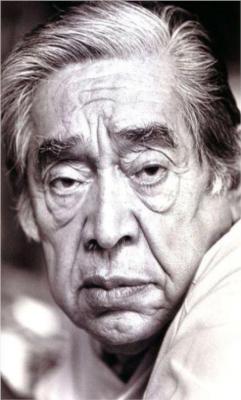
Aldemir Martins
A self-taught painter from the semi-arid interior of Ceará, Aldemir Martins built a career by insisting on the imagery of the Brazilian northeast at a time when the São Paulo art world was absorbed with European abstraction. His subjects came from the landscape he grew up in: the cactus, the fish, the birds, the cattle and the cangaceiro outlaws who have haunted the region's folklore for centuries.
Biography
Martins was born in Ceará in 1922[1] and eventually settled in São Paulo, where he developed a figurative style with the economy and directness of a woodcut. The Museum of Modern Art in New York acquired his 1957[1] painting 'Bird', a work that demonstrated how his images could read both as Brazilian specificity and as something more universal in their reduction to form and line. He received the Prêmio Jabuti in 1959, one of Brazil's most respected literary and arts awards.
His cats, perhaps his most recognisable motif, recur across decades of work with the same loosely drawn authority: animals caught in a state of alert ease, rendered with minimal marks on a plain ground. The work owes something to Japanese prints and something to the popular woodblock imagery of the Northeast, but the synthesis is entirely his own.
He died in São Paulo in February 2006[1] at the age of 83, having spent more than sixty years making art that drew its energy from the place he started.
Timeline
- 1922Born in Ceará, Brazil
- 1957Painting 'Bird' acquired by the Museum of Modern Art in New York
- 1959Received the Prêmio Jabuti award
- 2006Died in São Paulo, Brazil
Notable Works
Tap to view larger.
Next stop
Browse the movements →
Every movement in the collection, from the Renaissance to Pop art.
Frequently Asked Questions
What is Aldemir Martins known for?
Aldemir Martins is perhaps best known for his recurring cat motif, which appears across decades of his work. These animals are rendered with minimal marks on a plain ground, caught in a state of alert ease.What is Aldemir Martins's most famous work?
It is difficult to name one single work as Aldemir Martins's most famous. He was a prolific Brazilian artist, best known for paintings and illustrations that celebrated the culture and people of his home country. Martins's art often depicted everyday life in Brazil, with a focus on its people, animals, and the natural world. His paintings frequently feature cats, roosters, and other animals rendered in bold colours and simplified forms. These images evoke a sense of joy and playfulness. Martins also created portraits of notable Brazilian figures and scenes of Brazilian life, such as football matches and carnival celebrations. These works captured the energy and spirit of the nation. His work is held in numerous public and private collections.What should I know about Aldemir Martins's prints?
Aldemir Martins (1922[1]-2006[1]) was a Brazilian artist known for paintings, drawings, and prints. Born in Ingazeiras, Ceará, he spent much of his career in São Paulo. Martins's prints often feature simplified forms and bold lines. His subjects include Brazilian people, culture, and animals. Cats, roosters, and images of the Northeast region of Brazil are common. Martins developed a personal style that combined elements of modernism with popular themes. Martins began his artistic career as an autodidact. He gained recognition in the 1940s. During this period, he participated in the Família Artística Paulista group. He also exhibited at the first São Paulo Biennial in 1951[1]. His work gained both national and international attention throughout his career. Prints by Aldemir Martins offer accessible examples of his distinctive artistic vision. They reflect his interest in portraying the essence of Brazilian life.What style or movement did Aldemir Martins belong to?
Aldemir Martins's artistic style defies easy categorisation. While his work contains elements of modernism, particularly in its simplification of form and bold use of colour, it is not strictly aligned with any single movement. Martins's art often depicts Brazilian subjects, such as cats, roosters, and scenes from everyday life. These depictions often incorporate a sense of humour and a celebration of Brazilian culture. His style is characterised by strong lines, flat planes of colour, and a decorative quality. Some classify his work as part of the broader Neo-Figurative trend, which emerged in the latter half of the 20th century as a reaction against abstract art. Neo-Figuration sought to reintroduce recognisable imagery into painting, often with an expressive or distorted quality. Ultimately, Martins developed a personal and recognisable style that blended modern artistic principles with Brazilian themes. His unique approach resists simple classification within established art historical movements.Where can I see Aldemir Martins's work?
To view works by Aldemir Martins, you might begin by consulting the collections of major museums. Several institutions hold collections of modern art that could include his pieces. These include the Metropolitan Museum of Art in New York, the Los Angeles County Museum of Art (LACMA), and the Minneapolis Institute of Arts. You could also check the Museum of Modern Art in New York. Outside the United States, consider the Royal Ontario Museum in Toronto, or the National Museums of Scotland in Edinburgh. In London, the Victoria & Albert Museum and the Geffrye Museum may also hold relevant works. Checking the online collections or contacting the museum directly is advisable to confirm the presence and availability of Martins's work for viewing.Who influenced Aldemir Martins?
Aldemir Martins was exposed to a range of influences. Hans Hofmann taught the fundamentals of post-war abstraction, particularly non-figurative forms and colour use. Hofmann encouraged students to develop sophisticated relationships between these elements. Anni Albers, who Martins may have encountered through Bauhaus connections, combined weaving with modern art concepts. She studied with Paul Klee at the Bauhaus from 1922[1]. Klee aimed to create his own style free from preconceptions, blending figurative and abstract elements. Martins also engaged with the work of the New York School, including Arshile Gorky, whose 1951[1] Whitney exhibition impressed him. He also saw work by Jackson Pollock, as well as pieces by Adolph Gottlieb, Theodoros Stamos, Ad Reinhardt, and William Baziotes. Later, Martins was intrigued by the work of Morris Louis and Kenneth Noland.Who was Aldemir Martins?
Aldemir Martins (1922[1]-2006[1]) was a Brazilian artist known for his modernist paintings, drawings, and prints. Born in Ingazeiras, Ceará, he moved to Fortaleza as a child, where he began his artistic training. Martins's work often depicted themes related to Brazilian culture, such as cats, roosters, and scenes of daily life. He developed a distinctive style characterised by bold lines, simplified forms, and a limited colour palette. His images often have a strong graphic quality. In 1941[1], Martins joined the artists' association Sociedade Cearense de Belas Artes. He later moved to Rio de Janeiro in the mid-1940s, where he gained wider recognition. His art was exhibited in Brazil and internationally, including at the Venice Biennale. Martins received several awards throughout his career, solidifying his position as a significant figure in Brazilian modern art. He worked as a designer for magazines and produced illustrations for books, further popularising his style.Why are Aldemir Martins's works important today?
Aldemir Martins (1922[1]-2006[1]) was a Brazilian artist known for his distinctive style, often associated with Brazilian modernism. He worked in painting, drawing, printmaking, and sculpture, producing a varied body of work. Martins's art frequently depicts themes related to Brazilian culture, such as its people, animals, and daily life. His images of cats, for example, are particularly recognisable. His style often incorporates bold lines, simplified forms, and a strong sense of colour. These elements combine to create works that are both accessible and stylistically unique. Although the available passages do not directly address Martins's importance, his art offers a window into Brazilian identity. His works are appreciated for their aesthetic qualities, and for their cultural commentary. His art remains relevant as an example of Brazilian modernism, and for its accessible and engaging style.What was Aldemir Martins's art style?
Martins developed a figurative style with the economy and directness of a woodcut. His style owes something to Japanese prints and something to the popular woodblock imagery of the Northeast, but the synthesis is entirely his own.How did Aldemir Martins die?
Aldemir Martins died in 2006[1] at the age of 84.
Sources
Editorial draws on the following primary and tertiary references for Aldemir Martins.
- [1] wikipedia Wikipedia: Aldemir Martins Used for: biography, birth dates, death dates, identifiers, movement attribution, nationality.
- [2] book guggenheim-guggenheimintern1964allo Used for: biography.
- [3] book guggenheim-guhe00solo Used for: biography.
- [4] book Masterpieces of western art : a history of art in 900 individual studies from the Gothic to the present day Used for: biography.
Editorial overseen by Solis Prints. Sources verified 2026-10-15. Click a source for details, or hover over [N] in the page above to preview.
Editorial standardsMethodologyCorrectionsAI disclosureAbout the editorial team