



Alevtyna Kakhidze
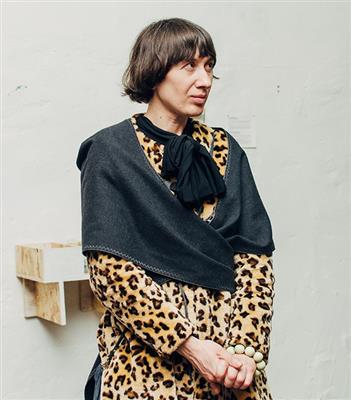
Growing up in Zhdanivka, Donetsk Oblast, Alevtyna Kakhidze has spent her career drawing the places most of her contemporaries preferred not to look at. After Russia-backed separatists seized parts of Donbas in 2014, she continued working in the region, producing diary-drawings from its towns that critics described as making the conflict zone human rather than merely legible.
Biography
Kakhidze studied at the National Academy of Visual Arts and Architecture in Kyiv and spent two years at the Jan van Eyck Academie in Maastricht (2004-2006[1]). She has been based in Muzychi, a village near Kyiv, since 1995. Her practice crosses performance, drawing, time-based media, and collaborative projects; recurring subjects include consumerism, plant culture, feminism, and the particular textures of life in conflict zones.
The international programme came quickly. She participated in the 7th Berlin Biennale, Manifesta 10 and Manifesta 14, and contributed to the Moroccan Pavilion at the 54th Venice Biennale. In 2008 she received the Kazimir Malevich Prize from the Polish Institute in Kyiv. Her works are held by Tate Modern, the Museum of Contemporary Art Antwerp (M HKA), Kunstmuseum Liechtenstein, and the National Art Museum of Ukraine.
Since 2018 she has served as UN Tolerance Envoy in Ukraine. In December 2025 the Ministry of Culture appointed her director of the Taras Shevchenko State Art School in Kyiv.
Timeline
- 1973Born in Zhdanivka, Donetsk Oblast
- 1995Based in Muzychi, a village near Kyiv
- 2004Studied at the Jan van Eyck Academie in Maastricht
- 2006Finished studies at Jan van Eyck Academie
- 2008Received the Kazimir Malevich Prize
- 2014Continued working in Donbas after conflict began
- 2018Served as UN Tolerance Envoy in Ukraine
- 2025Appointed director of Taras Shevchenko State Art School
Notable Works
Tap to view larger.
Next stop
Browse the movements →
Every movement in the collection, from the Renaissance to Pop art.
Frequently Asked Questions
What is Alevtyna Kakhidze known for?
Alevtyna Kakhidze is known for drawing places that others avoid, particularly conflict zones in Donbas. Critics have described her diary-drawings as making the conflict zone human rather than merely legible.What is Alevtyna Kakhidze's most famous work?
Without specific reference to Alevtyna Kakhidze's body of work, it is difficult to name her single most famous piece. Examining exhibition catalogues and collections databases may offer some insight. For example, the National Art Museum of Ukraine in Kiev holds Alexandra Exter's 1912 oil on canvas, *The Bridge (Sevres)*. The Museum Ludwig in Cologne possesses her *Composition (Genoa)*, dating from 1912-1914[1]. Exter's *City* (1913) is held at the Regional Picture Gallery in Vologda. The Museo Thyssen-Bornemisza in Madrid has her collage and oil on canvas *Still Life*, circa 1913. Finally, the Rostov Kremlin State Museum Preserve owns her 1914 oil on canvas, *Still Life. Bowl of Cherries*. Reviewing Kakhidze's exhibition history and museum holdings might reveal her most well-known work.What should I know about Alevtyna Kakhidze's prints?
When considering Alevtyna Kakhidze's prints, bear in mind some basic facts about fine-art printmaking. The numbering of prints is a recent convention; early prints were often unsigned. The artist's signature testifies to the authenticity of a print and their approval of a particular proof. Original prints are often sold in limited editions, commanding higher prices than posters, which are not numbered. The number of prints is limited by the number of impressions that can be made before the plate wears out. Some publishers impose their own limits to increase a print’s value; these may be set as high as 700 to 1,000 impressions, but some prints are limited to 250 to 500. The edition claim is written as a pair of numbers on the left bottom margin of the print; it consists of a print number and an edition number written as a group with a short separating line between them. The print number is written above or to the left, and the edition size is written below or to the right. The title of the print is written in the middle of the bottom margin of the print. The signature is on the right of the bottom margin. Edition descriptions are always signed in pencil.What style or movement did Alevtyna Kakhidze belong to?
It is difficult to assign Alevtyna Kakhidze to a single movement. Her work engages with several ideas associated with the early twentieth-century avant-garde, particularly relating to dynamism and rhythm. Some have linked Kakhidze's aesthetic ideas to Italian Futurism, noting shared interests in conveying movement and inner force. Like the Futurists, she explored rhythm as a primary component of motion. However, she was less interested in technology and the speeding vehicle, a common Futurist subject. Others have noted the importance of architectonic constructions, volumetric forms, and the use of light and colour to create dynamic stage environments. These techniques aimed to allow the inner rhythm of a drama to manifest itself through movement onstage. The goal was to move away from static painted sets and create a harmonious, plastic whole with freely moving figures.What techniques or materials did Alevtyna Kakhidze use?
Without specific details about Alevtyna Kakhidze's methods, we can discuss some general art techniques and materials. Artists use varied materials, from traditional options like wood, marble, bronze, and paint to more modern choices such as cardboard, plastic, and household items. With paint, artists may use fresco, egg tempera, watercolour, oils, acrylics, and mixed media. Each has unique properties; for example, oils can be applied thickly as impasto or thinly as glazes. Brushwork also varies, from fine and disguised to thick applications with a palette knife or stencilling. Sculptors may carve, model, cast, or assemble works. Carving is a subtractive process, while modelling is additive. Assemblage uses found objects. Techniques encompass the methods used in the creative process. Pencil techniques include hatching (parallel strokes), crosshatching (layered strokes at angles), shading, gradating (varying pressure), blending (smoothing lines), and creating texture (uneven strokes). These methods allow artists to create a range of effects, defining shapes and adding value to represent light and shadow.Where can I see Alevtyna Kakhidze's work?
Alevtyna Kakhidze is a contemporary Ukrainian artist. Her work has been exhibited in Ukraine and internationally. While it is difficult to provide a comprehensive list of galleries and museums that have presented her art, here are some places where related artists' work can be viewed. Works by Ivan Kliun are held at the State Tret'iakov Gallery (Moscow), the Museum Ludwig (Cologne), the Astrakhan Kustodiev Picture Gallery, the State Art Museum (Iaroslavl'), and the Regional Art Museum (Kirov). Gustav Klutsis's pieces are at the State Tret'iakov Gallery (Moscow), the State Art Museum of Latvia (Riga), the Museum für Gestaltung (Basel), and the Lenin Library (Moscow). Liubov' Popova's art can be seen at the State Tret'iakov Gallery (Moscow), the State Russian Museum (St Petersburg), the State Lunacharskii Museum of Fine Arts (Krasnodar), the State Surikov Art Museum (Krasnoiarsk), and the Irkutsk Regional Art Museum.Where was Alevtyna Kakhidze from?
Alevtyna Kakhidze is from Ukraine. More specifically, she appears to be associated with the city of Kyiv. Kyiv, also known as Kiev, was a significant centre for avant-garde artistic movements in the early 20th century. Artists and intellectuals in Kyiv engaged with trends such as Neo-Primitivism and Cubism. Alexandra Exter, for example, helped organise avant-garde exhibitions in Kyiv, such as The Link (1908) and The Ring (1914). These exhibitions exposed the Ukrainian public to new developments in French, German, Russian, and Ukrainian art. The city remained an important motif in her paintings; and in her conversations and correspondence as an émigré toward the end of her life, she continued to evoke the memory of the city of her youth.Who did Alevtyna Kakhidze influence?
It is difficult to identify specific individuals who Alevtyna Kakhidze has directly influenced, as her impact is more broadly felt within contemporary Ukrainian art and performance circles. Her work often engages with political and social issues, and this has had an effect on younger artists who are also working with similar themes. Kakhidze's practice, which includes performance, drawing, and installation, has opened up spaces for dialogue and critical engagement. Her focus on everyday life, combined with her sharp observations on political realities, provides a model for artists interested in socially engaged art. This approach encourages a move away from more traditional forms and subjects. While not a formal teacher, Kakhidze's participation in workshops, exhibitions, and public discussions means that she functions as an important figure for emerging artists. Her work provides a viewpoint on how art can be used to explore personal experiences and broader social concerns.What was Alevtyna Kakhidze's art style?
Alevtyna Kakhidze's practice crosses performance, drawing, time-based media, and collaborative projects. Her recurring subjects include consumerism, plant culture, feminism, and the textures of life in conflict zones.When was Alevtyna Kakhidze born?
Alevtyna Kakhidze was born in 1973[1].
Sources
Editorial draws on the following primary and tertiary references for Alevtyna Kakhidze.
- [1] wikipedia Wikipedia: Alevtyna Kakhidze Used for: biography, birth dates, death dates, identifiers, movement attribution, nationality.
- [2] book Artmarketissue66january2022 Used for: biography.
- [3] book guggenheim-amazonsofavantga00exte Used for: biography.
- [4] book Yevgenia Petrova (editor), Origins of the Russian avant-garde_ celebrating the 300th anniversary of St. Petersburg_ the Walters Art Museum, Baltimore (13 February-25 May 2003), Fine Arts Museums of San Francisco (29 June-21 September 2003) Used for: biography.
Editorial overseen by Solis Prints. Sources verified 2026-10-16. Click a source for details, or hover over [N] in the page above to preview.
Editorial standardsMethodologyCorrectionsAI disclosureAbout the editorial team