



Alexey Bogolyubov
When Bogolyubov opened the Radishchev Art Museum in Saratov in 1885[1], it became accessible to the public seven years before the Tretyakov Gallery and fifteen years before the Russian Museum. That act of civic generosity summarised much of his working life: a painter who accumulated institutional standing and personal wealth and devoted both to the advancement of Russian art.
Biography
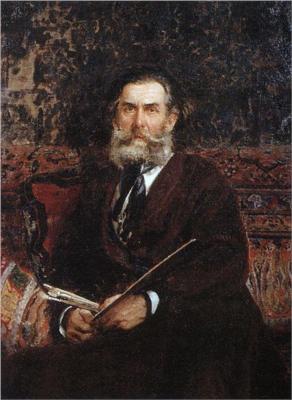
Born in 1824[1] in Novgorod Governorate, he was the grandson of the philosopher Alexander Radishchev. He served in the Imperial Russian Navy before enrolling at the St Petersburg Academy of Arts in 1849[1], where he studied under Maxim Vorobiev. He completed his Academy training in 1853 with a major Gold Medal, then spent seven years travelling Europe, studying under Andreas Achenbach in Düsseldorf and absorbing the influence of the Barbizon painters Camille Corot and Charles-François Daubigny. The formative trip made him one of the most cosmopolitan Russian painters of his generation.
Appointed official Navy artist on his return to Russia in 1860[1], he later joined the Peredvizhniki movement despite being considerably older than most of its members. His travels along the Volga in the 1860s shifted his approach from Romantic convention toward a harder realism, and his seascapes and river landscapes became his signature. He spent his later years in Paris, where he died in 1896[1]. His bequest of 200,000 rubles to establish a painting school in Saratov proved his most enduring legacy: the school subsequently trained Victor Borisov-Musatov and Pavel Kuznetsov.
Timeline
- 1824Born in Novgorod Governorate
- 1849Enrolled at the St Petersburg Academy of Arts
- 1853Completed Academy training with a major Gold Medal
- 1860Appointed official Navy artist
- 1860Studied under Andreas Achenbach in Düsseldorf
- 1860Absorbed influence of Barbizon painters
- 1860Travels along the Volga shifted his approach
- 1885Opened the Radishchev Art Museum in Saratov
- 1896Died in Paris
Notable Works
Tap to view larger.
Next stop
Browse the movements →
Every movement in the collection, from the Renaissance to Pop art.
Frequently Asked Questions
What is Alexey Bogolyubov known for?
Alexey Bogolyubov is known for his seascapes and river paintings. He is also known for opening the Radishchev Art Museum in Saratov and for leaving a bequest to establish a painting school there.What is Alexey Bogolyubov's most famous work?
It is difficult to name Alexey Bogolyubov's single most famous work. He produced a varied output across several genres, and little in the way of critical assessment is available in English. He created paintings embodying "Dobuzhinsky’s Saint Petersburg", such as *A Corner in Saint Petersburg* (1904), *A House in Saint Petersburg* (1905), and *Winter* (1909). He also produced views of Russian provincial towns, plus European cities such as *A Bridge in London* (1908) and *Naples* (1911). Between 1907 and 1911, Bogolyubov created paintings devoted to historical subjects; for example, *The Provinces in the 1830s*, *Training of New Recruits*, and *A Military Settlement*. From 1910, he drew dozens of portraits, including Konstantin Stanislavsky, Tamara Karsavina, and Alexander Benois. In 1918, he created 48 sketches for the decoration of the Admiralty during the celebration of the first anniversary of the October Revolution.What style or movement did Alexey Bogolyubov belong to?
Alexey Bogolyubov (1824[1]-1896[1]) was a Russian painter primarily associated with marine art. He is often linked to the Russian realist movement, although his style also shows some influence from Romanticism. Bogolyubov studied at the Academy of Arts in St Petersburg, where he was later a professor. He travelled extensively in Europe, particularly France and Italy, and was exposed to different artistic styles. This broadened his artistic outlook. His work often depicted naval battles, seascapes, and Russian rivers. He aimed for accurate representation, a characteristic of the realist approach. However, his paintings also possess a sense of drama and atmosphere, reminiscent of Romanticism. He moved between depicting the specific details of a scene and conveying a broader emotional response to nature. Bogolyubov's position is therefore complex. He is not easily categorised within a single movement, as his art incorporates elements of both realism and Romanticism.What was Alexey Bogolyubov known for?
Information on Alexey Bogolyubov is absent from the reference passages. The passages discuss Alexander Bogdanov, a theorist involved with Proletkult (Proletarian Culture) in Russia. Bogdanov was active in politics until 1921, when he returned to medicine. In 1926, he became director of the Institute of Blood Transfusion in Moscow. He died there in 1928 while conducting an experiment on himself. Bogdanov proposed that art could alter concrete reality. He argued that art from the past had little value for the new proletarian order. He believed the working class should be educated in the cultural spirit of the ruling classes. He felt proletarian critics should transfer the artistic legacy, and organisations dedicated to new art and criticism should educate workers in the Socialist ideal.Where can I see Alexey Bogolyubov's work?
Alexey Bogolyubov's work can be found in numerous museum collections. These include the State Russian Museum in St. Petersburg, the State Tretyakov Gallery in Moscow, and the Muzeum Sztuki in Łódź, Poland. Other locations include the State Art Museum of Latvia in Riga, the State Art Museum in Nizhnii Novgorod, and the State Radishchev Art Museum in Saratov. Smaller regional museums also hold his art. Examples are the Regional Art Museum in Kirov, the Primor'e Regional Picture Gallery in Vladivostok, and the Astrakhan Kustodiev Picture Gallery. These museums sometimes acquired works from the State Museum Fund. Museums in the Vyatka gubernia (now Kirov Oblast) obtained avant-garde pieces through the Museum Bureau. The Samara Regional Art Museum also has a collection, partly preserved by staff who resisted liquidating 'low-value, non-artistic works'.Where was Alexey Bogolyubov from?
Information regarding the birthplace of Alexey Bogolyubov has not been included in the provided documents. However, the available texts contain details of several other artists with Russian connections. Alexei Alexeevich Morgunov was born in Moscow in 1884[1] and died there in 1935. Liubov Sergeevna Popova was born near Moscow in 1889 and died there in 1924. Alexei Vasilievich Babichev was also born in Moscow, in 1887; he died there in 1963. Varvara Dmitrievna Bubnova was born in St Petersburg in 1886. Ilia Grigorievich Chashnik was born in Latvia in 1902 and died in Leningrad in 1929. Vasilii Nikolaevich Chekrygin was born in the Kaluga Province in 1897 and died near Moscow in 1922. Alexandra Exter was born in Belostok (now Poland), later moving to Kiev at the age of sixteen. Solomon Borisovich Nikritin was born in Chernigov. Mikhail Matveevich Plaksin was born near St Petersburg. Kliment Nikolaevich Redko was born in Poland.Who did Alexey Bogolyubov influence?
It is difficult to summarise Alexey Bogolyubov's influence. Some scholars claim that Mikhail Vrubel had a wide impact on the Russian avant-garde; his emphasis on texture and geometric patterns influenced artists such as Naum Gabo, Alexander Rodchenko, and Vladimir Tatlin. Gabo himself stated that Vrubel freed painting and sculpture from academic schemata, and that his impact on visual consciousness equalled Cézanne's. Other accounts suggest a more complex, less direct line of influence between generations of Russian artists. Some critics argue that Moscow Conceptualism inherited its aesthetic and political principles not directly from the Russian avant-garde, but from other figures such as the OBERIU group or the modernists of the 1960s. This inheritance passed in a digressive, convoluted way.Who influenced Alexey Bogolyubov?
Alexey Bogolyubov's artistic development occurred in the context of cross-cultural exchange. Ilya Bolotowsky, who emigrated from Russia to the United States in 1923, drew inspiration from Piet Mondrian's Neo-Plasticism. Bolotowsky found order and clarity in Mondrian's style, admiring his vertical-horizontal compositions. He combined this with his Russian heritage, specifically the colours and majesty of Russian Orthodox icons. He saw a connection between the ornamental robes in icons and his own compositions. Similarly, Liubov Popova synthesised Russian art with Italian Renaissance painting, studying icon paintings in Kiev, Novgorod, and other ancient cities. She saw a classical logic in both Renaissance and Old Russian traditions. Popova's work also shows the impact of Cubo-Futurist painters such as Kazimir Malevich and Natalia Goncharova. These influences suggest a broader trend among Russian artists of synthesising native traditions with Western European styles.Why are Alexey Bogolyubov's works important today?
Alexey Bogolyubov (1824[1]-1896[1]) is significant because he represents a strand of Russian art history that is now undergoing re-evaluation. Like other artists of the period, such as Kazimir Malevich, Bogolyubov's place in the Russian, or Ukrainian, artistic canon is being reassessed. Previously obscured by Soviet-era politics and cultural biases, Bogolyubov, along with other avant-garde figures, is now gaining recognition as a phenomenon with its own internal momentum. Avant-garde art in Ukraine faced an interrupted trajectory. Suppressed during the 1930s, it saw a partial revival in the 1960s before a fuller reappraisal became possible in the 1990s. This re-examination involves scholars from Ukraine, Russia, and the West, with fresh information emerging from collections and archives globally. Despite conflicting interpretations, this avant-garde movement is increasingly viewed as a rewarding area of study. The legacy of artists, such as Bogolyubov, prompts discussions about creative freedom, national identity, and European connections, and enriches the analysis of Russian art history.What was Alexey Bogolyubov's art style?
In the 1860s, Alexey Bogolyubov shifted from Romantic convention toward a harder realism. His signature style became seascapes and river depictions.
Sources
Editorial draws on the following primary and tertiary references for Alexey Bogolyubov.
- [1] wikipedia Wikipedia: Alexey Bogolyubov Used for: biography, birth dates, death dates, identifiers, movement attribution, nationality.
- [2] book Kovtun, Evgueny(Author), Art of Century : Russian Avant-Garde Used for: biography.
- [3] book guggenheim-artofavantgardei00rowe Used for: biography.
- [4] book Peter. Leek, Russian Painting Used for: biography.
Editorial overseen by Solis Prints. Sources verified 2026-10-14. Click a source for details, or hover over [N] in the page above to preview.
Editorial standardsMethodologyCorrectionsAI disclosureAbout the editorial team