



Alfred Krupa
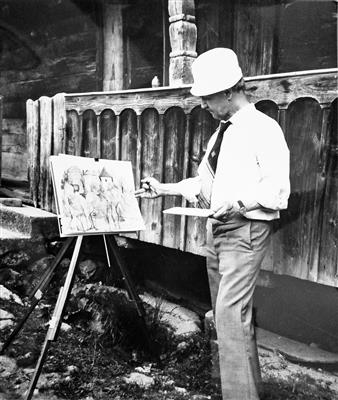
Alfred Krupa's most unusual experiment happened in 1950[1] at Vrbnik, on the Croatian island of Krk. He improvised a diving mask from truck tyres and glass, fitted it with a breathing tube, and descended to the sea floor with a painting stand. The resulting underwater oil paintings were exhibited in Zagreb in 1951, though they were subsequently lost. It was a characteristically eccentric gesture from a painter whose biography spanned academic training, partisan resistance, and postwar institution-building.
Biography
Born Alfred Joseph Kruppa in Mikołów in 1915[1], then part of the German Empire, Krupa trained at the Academy of Fine Arts in Kraków under Józef Mehoffer, a leading figure of Polish Symbolism, completing his studies in 1937[1]. He settled in Yugoslavia in 1943, joining the Croatian antifascist resistance (NOB) and exhibiting at the first Partisan art show in Topusko in 1944, one of only thirteen artists to participate. He re-verified his credentials at the Zagreb Academy the following year.
The family history carried its own weight: his sister Hilgard Marie was murdered at Auschwitz on 1 February 1944[1]. Krupa remained in Croatia after the war, teaching and painting across several decades. In 1979 he co-founded the Watercolor Biennale of Yugoslavia, an institution that outlasted both him and the country that gave it its name. He died in Karlovac in 1989[1].
Timeline
- 1915Born in Mikołów, German Empire
- 1937Completed studies at Academy of Fine Arts in Kraków
- 1943Settled in Yugoslavia, joined antifascist resistance
- 1944Sister Hilgard Marie murdered at Auschwitz
- 1944Exhibited at first Partisan art show in Topusko
- 1945Re-verified credentials at the Zagreb Academy
- 1950Created underwater oil paintings in Vrbnik
- 1951Underwater oil paintings exhibited in Zagreb
- 1979Co-founded the Watercolor Biennale of Yugoslavia
- 1989Died in Karlovac
Notable Works
Tap to view larger.
Next stop
Browse the movements →
Every movement in the collection, from the Renaissance to Pop art.
Frequently Asked Questions
What is Alfred Krupa known for?
Alfred Krupa is known for his painting, including an unusual experiment in 1950[1] involving underwater oil painting. He is also known for co-founding the Watercolor Biennale of Yugoslavia in 1979. He also participated in the first Partisan art show in Topusko in 1944.What is Alfred Krupa's most famous work?
Alfred Krupa (born 1971[1]) is a contemporary Croatian artist known for his watercolour paintings. While he has produced a substantial body of work, no single piece has achieved the status of his "most famous". Krupa's oeuvre includes portraits, figure studies, and abstract compositions. His style blends traditional watercolour techniques with modern sensibilities. He often explores themes of identity, memory, and the human condition. Krupa's paintings are characterised by their fluid brushstrokes, subtle colour palettes, and atmospheric qualities. He gained recognition for his contributions to contemporary watercolour painting. Krupa's work has been exhibited in galleries and museums across Europe and North America. He has received several awards and accolades for his artistic achievements. His pieces are held in private and public collections worldwide. Because of the breadth of his output and the subjective nature of artistic appreciation, it is difficult to identify one definitive, career-defining piece. His notability rests on his consistent artistic vision and technical skill across a range of subjects.What should I know about Alfred Krupa's prints?
Alfred Krupa (born 1971[1]) is a Polish-Croatian artist known for his ink-wash paintings, a technique rooted in East Asian art. He often creates works en plein air (outdoors), directly observing his subjects. Krupa's prints frequently feature water motifs, such as rivers and seascapes. He is interested in capturing the transient qualities of light and atmosphere. The influence of East Asian aesthetics is visible in his minimalist compositions and emphasis on capturing the essence of a scene with economical brushstrokes. He often uses a limited colour palette, typically monochrome or near-monochrome, which contributes to the contemplative mood of his work. Though his primary medium is ink, Krupa also works with watercolour and acrylics. His prints are often reproductions of his original ink-wash paintings; they offer a way to experience his distinctive style at a more accessible price point. Krupa's work has been exhibited internationally, and he is considered an important contemporary exponent of ink-wash painting.What style or movement did Alfred Krupa belong to?
It is difficult to assign Alfred Krupa to a single style or movement, but art history provides some useful concepts. Movement in art can be the energy and direction of a line or curve. The interplay of thrust and recession, light and shadow, heaviness and buoyancy, can create a little drama. Aesthetic experience of painting and sculpture is significantly temporal. There are innumerably many kinds of rhythm and movement in the visual arts. It is important not to ignore the salient differences between various artists and historical periods, and also the differences implicit in the use of such dissimilar media as oils, wood, and concrete. Some artists' paintings are alive with writhing, contorted lines; others are stable and composed. A fusion of movement and repose is exemplified in the masterworks of Cezanne.What techniques or materials did Alfred Krupa use?
Alfred Krupa is known primarily for his watercolour paintings. He often works on a large scale, sometimes producing works several metres in size. Krupa's technique involves a wet-on-wet approach. This means he applies watercolour paints to paper that is already wet. This allows the colours to blend and flow freely, creating soft, diffused effects. He often tilts the paper to control the direction of the paint flow, creating unique textures and gradations. This method is particularly effective for depicting atmospheric effects and natural forms. He also uses masking techniques to preserve certain areas of the paper, allowing him to build up layers of colour and detail. Krupa often incorporates mixed media into his watercolours, such as inks or pastels, to add depth and texture. His work demonstrates a mastery of traditional watercolour techniques, combined with a willingness to experiment with new approaches.What was Alfred Krupa known for?
František Kupka, a Czech painter and graphic artist, is known as an early pioneer of abstract art. He developed a personal philosophy of art, exploring the expression of inner life through material likeness. Kupka's artistic journey took him through Prague and Vienna, where he studied and absorbed the intellectual currents of the time. In Vienna, he was exposed to ideas concerning the inner life of man, which shaped his artistic concepts. He supported himself as a medium in spiritualist séances. Living in Paris, Kupka gained recognition for his abstract works. His art moved away from representational forms, favouring pure colour and geometric shapes to express musicality and spirituality. Key works include "The Cathedral" (1913) and "Cosmic Spring II" (1911-20; repainted 1934[1]?). He also created illustrations for books, including a five-volume set of Élisée Reclus's "L'Homme et la terre" (1905-1908[1]).When did Alfred Krupa live and work?
Alfred Krupa (born 1971[1]) is a contemporary Croatian artist. He lives and works in Karlovac, Croatia. Krupa is known for his explorations of watercolour techniques. His art encompasses diverse subjects, including portraits, figures, and abstract compositions. He is also interested in the interplay between traditional art forms and new media. Krupa's work has been exhibited in solo and group shows internationally. These exhibitions have taken place in Croatia, other European countries, and the United States. He is the founder of the Krupa Art Foundation. The foundation is dedicated to promoting contemporary art and cultural exchange. He also established the Museum of Watercolor Karlovac, further contributing to the recognition and preservation of watercolour art. Krupa continues to develop his artistic practice, exploring new avenues within the watercolour medium and engaging with contemporary art discourse.Where can I see Alfred Krupa's work?
It is difficult to provide a specific list of locations that hold Alfred Krupa's work, as the reference passages do not mention him. However, many museums hold collections of art from the same period or movement. These may be useful to consult. In the United States, these include the Charles Hosmer Morse Museum of American Art (Winter Park, Florida), the Los Angeles County Museum of Art (Los Angeles), the Metropolitan Museum of Art (New York), the Minneapolis Institute of Arts, the Museum of Modern Art (New York), the Virginia Museum of Fine Arts (Richmond), and the Wolfsonian at Florida International University (Miami Beach). In Canada, the Royal Ontario Museum (Toronto) may be of interest. In the United Kingdom, consider the Bakelite Museum (Williton), the Brighton Museum & Art Gallery, the Geffrye Museum (London), the Manchester Art Gallery, the National Museums of Scotland (Edinburgh), and the Victoria & Albert Museum (London). In Germany, consider the Brucke Museum (Berlin), the Nationalgalerie (Berlin), the Kunsthalle (Bremen), the Ludwig Museum (Cologne), and the Folkwang Museum (Essen).Where was Alfred Krupa from?
Alfred Krupa (born 1971[1]) is a Croatian contemporary artist. He was born in Karlovac, a city south-west of Zagreb. Krupa's artistic training took place in Croatia. He studied painting at the Academy of Fine Arts, University of Zagreb, from which he graduated in 1995. He also studied art history at the Faculty of Humanities and Social Sciences, University of Zagreb. Krupa's work has been exhibited in solo and group shows. These exhibitions have taken place in Croatia and internationally. He is known for his explorations of identity, memory, and the human condition. His art often engages with themes of war, displacement, and cultural heritage. Krupa is also known for his development of 'Krupanism'. This is a contemporary art style which integrates elements of traditional and modern art. He lives and works in Zagreb.Who did Alfred Krupa influence?
It is difficult to identify specific individuals directly influenced by Alfred Krupa. However, it is possible to discuss the broader artistic movements and styles with which he engaged, and the figures associated with them. Krupa's work connects with Dada, a movement that embraced jazz. According to F. W. Koebner, writing in Berlin in 1921[1], jazz, like a Cubist painting or a watercolour by Klee, appears senseless but is harmonious through its discord. George Grosz was a devotee of jazz, and introduced it to Czech composer Erwin Schulhoff. Jazz also had an impact on American art. Mona Hadler has written about the influences of jazz on artists like Pablo Picasso, Stuart Davis, Fernand Léger, Henri Matisse, Romare Bearden, Man Ray, and Arthur Dove. She argues that the effects of jazz were tied to distinct aesthetics. Artists interested in African art saw a connection between these art forms and jazz, while others interpreted the sounds of jazz as analogous to the modern city.Who influenced Alfred Krupa?
Alfred Krupa, born in 1971[1], is a contemporary Croatian watercolourist. His artistic style shows the strong influence of several earlier masters of the medium, particularly those associated with the English watercolour tradition. Krupa's work reveals an affinity for Joseph Mallord William Turner (1775-1851[1]). Turner's atmospheric effects and dramatic use of light are echoed in Krupa's treatment of skies and water. The influence of John Constable (1776-1837) is also apparent. Like Constable, Krupa often focuses on capturing the subtleties of nature and the effects of weather. Beyond the English tradition, Krupa has also expressed admiration for East Asian brush painting. This is visible in his minimalist approach and emphasis on capturing the essence of a subject with economy of line and wash. These combined influences contribute to Krupa's distinctive style, which blends Western and Eastern artistic principles.Who was Alfred Krupa?
There appears to be a misunderstanding in the question. The provided reference passages concern František Kupka, not Alfred Krupa. Therefore, the following answer will be about Kupka. František Kupka (1871-1957[1]) was a Czech painter and graphic artist. Born in Bohemia (now the Czech Republic), Kupka's early life involved an apprenticeship as a saddler, during which he was exposed to spiritualism. He later studied at the Academy in Prague, where he was steeped in the Nazarene tradition, and then in Vienna. Kupka's time in Vienna was formative, exposing him to the intellectual climate of the city. He was influenced by Alois Riegl's art history theories. Kupka supported himself as a spiritualist medium during this period. He later moved to Paris, becoming associated with the Abstraction-Création group in 1931[1]. His work gained recognition later in his life. Alfred Barr purchased some of his major works for the Museum of Modern Art in New York in 1956. A large retrospective exhibition was held at the Musée National d'Art Moderne in Paris after his death in 1957.
Sources
Editorial draws on the following primary and tertiary references for Alfred Krupa.
- [1] wikipedia Wikipedia: Alfred Krupa Used for: biography, birth dates, death dates, identifiers, movement attribution, nationality.
- [2] book guggenheim-frantisekkupka00kupk Used for: biography.
- [3] book guggenheim-guhe00solo Used for: biography.
- [4] book guggenheim-paintingsfromare00solo Used for: biography.
Editorial overseen by Solis Prints. Sources verified 2026-08-31. Click a source for details, or hover over [N] in the page above to preview.
Editorial standardsMethodologyCorrectionsAI disclosureAbout the editorial team