



Alice Rahon
Alice Rahon began her creative life as a poet, not a painter. Her first book, "A même la terre" (On the Bare Ground, 1936[2]), illustrated by Yves Tanguy, was the first volume by a woman to appear under the Editions Surrealistes imprint in Paris. A second collection, "Sablier couché" (1936), carried a frontispiece by Picasso. She was already embedded in the Surrealist inner circle well before she picked up a brush.
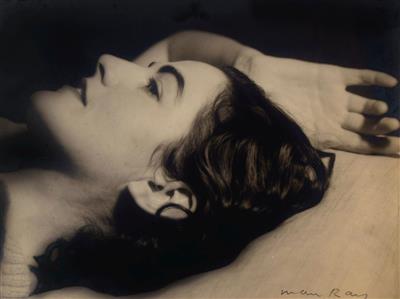
Biography
She had met the Austrian painter Wolfgang Paalen in 1931[2], married him in 1934, and together they joined the Surrealist Group in Paris. In 1939 the pair travelled to Mexico, with a detour along the Pacific Coast of Alaska and British Columbia where they visited numerous indigenous communities. The journey permanently reoriented her. She helped organise the International Surrealist Exhibition in Mexico City in 1940, and when Paalen left the country in 1947 she remained, spending the rest of her life there.
The transition from poetry to painting changed her practice but not her concerns. Her canvases absorbed prehistoric imagery, indigenous myth, and the Mexican landscape, built up in textures that incorporated sand and sgraffito techniques borrowed from Rufino Tamayo. For her 1951[2] solo exhibition at the Willard Gallery in New York she wrote the catalog statement herself, describing painting as a practice of "conjuration" descended from shamanic ritual. "Man Crossed by a River" (1967) was painted as a homage to André Breton, who had died the year before.
Rahon is now grouped alongside Leonora Carrington and Remedios Varo as one of the central figures in the circle of women Surrealist émigrés who remade the movement in 1940s Mexico City.
Timeline
- 1904Born
- 1931Met Wolfgang Paalen
- 1934Married Wolfgang Paalen
- 1936Published 'A même la terre', illustrated by Yves Tanguy
- 1936Published 'Sablier couché', with frontispiece by Picasso
- 1939Traveled to Mexico with Wolfgang Paalen
- 1940Helped organize International Surrealist Exhibition in Mexico City
- 1947Wolfgang Paalen left Mexico; Rahon remained
- 1951Solo exhibition at the Willard Gallery in New York
- 1967Painted 'Man Crossed by a River' as homage to André Breton
- 1987Died
Notable Works
Tap to view larger.
Next stop
Surrealism →
Explore the artists and ideas of Surrealism.
Related Artists


Frequently Asked Questions
What is Alice Rahon known for?
Rahon is known for her poetry and painting, particularly her association with the Surrealist movement in both Paris and Mexico City. Her work absorbed prehistoric imagery, indigenous myth, and the Mexican environment.What is Alice Rahon's most famous work?
It is difficult to name Rahon's single 'most famous work'. She produced paintings, poetry, and some writing across her career, and her notability rests on the combination of these elements. Examples of her paintings include *Rope Skipper* (1943[2]), *Archetypes* (1945), *Miss Cholera* (1946), and *Will to Power* (1946). These works incorporate thick impasto and mixed media, sometimes including sand, pebbles, and straw, to create textured surfaces. Later paintings such as *Triumph and Glory* (1950) and *Knoll of Visions* (1952) demonstrate her continued exploration of oil on canvas. These paintings are held in the collections of the Solomon R. Guggenheim Museum in New York, and other significant collections. Rahon's work was part of the Surrealist movement; she participated in the 1936 Surrealist exhibition in London.What should I know about Alice Rahon's prints?
Alice Rahon (1904[2]-1987[2]) was a French[2]-Mexican Surrealist painter and poet. Although best known for her paintings, she also produced prints, often incorporating similar themes and imagery. Her work frequently explores themes of memory, mythology, and the natural world. Rahon's prints often feature abstract forms and symbolic elements. These draw on her interest in pre-Columbian art and Mexican folklore. She used a variety of printmaking techniques, including lithography and etching, to create textures and effects. These methods allowed her to translate her distinctive style into a more accessible medium. Her move to Mexico in 1939[2] had a major impact on her art. She was influenced by the country's rich cultural heritage and stunning natural environment. This influence is evident in her use of colour and her incorporation of Mexican motifs. Rahon's prints offer collectors an opportunity to acquire works that reflect her unique artistic vision and her engagement with Mexican culture. They provide insight into her broader artistic practice. They also show her place within the Surrealist movement.What style or movement did Alice Rahon belong to?
Alice Rahon is associated with the Surrealist movement. She was born in France in 1904[2] as Alice Marie Yvonne Philippot. In 1936[2], her book of poems, *A même la terre*, became the first volume by a woman published by the Surrealist Group's Editions Surréalistes imprint. Rahon married Austrian painter Wolfgang Paalen in 1934, and they joined the Surrealist Group in Paris shortly after. In the early 1940s, Rahon and Paalen moved to Mexico. She assisted Paalen in organising the 1940 International Surrealist Exhibition in Mexico City. She also collaborated on the journal *Dyn* from 1942 to 1945. Although Paalen temporarily broke with Surrealism[2] during World War II, Rahon continued to defend its principles throughout her life. Her work often incorporated images from prehistoric art, Mexican myths, and folk practices. She experimented with various media, such as collage, sculpture, and found objects, and she also explored textures using sand and sgraffito techniques. After her marriage ended in 1947, Rahon remained in Mexico, where she continued to paint until her death in 1987[2].What techniques or materials did Alice Rahon use?
Alice Rahon, born in France in 1904[2], began as a poet, even publishing volumes with illustrations by Yves Tanguy and Picasso. She discovered painting after travelling to Mexico in 1939[2] with Wolfgang Paalen. Rahon experimented with a variety of media. Her techniques included collage, sculpture and the use of found objects. Like Rufino Tamayo, she explored textures using sand and sgraffito. Her artworks often contain abstract forms. Images from prehistoric art, Mexican geography, myths and folk practices appear in her paintings. Living in Mexico during the 1940s, Rahon found artistic freedom. Along with other women artists, she questioned some of the male-dominated ideas of Surrealism[2]. She rejected the idea of women as merely creative muses. Instead, she depicted female figures who could effect change, often through esoteric or mystical practices. Rahon remained in Mexico after her marriage with Paalen ended in 1947. She died in 1987[2].What was Alice Rahon known for?
Alice Rahon (born Alice Marie Yvonne Philippot) was a painter and poet associated with the Surrealist movement. Her initial artistic success came through poetry; her first book, *A même la terre*, was published in 1936[2] with illustrations by Yves Tanguy. She produced another book of poems, *Noir animal*, in 1941. Rahon married the Austrian painter Wolfgang Paalen in 1934, and they joined the Surrealist Group in Paris shortly after. In the early 1940s, Rahon and Paalen moved to Mexico, where she helped organise the 1940 International Surrealist Exhibition in Mexico City. She also collaborated on the journal *Dyn* between 1942 and 1945. Although Paalen distanced himself from Surrealism[2] during World War II, Rahon remained committed to its principles. After her marriage ended in 1947, Rahon remained in Mexico. While she began as a poet, after moving to Mexico she explored painting, collage, sculpture, and found objects. Her paintings often incorporated textures such as sand. Recurring images in her work include those drawn from prehistoric art, Mexican folk practices, and the local environment. Rahon died in 1987[2].When did Alice Rahon live and work?
Alice Rahon was born in France on 9 June 1904[2]. She spent much of her adult life in Mexico and died in Mexico City in September 1987[2]. Rahon's early life was spent moving around Europe due to her father's diplomatic career. She became connected with artistic and intellectual circles in Paris in the 1930s, associating with Surrealist artists and writers. In 1936[2], she married the Austrian painter Wolfgang Paalen. In 1939, at the outbreak of the Second World War, Rahon and Paalen left Europe for Mexico, where they became part of the burgeoning artistic community. She began painting in the 1940s and had her first solo exhibition in Mexico City in 1945. She remained in Mexico for the rest of her life, becoming a Mexican citizen and developing a unique style influenced by Mexican culture and mythology.Where can I see Alice Rahon's work?
Alice Rahon's work can be viewed in several museums. These include institutions in both the United States and Europe. In the United States, you can find her art at the Los Angeles County Museum of Art (LACMA) and the Metropolitan Museum of Art in New York City. Additionally, the Minneapolis Institute of Arts, the Museum of Modern Art (also in New York), and the Virginia Museum of Fine Arts hold pieces. For those in Florida, the Wolfsonian at Florida International University and the Charles Hosmer Morse Museum of American Art also have collections. In Europe, several museums in France exhibit art from this period. These include the Musée des Beaux-Arts in Nancy, the Musée National d’Art Moderne, Centre Georges Pompidou, and the Musée d’Orsay, both in Paris. Other French[2] museums include the Musée des Beaux-Arts in Rouen; the Musée d’Art Moderne in Strasbourg; and the Musée des Augustins in Toulouse. In the UK, the Victoria & Albert Museum in London and the National Museums of Scotland, Royal Museum in Edinburgh, may also hold her work.Where was Alice Rahon from?
Alice Rahon, born Alice Marie Yvonne Philippot, was of Breton origin. She was born in 1904[2] in Chenecey-Buillon, Doubs, a village in eastern France, at her grandparents' home. After her divorce, she took her mother's maiden name, Rahon. In 1931[2], Rahon met Austrian painter Wolfgang Paalen, and they soon began living together. They married in 1934, and shortly after, they joined the Surrealist Group in Paris. Rahon's initial artistic expression was through poetry. Her first book of poems, *A même la terre*, featured illustrations by Yves Tanguy and was the first volume by a woman under the Editions Surréalistes imprint in 1936. In the early 1940s, Rahon moved to Mexico with Paalen and photographer Eva Sulzer. She also travelled to Alaska and British Columbia, visiting many Native American tribes along the Pacific Coast. She helped Paalen organise the 1940 International Surrealist Exhibition in Mexico City. After her marriage with Paalen ended in 1947, Rahon remained in Mexico. Rahon died in 1987[2].Who did Alice Rahon influence?
Alice Rahon, a French[2]-Mexican Surrealist artist, moved to Mexico in 1939[2] and became part of a community of female émigré artists. These women, including Leonora Carrington and Remedios Varo, gained creative independence in Mexico. They questioned male-dominated Surrealist thought, rejecting the idea of women as muses. Instead, they depicted female figures as powerful agents of change. Rahon began as a poet, with her first book, *A même la terre*, appearing under the Editions Surréalistes imprint in 1936. She later explored painting, collage, and sculpture, incorporating techniques from Rufino Tamayo and experimenting with sand and sgraffito. Her work often featured images from prehistoric art, Mexican geography, and folk myths. While sources do not explicitly state who Rahon directly influenced, the Routledge Companion to Surrealism[2] notes that Rahon, Carrington, and Varo propelled the Surrealist aesthetic in new directions. The book *Surrealist Women* also mentions several other female Surrealist artists, such as Judit Reigl, Thérèse Renaud, Edith Rimmington, and Penelope Rosemont, who were working during the same period.Who influenced Alice Rahon?
Alice Rahon, of Breton origin, was born in France in 1904[2]. She married Austrian painter Wolfgang Paalen in 1934[2], and they joined the Surrealist Group in Paris shortly thereafter. Her initial artistic influence came from poetry; her first book, *A même la terre*, was illustrated by Yves Tanguy and issued under the group’s Editions Surréalistes imprint in 1936. Picasso illustrated her *Sablier couché*, also published in 1936. Rahon and Paalen moved to Mexico in the early 1940s, where she met other women artists. These included expatriates such as Remedios Varo and Leonora Carrington, who had also come to Mexico. Rahon collaborated on the journal *Dyn* from 1942 to 1945. Although Paalen broke with surrealism during World War II, Rahon continued to defend its core tenets. She experimented with media, such as collage, sculpture, and found objects. Her paintings often included images from prehistoric art, Mexican settings, myths and folk practices. One of her later paintings, “Man Crossed by a River” (1967), paid homage to André Breton.Who was Alice Rahon?
Alice Rahon (born Alice Marie Yvonne Philippot in 1904[2]) was a French[2]-Mexican artist and poet associated with Surrealism[2]. She was born in Chenecey-Buillon, France, and died in 1987[2]. After an early divorce, she took her mother's maiden name, Rahon. In 1931[2], Rahon met the Austrian painter Wolfgang Paalen, and they soon began living together. They married in 1934 and joined the Surrealist Group in Paris a little over a year later. Rahon's first book of poems, *A même la terre*, with illustrations by Yves Tanguy, was the first book by a woman published by Editions Surréalistes in 1936. In the early 1940s, Rahon moved to Mexico with Paalen and photographer Eva Sulzer. She helped Paalen organise the 1940 International Surrealist Exhibition in Mexico City. She also collaborated on the journal *Dyn* from 1942 to 1945. Although Paalen broke with Surrealism during World War II, Rahon continued to defend its principles. After her marriage ended in 1947, she remained in Mexico. Rahon began as a poet but started painting after her journey to Mexico in 1939. She experimented with various media, such as collage, sculpture, and found objects, and incorporated techniques pioneered by Tamayo, experimenting with sand and sgraffito. Her work often featured images from prehistoric art, the Mexican environment, and myths.
Sources
Editorial draws on the following primary and tertiary references for Alice Rahon.
- [1] wikidata Wikidata: Q250333 Used for: identifiers.
- [2] wikipedia Wikipedia: Alice Rahon Used for: biography, birth dates, death dates, identifiers, movement attribution, nationality.
- [3] book guggenheim-twopri00weis Used for: biography.
Editorial overseen by Solis Prints. Sources verified 2026-10-15. Click a source for details, or hover over [N] in the page above to preview.
Editorial standardsMethodologyCorrectionsAI disclosureAbout the editorial team