



Allan Randall Freelon
- New Negro Movement
In February 1935[1], Allan Randall Freelon exhibited a painting called Barbecue: American[1] Style in a show organised by the NAACP at a New York gallery. The work depicted a naked man, tortured and burning, surrounded by the feet of onlookers. His statement: "I have not attempted to portray any particular lynching, but merely to record the horror of what has come to be a major sports event." It is one of the most direct anti-lynching images produced by any American artist of the period.
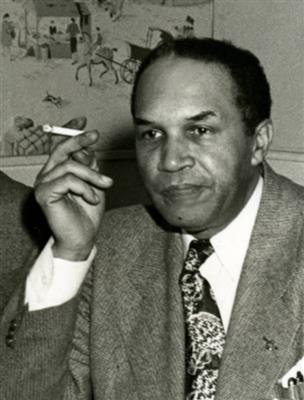
Biography
Freeleon was born in Philadelphia in 1895[1] and trained at the Pennsylvania Museum and School of Industrial Art on a four-year scholarship, later studying at the Barnes Foundation (1927[1]-29) and completing a master's degree at Temple University's Tyler School of Art in 1943. He served as a second lieutenant in the US Army during the First World War. Back in Philadelphia, he became one of the most prominent African American[1] artists of his generation, exhibiting at the Albright-Knox Gallery, the National Gallery of Art, and the Whitney Museum, and participating in the first African American art exhibition in Harlem.
His civic record was equally substantial. In 1921[1] he was appointed assistant director of art education in the Philadelphia school district, the first African American[1] appointed to that body's Department of Superintendence. He taught etching and lithography at the Philadelphia Museum of Art from 1940 to 1946, edited the literary magazine Black Opals, and was the first African American elected to the Print Club of Philadelphia. He disagreed with Alain Locke's call for African themes in Black art, arguing in 1944 that the theory was propaganda rather than artistic freedom.
He died in Telford, Pennsylvania in 1960[1]. His grandson is the architect Philip Freelon, who designed the National Museum of African American[1] History and Culture in Washington.
Timeline
- 1895Born in Philadelphia, Pennsylvania
- 1921Appointed assistant director of art education in Philadelphia school district
- 1927Studied at the Barnes Foundation (until 1929)
- 1935Exhibited 'Barbecue: American Style' at NAACP show in New York
- 1940Taught etching and lithography at Philadelphia Museum of Art (until 1946)
- 1943Completed master's degree at Temple University's Tyler School of Art
- 1944Argued against Alain Locke's call for African themes in Black art
- 1960Died in Telford, Pennsylvania
Notable Works
Tap to view larger.
Next stop
Browse the movements →
Every movement in the collection, from the Renaissance to Pop art.
Related Artists


Frequently Asked Questions
What is Allan Randall Freelon known for?
Allan Randall Freelon is known for his art and his civic contributions. His 1935[1] painting, Barbecue: American[1] Style, is one of the most direct anti-lynching images produced by any American artist of that period. He also disagreed with Alain Locke's call for African themes in Black art, arguing in 1944 that the theory was propaganda rather than artistic freedom.Who was Allan Randall Freelon?
Allan Randall Freelon was an artist from Philadelphia, born in 1895[1]. He trained at the Pennsylvania Museum and School of Industrial Art and became a prominent African American[1] artist, exhibiting in major galleries and museums. He also served as assistant director of art education in Philadelphia and taught at the Philadelphia Museum of Art.How did Allan Randall Freelon die?
Allan Randall Freelon died in 1960[1] at the age of 65.
Sources
Editorial draws on the following primary and tertiary references for Allan Randall Freelon.
- [1] wikipedia Wikipedia: Allan Randall Freelon Used for: biography, birth dates, death dates, identifiers, movement attribution, nationality.
- [2] book guggenheim-artoftomorrowfif1939gugg Used for: biography.
- [3] book guggenheim-guggenhe02solo Used for: biography.
- [4] book guggenheim-guhe00solo Used for: biography.
Editorial overseen by Solis Prints. Sources verified 2026-10-16. Click a source for details, or hover over [N] in the page above to preview.
Editorial standardsMethodologyCorrectionsAI disclosureAbout the editorial team