

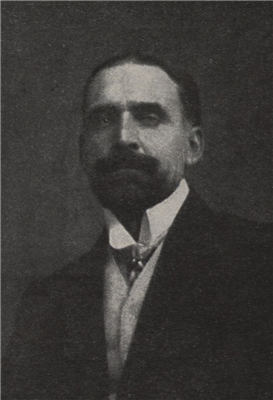
Alois Hans Schram
The ceiling paintings Alois Hans Schram completed for the ballroom of the Viennese Hofburg in 1915[1] were among the last major decorative commissions executed in the Habsburg imperial style before the dynasty collapsed three years later. Schram had spent his entire career in that tradition: allegory, gilded opulence, and the academic finish that came from nine years of study at the Academy of Fine Arts in Vienna under Hans Makart, the period's most theatrical decorator.
Biography
Schram was born in Vienna in 1864[1] and enrolled at the Academy at fifteen. He was a precocious student; he won the Goldene Fuger-Medaille for composition in 1881[1], and in 1887 took the Spezialschulpreis for a scene depicting Bianca Cappello (now in the Denver Art Museum). A state scholarship in 1890 took him to Rome, and he spent much of the following decade travelling through Europe and the Middle East, building the visual store of orientalist and historical imagery that would sustain his decorative commissions.
His largest civic works were the allegorical friezes in the Austrian Parliament Building, executed between 1909[1] and 1911, and the Hofburg ballroom ceiling. He also produced decorative schemes for a palace in Trieste and a judicial building in Salzburg, and remained a member of the Kunstlerhaus throughout his career. A committed academician, he continued painting in the Neo-Baroque manner even as the Viennese Secession was reshaping the city's art world around him.
Schram died in Vienna in April 1919[1]. His estate was left to the Kunstlerhaus to establish a fund for young artists, a gesture that reflected both his professional loyalties and a clear-eyed understanding that the world he had painted for was gone.
Timeline
- 1864Born in Vienna.
- 1879Enrolled at the Academy of Fine Arts in Vienna at 15.
- 1881Won the Goldene Fuger-Medaille for composition.
- 1887Took the Spezialschulpreis for a scene depicting Bianca Cappello; the work is now in the Denver Art Museum.
- 1890Received a state scholarship to study in Rome.
- 1909Began executing allegorical friezes in the Austrian Parliament Building; the work continued until 1911.
- 1915Completed ceiling paintings for the ballroom of the Viennese Hofburg.
- 1919Died in Vienna in April at 55. His estate was left to the Kunstlerhaus.
Notable Works
Tap to view larger.
Next stop
Browse the movements →
Every movement in the collection, from the Renaissance to Pop art.
Related Artists
Frequently Asked Questions
What is Alois Hans Schram's most famous work?
Alois Hans Schram (1864[1]-1919[1]) was an Austrian painter and printmaker associated with the Vienna Secession. He is best known for his colour woodcuts, a medium he adopted later in his career. While Schram produced a substantial body of work, no single piece has achieved universal recognition as his "most famous". However, several of his prints are particularly well regarded and frequently reproduced. These include "Am Mühlbach" (By the Mill Stream), "Winterabend" (Winter Evening), and "Holländische Mühle" (Dutch[1] Mill). These works demonstrate his skill in capturing atmospheric effects and his interest in rural subjects. Schram's prints often feature simplified forms, muted colours, and a strong emphasis on decorative patterns. This aesthetic aligns with the broader Secessionist movement, which sought to break away from academic traditions and embrace new forms of artistic expression. His work can be found in the collections of major museums, including the Albertina in Vienna. Although he may not have a single defining piece, his contributions to the colour woodcut medium are significant.What style or movement did Alois Hans Schram belong to?
It is difficult to assign Alois Hans Schram to a single artistic movement. One might consider the artistic and intellectual context of the First Viennese School, of which art historian Alois Riegl was a celebrated representative. Riegl's career occurred in the short period between 1891[1] and 1903. Riegl moved from formalism to a method of analysis, contributing to the theory of communication, the aesthetics of reception, and historical psychology. Another possible avenue of enquiry is to examine the thoughts of architect Gottfried Semper on style in the technical arts. Semper's aesthetic observations are based on philosophical ideas; serious art is not merely the expression of emotion but equally the result of precise thought. Semper looked toward the future. He said that when assembling constructional elements, one should not attempt to eliminate the necessary seam; instead, one should make it into a decorative motif.What techniques or materials did Alois Hans Schram use?
Alois Hans Schram (1864[1]-1919[1]) was an Austrian painter and printmaker known for his colour woodcuts. He studied at the Academy of Fine Arts Vienna under Julius Berger and August Eisenmenger. Schram's primary technique was the colour woodcut, a method involving the creation of multiple woodblocks, one for each colour in the final image. Each block is carefully carved, inked, and then printed in succession on paper to build up the complete picture. This required precision and a deep understanding of colour theory to achieve the desired effects. While colour woodcuts were his main focus, Schram also produced paintings and drawings. These works often served as studies or preparatory sketches for his prints, allowing him to refine his compositions and colour schemes before committing to the more labour-intensive printmaking process. His subject matter included portraits, genre scenes, and allegorical subjects, often rendered with a meticulous attention to detail.What was Alois Hans Schram known for?
Alois Hans Schram (1864[1]-1919[1]) was an Austrian painter and printmaker, active in Vienna. He is best known for his depictions of the city, as well as genre scenes and portraits. Schram studied at the Academy of Fine Arts in Vienna, and became a member of the Vienna Künstlerhaus. His early work showed the influence of historicism, but he later adopted a more naturalistic style. He often depicted scenes of everyday life in Vienna, such as people in cafes, markets, or parks. He also produced a number of portraits of prominent Viennese citizens. Schram's prints, often etchings or lithographs, allowed wider circulation of his images. These prints captured the atmosphere of Vienna at the turn of the century. He also created colour prints, which added another dimension to his work. Although he is not as well known as some of his contemporaries, Schram's work provides a valuable record of Viennese life in the late 19th and early 20th centuries.When did Alois Hans Schram live and work?
Alois Hans Schram was an Austrian artist who lived from 1864[1] to 1919[1]. In 1914[1], Schram emerged from a period of self-imposed isolation. During that year, he participated in a modern art competition sponsored by Reininghaus and received an important commission to paint a portrait of Friedericke Maria Beer. He also experimented with etching and contributed to *Die Aktion*. In 1915, Schram was drafted into the Austrian army on 31 May. Shortly after, on 17 June, he married Edith Harms. He and Edith reported for military duty in Prague on 21 June, but he was soon recalled to Vienna after basic training. During this time, he exhibited his work in Zurich and Vienna. Paris von Gütersloh, a painter and friend, published a small monograph on Schram. Major canvases from this period include *Portrait of his Wife*, *Soaring*, and *Death and Maiden*. In May 1916, Schram was declared unfit for combat duty due to health reasons. He was assigned guard duty in the village of Mühling, where he sketched Russian prisoners of war. He participated in four exhibitions in Germany and one in Vienna. *Die Aktion* dedicated its September issue to his work. He painted *Portrait of an Old Man* (his father-in-law) and *The Saw Mill*.Where can I see Alois Hans Schram's work?
Alois Hans Schram's artworks can be viewed in several museums. These include the Nationalgalerie, and the Brücke Museum, both in Berlin. Other German museums that hold his work are the Kunsthalle in Bremen, the Ludwig Museum and Wallraf-Richartz Museum in Cologne, the Folkwang Museum in Essen, and the Kunsthalle in Hamburg. You can also find his work in the Von der Heydt Museum in Wuppertal, and the Bayerische Staatsgemäldesammlungen in Munich. Outside of Germany, museums that possess Schram's art include the Neue Galerie am Landesmuseum Joanneum in Graz, Austria. In the United States, the Minneapolis Institute of Arts also holds some of his pieces. Other possible locations for his works are the Graphische Sammlung Albertina, the Historisches Museum der Stadt Wien, the Niederösterreichisches Landesmuseum, the Österreichische Galerie, and the Österreichisches Museum für Angewandte Kunst; all are located in Vienna.Where was Alois Hans Schram from?
Alois Hans Schram was an Austrian artist, born in Vienna on 28 July 1864[1]. He died there on 1 February 1919[1]. Schram studied at the Academy of Fine Arts Vienna. His teachers included Josef Mathäus Trenkwald and Carl Wurzinger. He is known for genre paintings and portraits. He also produced illustrations. Schram's paintings often depicted scenes of everyday life, particularly those of the Viennese middle class. These works offer a glimpse into the social customs of the period. He captured people in moments of leisure, work, and social interaction. These paintings provide insights into the cultural fabric of Vienna at the turn of the century. His portrait work includes depictions of notable figures from Viennese society. These portraits demonstrate his skill in capturing likeness and character. Schram's illustrations appeared in books and magazines, further disseminating his art to a wider audience. His artistic output provides a record of Viennese life during a period of significant social and cultural change.Who did Alois Hans Schram influence?
Alois Hans Schram's artistic influence is difficult to measure directly. Gustav Klimt, Koloman Moser, Egon Schiele, and Oskar Kokoschka were all Viennese artists who were admired by the younger generation. Klimt taught Kokoschka, who dedicated "Die traumenden Knaben" to him. Schiele sought Klimt's advice in 1907[1], and Klimt helped him assert himself. Schiele's early work reflected Klimt's influence, but Schiele developed his own style after 1910. Schiele's cartilaginous portraits sometimes recall the figures of Klimt. Klimt and Schiele bridge the gap between Art Nouveau and Expressionism. Paul van Ostaijen, who introduced Futurist, Expressionist, and Cubist theories into Flanders, discussed painting with Oscar Jespers, Paul Joostens, Floris Jespers, Fritz Stuckenberg, and Heinrich Campendonk. His critical writings helped to spread their reputation. The dissemination of theoretical works was important, since they manifested the urge to innovate that was common to an entire generation.Who influenced Alois Hans Schram?
Alois Hans Schram (1864[1]-1919[1]) was an Austrian painter and printmaker. He is best known for genre scenes and depictions of everyday life. Schram's artistic training occurred at the Academy of Fine Arts Vienna during a period of significant change. He studied under Josef Mathäus Trenkwald, Christian Griepenkerl, and August Eisenmenger. These instructors provided him with a solid academic foundation. His early work shows the influence of historical painting, a dominant style at the Academy. However, Schram soon moved toward Realism, which was gaining popularity in Vienna. Realist painters aimed to portray the world accurately, often focusing on the lives of ordinary people. Schram's genre scenes reflect this interest in Realism. Later in his career, Schram also incorporated elements of Impressionism into his work. Impressionist painters sought to capture the fleeting effects of light and colour. While Schram never fully embraced Impressionism, his later paintings show a lighter palette and a greater concern with atmosphere. He synthesised elements from several different schools.Who was Alois Hans Schram?
Without specific biographical information, it is difficult to provide a detailed account of Alois Hans Schram's life. However, some insights can be gleaned from the available passages. One passage references the early artistic development of Wassily Kandinsky. Kandinsky describes his childhood experiences with colour and form, recalling how drawing allowed him to exist outside time and space. He notes the impact of an early watercolour mishap, where an attempt to paint black hoofs on a piebald horse resulted in "disgusting, ugly spots". This experience instilled in him a lasting aversion to using pure black. Kandinsky also mentions the influence of Rembrandt's use of light and dark, as well as a trip to the Government District of Wologda, where he was sent as an ethnologist and jurist. These experiences shaped his artistic sensibilities and contributed to his later exploration of non-objective art. He discusses his efforts to make paintings that would reveal hidden colour tones over time, requiring careful observation.What was Alois Hans Schram's art style?
Alois Hans Schram was a committed academician who painted in the Neo-Baroque manner. He continued with this style even as the Viennese Secession was reshaping the city's art world around him.
Sources
Editorial draws on the following primary and tertiary references for Alois Hans Schram.
- [1] wikipedia Wikipedia: Alois Hans Schram Used for: biography, birth dates, death dates, identifiers, movement attribution, nationality.
- [2] book guggenheim-guhe00solo Used for: biography.
- [3] book Husslein-Arco, Agnes, editor; Koja, Stephan, editor; Law, Rebecca (Translator), translator; McInnes, Robert (Translator), translator; Somers, Nick, translator; Monet, Claude, 1840-1926. Paintings. Selections; Österreichische Galerie Belvedere, h Used for: biography.
- [4] book Masterpieces of western art : a history of art in 900 individual studies from the Gothic to the present day Used for: biography.
Editorial overseen by Solis Prints. Sources verified 2026-10-07. Click a source for details, or hover over [N] in the page above to preview.
Editorial standardsMethodologyCorrectionsAI disclosureAbout the editorial team