

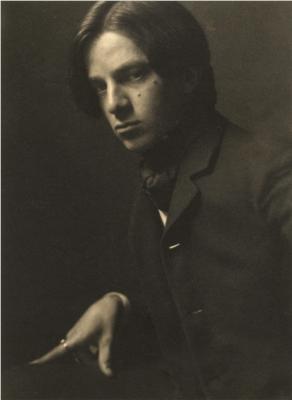
Alvin Langdon Coburn
In 1916[1], while most of his Pictorialist colleagues were still debating whether photography qualified as art, Alvin Langdon Coburn had already decided the question was wrong. In his essay "The Future of Pictorial Photography," he called for exhibitions that prioritised design over subject matter and coined the term "abstract photography" for what he had in mind. His frame of reference was modernist and deliberately cross-disciplinary: he cited Matisse, Stravinsky, Gertrude Stein, and the Cubist painter Max Weber, urging photographers to fall in line with the other arts.
Biography
Born in Boston in 1882[1], Coburn had joined Alfred Stieglitz's Photo-Secession after the core founding group (Steichen, Kasebier, Clarence H. White) and quickly established himself as both a portraitist and a landscape photographer of the first order. His books London (1909[1]) and New York (1910) treated the modern city as a formal subject; his portrait series Men of Mark (1913) gathered writers including Henry James, George Bernard Shaw, Mark Twain, and W.B. Yeats. A professional friendship with the British[1] Pictorialist Frederick H. Evans resulted in portraits exchanged in both directions.
The Vortograph of 1917[1] represented the clearest statement of his abstract ambitions. Built with a vortoscope, a kaleidoscopic device of three mirrors conceived in collaboration with Ezra Pound, the resulting gelatin silver prints dissolved any recognisable subject entirely. The example held at George Eastman House in Rochester, printed in 1947 from the original negative, is now considered a canonical instance of early experimental photography.
Coburn later moved to Wales, became a prominent Freemason, and largely withdrew from photography. He died in 1966[1], having moved further from the art world than almost anyone would have predicted for the man who once told photographers to follow Matisse.
Timeline
- 1882Born in Boston.
- 1909Published the book "London", treating the city as a formal subject.
- 1910Published the book "New York", treating the city as a formal subject.
- 1913Published "Men of Mark", a portrait series featuring writers such as Henry James and George Bernard Shaw.
- 1916Wrote the essay "The Future of Pictorial Photography", advocating for abstract photography.
- 1917Created "Vortograph" using a vortoscope, a kaleidoscopic device made with Ezra Pound.
- 1947Printed the "Vortograph" gelatin silver print from the original negative at George Eastman House in Rochester.
- 1966Died, having moved to Wales and withdrawn from photography.
Notable Works
Tap to view larger.
Next stop
Browse the movements →
Every movement in the collection, from the Renaissance to Pop art.
Related Artists




Frequently Asked Questions
What is Alvin Langdon Coburn known for?
Alvin Langdon Coburn is known for his Pictorialist photography, his portraits, and his cityscapes. He is also known for his abstract photography, particularly his Vortographs, which he created using a kaleidoscopic device.What is Alvin Langdon Coburn's most famous work?
Alvin Langdon Coburn is well known for his photographs of early 20th-century urban life and celebrity portraits. However, he is perhaps best remembered for his series of abstract photographs called "Vortographs". In 1916[1], Coburn created these images using a kaleidoscope-like instrument he invented called a Vortoscope. This device, which used three mirrors clamped together, allowed him to fracture and multiply the image of a subject. The name "Vortograph" derives from Vorticism, an English avant-garde movement. Ezra Pound, a poet and Vorticism supporter, encouraged Coburn in this new direction. Coburn only made about sixteen Vortographs between 1916 and 1917. These include portraits of Pound and other figures from the Vorticist circle, such as the artist Wyndham Lewis. "Ezra Pound", Vortograph (1916) is among the most recognisable. Other subjects include architectural studies and still-life arrangements. Although Coburn returned to more conventional photography later in his career, the Vortographs remain a unique and important contribution to the history of abstract photography.What should I know about Alvin Langdon Coburn's prints?
Alvin Langdon Coburn (1882[1]-1966[1]) was a British[1] photographer. When considering Coburn's prints, it is helpful to know some basic terminology. A 'vintage print' is made around the time the negative was taken. A 'period print' is made within roughly 10 to 15 years after the shot. Any print made later than that is termed an 'old print'. A 'modern print' is a recent print from the original negative. An 'original print' is one the artist made or directly supervised. A 'facsimile' is a print made by re-photographing a print, or using the original negative, with base and processing as close as possible to the vintage print. Coburn gifted prints to the Royal Photographic Society (RPS). A platinum print of Frederick H. Evans is labelled 'With Bernard Shaw's Compliments'. Coburn's prints include images of Westminster Abbey and Durham Cathedral, both from 1911[1].What style or movement did Alvin Langdon Coburn belong to?
Alvin Langdon Coburn was associated with the Photo-Secession movement. This American movement, which took shape between 1902[1] and 1904, included leading artistic photographers such as Edward Steichen, Gertrude Kasebier, and Clarence H. White. The Photo-Secession, led by Alfred Stieglitz, aimed to promote photography as a fine art. The group mounted exhibitions at camera clubs, art museums, and international fairs in the United States and Europe. Stieglitz also launched the journal *Camera Work* in 1903 to further the cause, and opened the Photo-Secession Gallery in New York City in 1905. Coburn, along with others like Anne Brigman and George Seeley, joined the Photo-Secession later. The movement's members often employed Pictorialism, imitating painting styles, especially those of Romantic, Realist, and Impressionist art. They used techniques such as soft-focus lenses and darkroom manipulation to give their photographs a painterly aesthetic.What techniques or materials did Alvin Langdon Coburn use?
Alvin Langdon Coburn was an early 20th-century photographer associated with Pictorialism. This movement favoured soft focus and painterly effects. Coburn often manipulated his negatives and prints to achieve these artistic results. One technique Coburn employed was the use of the soft-focus lens. This lens blurred the image, creating a dreamy, atmospheric quality. He also experimented with gum bichromate printing, a process that allowed for extensive manual manipulation of the print surface. This gave his photographs a unique, handcrafted feel, setting them apart from purely mechanical reproductions. In 1916[1] and 1917, Coburn created a series of abstract photographs he called "vortographs". To make these images, he used a kaleidoscope-like instrument he invented, which he named the vortoscope. This device allowed him to fracture and rearrange reality into geometric patterns. Coburn's vortographs are among the earliest examples of abstract photography. They demonstrate his willingness to experiment with new technologies and push the boundaries of the medium.What was Alvin Langdon Coburn known for?
Alvin Langdon Coburn (1882[1]-1966[1]) was a photographer known for his platinum prints of landscapes and architectural subjects. Coburn photographed various English cathedrals, such as Canterbury, Gloucester, Ely, Southwell, and Wells. His images often focused on details of Norman and Gothic architecture. For example, he captured the entrance to the Ambulatory and Crypt at Gloucester Cathedral (1890[1]), and the Nave looking West at Wells Cathedral (circa 1903). He also photographed Durham Cathedral from the Wear in 1911 and from the Close in 1912. Beyond cathedrals, Coburn photographed Kelmscott Manor, the summer home of William Morris, in 1896. These platinum prints include images of the exterior, such as Kelmscott Manor from the Thames and from the Garden, and interiors such as William Morris's Bedroom.When did Alvin Langdon Coburn live and work?
Alvin Langdon Coburn was a photographer who was active from the late 19th century into the mid-20th century. Coburn's work was exhibited alongside photographs by Julia Margaret Cameron, another British[1] photographer, in a number of exhibitions. These exhibitions took place at venues such as The Little Gallery of the Offices of the Royal Photographic Society (1906[1]), the Royal Photographic Society of Great Britain (1908, 1927), the National Arts Club in New York (1909), the Royal Society of British Artists (1914), and the Albright Art Gallery in Buffalo, New York (1915). Coburn also made platinum prints of Cameron's photographs for an "Old Masters" exhibition at the Hammersmith House Photographic Society in London in 1916.Where can I see Alvin Langdon Coburn's work?
Alvin Langdon Coburn's work can be viewed in several locations in the United States and the United Kingdom. In the United States, these include the Charles Hosmer Morse Museum of American Art (Winter Park, Florida), the Los Angeles County Museum of Art (Los Angeles), the Metropolitan Museum of Art (New York), the Minneapolis Institute of Arts (Minneapolis), the Museum of Modern Art (New York), the Royal Ontario Museum (Toronto), the Virginia Museum of Fine Arts (Richmond), and the Wolfsonian at Florida International University (Miami Beach). In the United Kingdom, you can find his work at the Bakelite Museum (Williton), Brighton Museum & Art Gallery (Brighton), the Geffrye Museum (London), Manchester Art Gallery (Manchester), the National Museums of Scotland, Royal Museum (Edinburgh), and the Victoria & Albert Museum (London).Where was Alvin Langdon Coburn from?
Alvin Langdon Coburn was an American photographer. He was born in Boston, Massachusetts, on 11 June 1882[1]. His father died when Coburn was seven years old. He began taking photographs in his late teens. Coburn travelled extensively throughout his life. He lived for a time in London, and he became an important figure in the British[1] photographic scene. He was associated with photographers such as Frederick Evans and George Davison. He was elected to the Linked Ring, a British photographic society, in 1903[1]. He later became an honorary member of the Royal Photographic Society. Although he spent significant time in Britain, Coburn eventually returned to the United States. In later life, he became increasingly interested in mysticism. He changed his name to Alvin Langdon Coburn-Kauffman, adding his stepfather's surname. Coburn died in Carmel, California, on 23 November 1966[1].Who did Alvin Langdon Coburn influence?
Alvin Langdon Coburn is generally associated with an impulsion towards abstraction in photography in the early 20th century. In his 1916[1] essay, 'The Future of Pictorial Photography', he advocated for photographic works that privileged design over subject matter. Coburn's idea, called 'abstract photography', proposed to liberate photographers from the limitations of mimesis, so they could focus on 'expressing the inexpressible'. Coburn referenced Henri Matisse, Igor Stravinsky, Gertrude Stein, and Cubist painter-poet Max Weber, encouraging photographers to embrace modernity. His experimental black-and-white photographs often lacked easily discernible subject matter. His Vortograph, produced around 1917, is a canonical example of early abstract and experimental photography. Later abstract photographers, such as Aaron Siskind, Minor White, and Barbara Morgan, drew inspiration from Abstract Expressionism.Who influenced Alvin Langdon Coburn?
Alvin Langdon Coburn was influenced by several figures in the artistic photography movement. As a teenager, Coburn met F. Holland Day in Boston in 1898[1]. Day became his mentor and encouraged Coburn's artistic development. Coburn also drew inspiration from the Photo-Secession group, founded by Alfred Stieglitz in 1902. This group promoted photography as a fine art form. Coburn was elected as a member of the Photo-Secession in 1904. He exhibited with them and contributed to their journal, Camera Work. The painter James McNeill Whistler also impacted Coburn's aesthetic. Whistler's emphasis on tonal harmonies and atmospheric effects resonated with Coburn. This influence is visible in Coburn's early pictorialist photographs, which often feature soft focus and carefully arranged compositions. Coburn's association with these individuals and movements shaped his artistic vision and contributed to his success as a photographer.Who was Alvin Langdon Coburn?
Alvin Langdon Coburn was a photographer born in Boston in 1882[1]. He joined Alfred Stieglitz's Photo-Secession group and became known as a portraitist and a photographer of modern cities.
Sources
Editorial draws on the following primary and tertiary references for Alvin Langdon Coburn.
- [1] wikipedia Wikipedia: Alvin Langdon Coburn Used for: biography, birth dates, death dates, identifiers, movement attribution, nationality.
- [2] book Titia Hulst (editor), A History of the Western Art Market _ A Sourcebook of Writings on Artists, Dealers, and Markets Used for: biography, stylistic analysis.
- [3] book Ansel Adams; Beaumont Newhall; Nancy Newhall; Louise Dahl-Wolfe; Aaron Siskind; Richard Avedon; Harry Callahan; Lee Friedlander; Tina Modotti; W. Eugene Smith; Paul Strand; Edward Weston; Garry Winogrand; Amy Rule, Ansel Adams; Beaumont Newhall; Nancy Newhall; Louise Dahl-Wolfe; Aaron Siskind; Richard Avedon; Harry Callahan; Lee Friedlander; Tina Modotti; W. Eugene Smith; Paul Strand; Edward Weston; Garry Winogrand; Amy Rule - Original sources _ art and ar Used for: stylistic analysis.
- [4] book Caws, Mary Ann; Wright, Sarah Bird; , Bloomsbury and France Used for: biography.
- [5] book Getty, Getty - The Photographs of Frederick H Evans Used for: biography, stylistic analysis.
- [6] book Post-impressionism : cross-currents in European painting Used for: biography.
Editorial overseen by Solis Prints. Sources verified 2026-10-07. Click a source for details, or hover over [N] in the page above to preview.
Editorial standardsMethodologyCorrectionsAI disclosureAbout the editorial team