

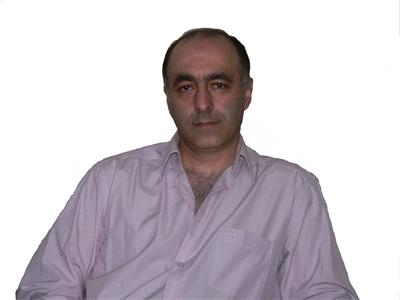
Andranik Avetisyan
The paintings of Andranik Avetisyan are held together, quite literally, by spider silk. The Gyumri-born artist became fascinated by the geometry of cobwebs and began breeding spiders specifically to harvest their threads, using the resulting silk as the physical substrate for his work. No other artist has made this technique their signature medium.
Biography
Born on 28 December 1968[1] into an artistic family (his father Hovhannes was a painter with his own studio), Avetisyan grew up surrounded by art in Soviet Armenia. He trained at the Art College S.Mirkurov and later at the Gyumri State Pedagogical Institute, though two years of service in the USSR frontier forces (1987-1989[1]) interrupted his formal studies at a formative moment.
The cobweb works that define his practice explore themes of life, energy, space, and the invisible structures that shape human relations. The medium carries obvious metaphorical weight: the spider's web as a representation of connection, fragility, and patience. At the 2017 Cannes International Exhibition of Modern Art, the technique earned him the "New Talent and Creative Thought" prize.
His work is held in private collections internationally and continues to attract attention for the sheer novelty of the process alongside its meditative subjects.
Timeline
- 1968Born in Gyumri on 28 December. His father, Hovhannes, was a painter.
- 1987Began military service in the USSR frontier forces, interrupting his art studies.
- 1989Completed military service and resumed his studies.
- 2017Awarded the "New Talent and Creative Thought" prize at the Cannes International Exhibition of Modern Art for his cobweb technique.
- 2024His work is held in private collections internationally.
Next stop
Browse the movements →
Every movement in the collection, from the Renaissance to Pop art.
Related Artists



Frequently Asked Questions
What is Andranik Avetisyan known for?
Andranik Avetisyan is known for his unique artistic technique using spider silk as the substrate for his paintings. He breeds spiders specifically to harvest their silk, which he then uses to create works exploring themes of life, energy, space, and human relations.What should I know about Andranik Avetisyan's prints?
When considering Andranik Avetisyan's prints, bear in mind some basic printmaking conventions. An 'original print' is conceived as a print, not a copy of a work in another medium. Each one is created from a plate, stone, screen, or block made specifically for that purpose. The artist inks and pulls each print individually; it is a multi-original medium. Most printmakers limit their editions, marking each print with two numbers on the bottom left margin: the print number and the edition number (for example, 12/25, meaning print number 12 from an edition of 25). The artist usually signs the print in pencil on the bottom right; the title goes in the centre. The edition size is the artist's decision, not a technical requirement. 'Vintage', 'period', and 'modern' are terms used to describe photographic prints based on when they were printed relative to when the negative was created. An 'original print' is one made by the artist, or under their direct supervision. When buying prints, examine them closely, and do not hesitate to ask questions about the printmaking process and materials.What techniques or materials did Andranik Avetisyan use?
Andranik Avetisyan's artistic techniques involved a combination of traditional methods and personal innovation. His approach to "faktura" (the surface quality of a work) prioritised human-made textures over those found in nature. Avetisyan saw technique as a tool for attaining art, requiring resourcefulness, foresight, and a feeling for compatibility. While specific details about Avetisyan's material choices are scarce, an understanding of materials is key to the artist's technique. He likely chose materials that were constant and amenable to manipulation, allowing him to impose his will and create new forms. Furthermore, Avetisyan's techniques developed through the connection between the spirit and the material. This process honed his senses and reasoning, which influenced his artistic output. The artist's methods are a blend of conscious choices and intuitive responses to the materials at hand.When did Andranik Avetisyan live and work?
Andranik Avetisyan, later known as Arshile Gorky, was born Vosdanik Adoian on 15 April 1904, in the village of Khorkom, Armenia. His early life was marked by displacement and hardship. In 1908, his father emigrated to the United States. Gorky attended St Vardan's Armenian Apostolic School in Khorkom from 1909 to 1910, studying drawing and Armenian. In 1915, facing persecution during World War I, the family fled to Yerevan. Gorky attended the Temagan Boy's School, while also working to support his family. His mother died in 1919, and in 1920, Gorky and his sister Vartoosh emigrated to the United States, joining their father in Providence, Rhode Island. He briefly attended schools in Providence, and later studied at the New School of Design in Boston. By 1925, he had moved to New York City and enrolled at the National Academy of Design. He adopted the pseudonym "Arshile Gorky". Gorky worked in New York until his death on 21 July 1948, at the age of 44.Where can I see Andranik Avetisyan's work?
While I do not have specific information regarding where you can view works by Andranik Avetisyan, I can offer some general guidance for locating art. Many major museums exhibit a range of artists. For example, in the UK, you might check the Brighton Museum & Art Gallery, Manchester Art Gallery, the National Museums of Scotland, or the Victoria & Albert Museum in London. Other European locations include the Musée d’Art Moderne in Paris, the Kunsthistorisches Museum in Vienna, or the Museo Nacional del Prado in Madrid. In the United States, consider the Metropolitan Museum of Art or the Museum of Modern Art in New York, the Los Angeles County Museum of Art (LACMA), or the Minneapolis Institute of Arts. You could also consult museum directories or online databases to search for specific works by Avetisyan in collections around the world.Who did Andranik Avetisyan influence?
It is difficult to say exactly who Andranik Avetisyan influenced. Artists in the Soviet Union often encountered abstract art in idiosyncratic ways, and their position as outsiders shaped their self-conscious exploration of international postwar trends. Cultural identity within the Soviet Union was typically in flux; artists of varied backgrounds influenced new generations. In Tbilisi, the relationship between mentor and student shaped artistic trends. Alexander Bandzeladze, for example, influenced Gia Edzgveradze. Avtandil Varazi was also appreciated within the dissident artistic community. Bandzeladze's work made critic Leonid Bazhanov realise the intensity of the unofficial art world of Tbilisi studios. Bandzeladze's colour-saturated, gestural images later explored the tension between paint as matter and concept through more graphic means. By the mid-1980s, he, along with younger artists like Edzgveradze, began to explore this tension.When was Andranik Avetisyan born?
Andranik Avetisyan was born in 1968[1].
Sources
Editorial draws on the following primary and tertiary references for Andranik Avetisyan.
- [1] wikipedia Wikipedia: Andranik Avetisyan Used for: biography, birth dates, death dates, identifiers, movement attribution, nationality.
- [2] book Pächt, Otto, 1902-1988, Book illumination in the Middle Ages : an introduction Used for: biography.
- [3] book Masterpieces of western art : a history of art in 900 individual studies from the Gothic to the present day Used for: biography.
- [4] book Russian art of the avant-garde : theory and criticism, 1902-1934, with 105 illustrations Used for: biography.
- [5] book Peter. Leek, Russian Painting Used for: biography.
Editorial overseen by Solis Prints. Sources verified 2026-09-30. Click a source for details, or hover over [N] in the page above to preview.
Editorial standardsMethodologyCorrectionsAI disclosureAbout the editorial team