



Andre Bauchant
Bauchant came to painting by accident, at the age of 45, after the First World War destroyed the plant nurseries he had been tending in Touraine since childhood. Drafted in 1914[1] and assigned as a mapmaker because he could draw, he returned in 1919 to find his livelihood gone. He redirected that draughtsman's skill towards canvas and never looked back.
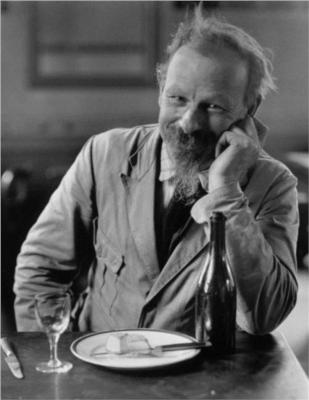
Biography
His subjects were extravagant from the start: biblical processions, scenes from Greek mythology, figures frozen in formal attitudes recalling medieval painting. Le Corbusier was among the first to recognise him, writing about his work in L'Esprit Nouveau in 1922[1] alongside Amédée Ozenfant. By 1927 Sergei Diaghilev had taken notice, commissioning Bauchant to design sets for Stravinsky's Apollon Musagète. These were not small patrons for a self-taught former gardener from Indre-et-Loire.
Wilhelm Uhde placed him in the 1928[1] group exhibition Les Peintres du cœur sacré alongside Henri Rousseau, a pairing that fixed his reputation within the French[1] naïve tradition. His debut at the Salon d'Automne had come in 1921 with Ulysses and the Sirens; a retrospective at Galerie Charpentier in 1949 presented 215 works. By then the Tate in London and MoMA in New York both held his paintings.
The palette he used recalled quattrocento fresco painters: unglazed, flat, colours applied as if on plaster. This was not the result of artistic theory but the organic outcome of a self-taught mind working out its own visual logic, painting by painting.
Timeline
- 1873Born in Touraine.
- 1914Drafted into the First World War and assigned as a mapmaker due to his drawing skills.
- 1919Returned from the war to find his plant nurseries destroyed, leading him to pursue painting at 45.
- 1921Debuted at the Salon d'Automne with "Ulysses and the Sirens".
- 1922Le Corbusier wrote about Bauchant's work in L'Esprit Nouveau.
- 1927Commissioned by Sergei Diaghilev to design sets for Stravinsky's Apollon Musagète.
- 1928Featured in the group exhibition Les Peintres du cœur sacré alongside Henri Rousseau.
- 1949A retrospective at Galerie Charpentier presented 215 works.
- 1958Died at 85.
Notable Works
Tap to view larger.
Next stop
Browse the movements →
Every movement in the collection, from the Renaissance to Pop art.
Related Artists


Frequently Asked Questions
What is Andre Bauchant known for?
Andre Bauchant is known for his self-taught, naïve style, which gained recognition in the 1920s. He was commissioned by Sergei Diaghilev to design sets for Stravinsky's Apollon Musagète and was included in the 1928[1] Les Peintres du cœur sacré exhibition alongside Henri Rousseau.What style or movement did Andre Bauchant belong to?
André Bauchant is usually categorised as a Naive artist, also known as a Modern Primitive. These terms describe artists with little or no formal academic training, who demonstrate an individual, childlike simplicity in their work. Bauchant's style features simplified forms, flattened perspective, and clear, bright colours. His subject matter often drew from historical and mythological scenes, treated with a charmingly unsophisticated approach. It is worth noting that the label "Naive art" is sometimes viewed as problematic. It can imply a lack of skill or intelligence, which is not necessarily the case. Many Naive artists possess considerable technical ability and a sophisticated understanding of colour and composition, even if they do not adhere to traditional academic conventions. Bauchant, like other artists in this category, developed a distinctive and personal style outside the mainstream art world.What was Andre Bauchant known for?
Without more information about Bauchant, a detailed response is not possible. However, based on the reference passages, here's a general answer about what artists are known for: Artists are often known for their individual styles and techniques. Some, like Lubin Baugin (c. 1610-1612[1]-1663), were recognised for their influences; Baugin was called "Le petic Guide" because his work was similar to that of Guido Reni. Others, such as Gentile Bellini (1429-1507), became known as important portraitists, and Bernardo Bellotto (1721-1780) followed his uncle's style of veduta painting. Some artists, like Willi Baumeister (1889[1]-1955), began with figurative work before moving towards abstraction. Certain movements, such as Fauvism, which began around 1905, saw artists using colour outside of its normal context, employing it as their main resource.When did Andre Bauchant live and work?
André Bauchant was born in Château-Renault, France, in 1873[1]. He died in Montoire, France, in 1958[1]. He had no formal training as an artist. He worked as a market gardener until the First World War. After being demobilised from military service, Bauchant devoted himself to painting. He became known for his naive style. His subject matter included historical and mythological scenes, as well as rural life. From 1919[1], he exhibited at the Salon d'Automne and the Salon des Indépendants. These were important annual art exhibitions in Paris. Bauchant also designed sets and costumes for Sergei Diaghilev's Ballets Russes in the late 1920s. His work gained recognition internationally, and he had exhibitions in Europe and the United States.Where can I see Andre Bauchant's work?
André Bauchant's work can be seen in various museums and galleries, mainly in France. Several institutions in Paris hold his pieces, including the Musée des Arts Décoratifs, Musée d’Art Moderne, Musée d’Orsay, and Musée du Louvre. Outside of Paris, museums such as the Musée des Beaux-Arts in Nantes, Musée des Beaux-Arts in Nancy, and Musée de l’Ecole de Nancy also possess works by Bauchant. Other French[1] museums that exhibit his art include the Musée des Beaux-Arts in Rouen, Musée des Beaux-Arts in Dijon, and Musée d’Art et d’Industrie in Saint Etienne and Roubaix. Furthermore, the Musée de Peinture et de Sculpture in Grenoble and Musée Saint-Denis in Reims feature his pieces. These collections offer opportunities to view Bauchant's artistic output.Where was Andre Bauchant from?
André Bauchant was born in Château-Renault, a commune in the Indre-et-Loire department in central France. He was born on 24 April 1873[1]. Before becoming a painter, Bauchant worked as a market gardener. During the First World War, he served as an interpreter due to his knowledge of languages; this exposed him to a wider world, which influenced his later artistic subjects. After the war, Bauchant devoted himself to painting, developing a distinctive naive style. His work often depicted historical or mythological scenes, rendered with a flat perspective and simplified forms. Although he lived and worked in his native region, his art gained recognition in Paris and beyond. He died in Montoire-sur-le-Loir, Loir-et-Cher, on 17 August 1958[1].Who did Andre Bauchant influence?
André Bauchant was a French[1] naive artist. It is difficult to identify specific artists who were directly influenced by him. However, his style and subject matter relate to wider trends in early 20th-century art. Bauchant's simplified forms and interest in historical and pastoral themes connect to the primitivism seen in the work of artists such as Henri Matisse and André Derain. Matisse's impact was widespread, affecting artists across Europe and America. His emphasis on colour and simplified forms influenced figures like André Lhote, who incorporated these lessons into his version of synthetic cubism around 1916[1]. In America, Matisse's ideas impacted artists such as Max Weber, Milton Avery, and Richard Diebenkorn. Bauchant's position within this network of influences is less clear, but his work shares characteristics with the broader movement towards simplification and directness in art that was current at the time.Who influenced Andre Bauchant?
It is difficult to identify specific individuals who directly influenced André Bauchant. However, some general influences can be suggested. Bauchant began painting later in life, without formal academic training. He was therefore largely self-taught, and his style is often categorised as "naïve" or "primitive". These artists often draw inspiration from a variety of sources, including folk art, popular imagery, and their own imagination. It is known that Bauchant exhibited at the Salon d'Automne and the Salon des Indépendants in Paris. These exhibitions exposed him to a wide range of contemporary art movements, such as Fauvism and Cubism. While Bauchant did not adopt these styles wholesale, it is possible he absorbed some elements from them. The artist Henri Rousseau, known as "Le Douanier", was an influence on many artists. Rousseau was introduced to the Société des Artistes Indépendants by Signac, at whose exhibitions he regularly showed his works and where he came into contact with Gauguin, Pissarro and Seurat. Amongst his admirers were Renoir, Redon, Toulouse-Lautrec and Picasso.Why are Andre Bauchant's works important today?
André Bauchant (1873[1]-1958[1]) was a French[1] artist associated with the Naïve art movement. He had no formal artistic training until after serving in World War One, when he was in his forties. Bauchant's work is valued for its unique perspective and self-taught style. His paintings often depict historical or mythological scenes, rendered with simplified forms and bright colours. This distinctive approach offers a refreshing contrast to academic art traditions. In the early 20th century, modern art moved away from movements and manifestos, instead focusing on individual talents. Bauchant's originality, rooted in personal vision rather than formal training, aligns with this shift. His work provides insight into the broader context of early modernism, where artists explored new modes of expression outside established conventions. His paintings are appreciated for their directness and imaginative storytelling. Bauchant's art provides a window into a personal world, one that continues to fascinate viewers today.What was Andre Bauchant's art style?
Andre Bauchant's art style recalled quattrocento fresco painters, using unglazed, flat colours as if applied to plaster. This approach was not based on artistic theory, but rather the result of a self-taught artist developing his own visual logic.How did Andre Bauchant die?
Andre Bauchant died in 1958[1] at the age of 85.
Sources
Editorial draws on the following primary and tertiary references for Andre Bauchant.
- [1] wikipedia Wikipedia: Andre Bauchant Used for: biography, birth dates, death dates, identifiers, movement attribution, nationality.
- [2] book guggenheim-artoftomorrowfif1939gugg Used for: biography.
- [3] book Museum of Fine Arts, Houston, Italian paintings XIV-XVI centuries in the Museum of Fine Arts, Houston Used for: biography.
- [4] book Masterpieces of western art : a history of art in 900 individual studies from the Gothic to the present day Used for: biography.
- [5] book Brodskai︠a︡, Natalʹi︠a︡ Valentinovna, The Fauves _ Art of Century Used for: biography.
- [6] book 1892-1968, Panofsky, Erwin,, Tomb sculpture: four lectures on its changing aspects from ancient Egypt to Bernini Used for: stylistic analysis.
Editorial overseen by Solis Prints. Sources verified 2026-09-30. Click a source for details, or hover over [N] in the page above to preview.
Editorial standardsMethodologyCorrectionsAI disclosureAbout the editorial team