



André Gill
André Gill's most enduring creation is probably a sign he painted in 1875[2] for a Montmartre nightclub: a rabbit leaping from a saucepan, which became the permanent emblem of the Lapin Agile. Yet in his lifetime he was known above all as the leading caricaturist of the French[2] satirical press, the man whose enlarged-head portrait series appeared on hundreds of thousands of magazine covers.
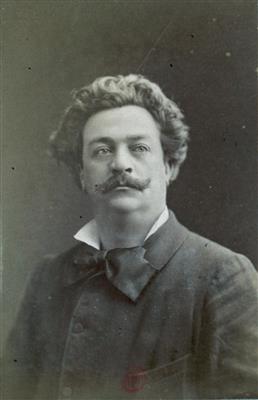
Biography
Born in Paris in 1840[2] as Louis-Alexandre Gosset de Guînes, he trained at the Royal Academy of Painting and Sculpture and adopted his pseudonym as a tribute to the English caricaturist James Gillray. His reputation was made at La Lune from 1865[2] to 1868, where his series The Man of the Day produced caricatures of Victor Hugo, Sarah Bernhardt, Richard Wagner, Charles Dickens, and Giuseppe Garibaldi. When La Lune was censored he moved to L'Éclipse, which ran from 1868 to 1876.
His method was distinctive: he enlarged his subjects' heads onto undersized bodies, creating images that were immediately recognisable without being cruel. The approach was close enough to affectionate to make him popular rather than feared, though one 1868[2] drawing of a pumpkin, interpreted as mocking a judge, still earned him a brief prison sentence. He was named curator of the Musée du Luxembourg in May 1871, an appointment that could not survive the political convulsions of the Paris Commune year.
The last years of his life were spent in severe mental illness. He died in the Charenton asylum on 1 May 1885[2], aged 44. His caricatures had defined the visual grammar of French[2] republican satire for two decades.
Timeline
- 1840Born Louis-Alexandre Gosset de Guînes in Paris.
- 1865Began working at La Lune, creating the series The Man of the Day.
- 1868Drew a caricature of a pumpkin that was interpreted as mocking a judge, resulting in a brief prison sentence.
- 1868Moved to L'Éclipse after La Lune was censored; he worked there until 1876.
- 1871Appointed curator of the Musée du Luxembourg in May, but his appointment was short-lived due to political upheaval.
- 1875Painted a rabbit leaping from a saucepan, which became the emblem of the Lapin Agile nightclub in Montmartre.
- 1885Died at the Charenton asylum on 1 May, aged 44, after spending his last years in severe mental illness.
Notable Works
Tap to view larger.
Where to See André Gill
1 museum worldwide.
-
 1 works
Maison de Victor Hugo
Paris, France
Next stop
Browse the movements →
Every movement in the collection, from the Renaissance to Pop art.
Related Artists


Frequently Asked Questions
What is André Gill known for?
André Gill is known for being the leading caricaturist of the French[2] satirical press. His enlarged-head portrait series appeared on many magazine covers.What is André Gill's most famous work?
André Gill (1840[2]-1885[2]) was a French[2] caricaturist, painter, and songwriter. Although he produced a varied body of work, Gill is best known for his caricatures, particularly those created for the Parisian publication *La Lune*. Gill's most famous single image is arguably his caricature of singer and entertainer, Mademoiselle Thérésa. This image was adopted as the logo for *La Lune* and its successor, *L'Éclipse*. It became widely recognised and associated with Gill's satirical style. Gill's caricatures often targeted political figures and celebrities of his time. His work captured the personalities and social commentary of 19th-century France. He worked for several illustrated papers; his images were reproduced via lithography, allowing for wide distribution. Gill's work provides insight into the humour and social critiques of the period.What should I know about André Gill's prints?
André Gill (1840[2]-1885[2]) was a French[2] caricaturist, whose prints appeared primarily in periodicals. Prints are produced in a number of states or editions. These can include artist proofs (sometimes signed by the artist), lettered proofs, presentation proofs (usually similar to artist's proofs), and proofs before letters (no title engraved). Remarque artist proofs often include a device in the margin. In the 1880s, there was a market expansion for fine art etchings. Specialist publications, such as *The Etcher* and *English Etchings*, were created to meet demand. Continental printmaking had a rich tradition; reproductive etchers from abroad were often hired because they were more affordable than British ones. The Printsellers’ Association did not always record the number of proof impressions of etchings. This means that full edition details are not always available, unlike for mezzotint, line, and mixed-method engravings.What style or movement did André Gill belong to?
André Gill is mostly associated with the styles of caricature and illustration. He made a name for himself during the 19th century in France, a period when caricature gained significant traction as a form of social and political commentary. Gill's work frequently appeared in periodicals, and it often featured satirical depictions of well-known figures. His style is characterised by exaggerated features, expressive lines, and a keen eye for capturing the essence of his subjects. While not formally aligned with a specific art movement, his approach shares similarities with Realism, in its focus on contemporary life and social issues, and with early Expressionism, in its emphasis on emotional expression through distortion. Gill's contributions lie primarily in the realm of popular illustration and visual satire rather than high art movements.What was André Gill known for?
André Gill (1840[2]-1885[2]) was a French[2] caricaturist, best known for his work in the late 19th century. Gill's caricatures often appeared in popular magazines and journals of the time. He worked for publications such as *La Lune* and *L'Éclipse*. These publications allowed him to reach a broad audience with his satirical and often politically charged images. Gill developed a recognisable style, characterised by exaggerated features and expressive lines. He frequently depicted well-known personalities, including politicians, artists, and other public figures. His work provides insight into the social and political climate of the era. Gill's caricatures offer a critical commentary on the events and personalities that shaped French society during the Second Empire and the early years of the Third Republic. Gill's career had a tragic end; he suffered from mental illness and died in a psychiatric hospital in 1885[2].Where can I see André Gill's work?
André Gill's works can be viewed in several locations. In the United Kingdom, institutions holding his pieces include the British Library, the British Museum, the National Gallery, the National Portrait Gallery, Tate, UCL Art Collections (University College), and the Victoria and Albert Museum; all are located in London. Outside of the UK, Gill's art can be found at the Staatliche Museen zu Berlin (Gemiildegalerie and Kupferstichkabinett) in Berlin, the Herzog Anton Ulrich-Museum (Kunstmuseum des Landes Niedersachsen) in Braunschweig, and the Gemiildegalerie Alte Meister (Staatliche Kunstsammlungen Dresden) in Dresden. Other locations include the National Gallery of Scotland in Edinburgh, the Galleria degli Uffizi in Florence, the Stadel Museum (Stadelsches Kunstinstitut und Stadtische Galerie) in Frankfurt am Main, and the Niedersachsisches Landesmuseum in Hanover. You can also find his work at the National Museums Liverpool (Walker Art Gallery) in Liverpool, the J. Paul Getty Museum in Los Angeles, the Museo Thyssen-Bornemisza in Madrid, the Staatliche Graphische Sammlung in Munich, and the Metropolitan Museum of Art in New York.Where was André Gill from?
André Gill (1840[2]-1885[2]) was a French[2] caricaturist. Born Louis-Alexandre Gosset de Guînes in Paris, he adopted the pseudonym André Gill in homage to his idol, James Gillray. Gill found early success creating satirical illustrations for periodicals such as *Le Journal amusant*. His caricatures, often bitingly critical of French society and politics, gained him considerable attention. Gill's style is marked by bold lines and exaggerated features, making his subjects instantly recognisable. He is particularly remembered for his association with *La Lune* and *L'Éclipse*, publications that offered platforms for his politically charged work. Although he experienced periods of obscurity and mental health struggles later in life, Gill's contributions to French satirical art remain significant.Who did André Gill influence?
André Gill's influence can be traced through various artists and movements. In the late 19th century, Frans Hals was acknowledged as a source for Manet and modern painting. Edgar Degas said that Manet “did not paint fingernails because Frans Hals did not depict them”. Writers in France, such as Astruc, recognised Hals’s importance to painters working outside the academy. These painters attempted to position themselves as moderns. Courbet and Manet's emulations affected the perception of Hals at the end of the 19th century. Other independent artists and movements consciously adopted a new concept of originality, placing them in opposition to the Academy. Charles Gleyre (whose pupils included Monet, Renoir, Sisley and Bazille) encouraged his students to make outdoor studies. Thomas Couture's pupil, Edouard Manet, absorbed his unconventional attitudes to light and shade. Couture encouraged students to work rapidly, suppressing detail in favour of direct spontaneity. Delacroix's expressive colour and bold brushwork was revered by younger artists.Who influenced André Gill?
It is difficult to summarise the influences on André Gill (Louis-Alexandre Gosset de Guînes, 1840[2]-1885[2]) with certainty. The references are spread across many sources. Gill was a contemporary of, among others, Victor Hugo (1802-1885[2]), Théophile Gautier (1811-1872[2]), and Charles Dickens (1812-1870), but whether they directly affected his artistic style is unverified. Gill died relatively young, at only 44 years of age. He worked primarily as a caricaturist; his work appeared in publications such as *Le Journal Amusant*. It is reasonable to assume that Gill would have studied the work of other caricaturists, cartoonists, and satirical artists of his period. However, no single dominant influence is obvious from the source material.Why are André Gill's works important today?
André Gill (Louis-Alexandre Gosset de Guînes, 1840[2]-1885[2]) was a French[2] caricaturist. He is remembered today for his satirical illustrations in Parisian publications during the Second Empire and early Third Republic. Gill's caricatures frequently appeared in periodicals such as *Le Charivari*, *La Lune*, and *L'Éclipse*. These publications offered sharp political and social commentary. His images captured the likenesses of prominent figures, including politicians, artists, and other celebrities, often exaggerating their features for comic or critical effect. His style is notable for its bold lines and expressive distortions. Gill's work provides insight into the political and cultural climate of France during a period of significant change. His caricatures offer a visual record of the personalities and events that shaped the era. Gill's influence extended to later generations of artists. His innovative approach to caricature helped to establish it as a powerful form of social and political critique. His images remain relevant as historical documents and examples of graphic satire.What was André Gill's art style?
Gill's distinctive style involved enlarging his subjects' heads onto undersized bodies. His caricatures were recognisable without being cruel, making him popular.
Sources
Editorial draws on the following primary and tertiary references for André Gill.
- [1] museum Maison de Victor Hugo Used for: museum holdings.
- [2] wikipedia Wikipedia: André Gill Used for: biography, birth dates, death dates, identifiers, movement attribution, nationality.
- [3] book Masterpieces of western art : a history of art in 900 individual studies from the Gothic to the present day Used for: biography.
- [4] book Meyer, James Sampson, 1962-, Minimalism : art and polemics in the sixties Used for: stylistic analysis.
- [5] book Martha Langford (editor); Johanne Sloan (editor), Photogenic Montreal _ Activisms and Archives in a Post-industrial City Used for: biography.
- [6] book Post-impressionism : cross-currents in European painting Used for: biography.
- [7] book Engen, Rodney K, Pre-Raphaelite prints : the graphic art of Millais, Holman Hunt, Rossetti and their followers Used for: biography.
- [8] book Tillyard, S. K, The impact of modernism, 1900-1920 : early modernism and the arts and crafts movement in Edwardian England Used for: biography.
Editorial overseen by Solis Prints. Sources verified 2026-09-30. Click a source for details, or hover over [N] in the page above to preview.
Editorial standardsMethodologyCorrectionsAI disclosureAbout the editorial team