



Andre Kertesz
In 1926[1], André Kertész walked into Piet Mondrian's Paris studio and photographed two pairs of glasses and a pipe resting in a bowl on a table corner. The resulting gelatin silver print (8 × 9 cm, now in the Médiathèque de l'Architecture et du Patrimoine) is a precise visual analogue for the Dutch painter's own compositional thinking: Kertész had arrived in Paris the previous year from Budapest, already knowing how to find geometry in ordinary things.
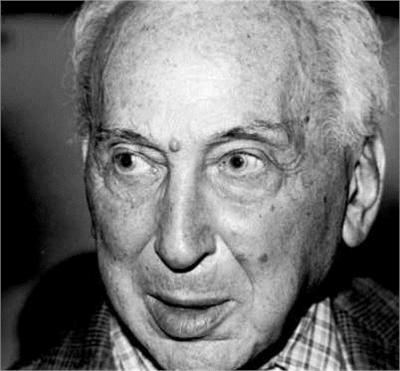
Biography
His subjects in those Paris years were often men who did not fit the official story of postwar recovery: drunks at café tables, amputees, the occasionally homeless. A 1928[1] photograph placed a slumped man beneath an Ovomaltine advertisement reading "donne des forces" ("gives strength"), the contrast needing no further commentary. He knew Man Ray and Brassaï through the Surrealist milieu, though he denied formal affiliation with Breton's group.
In early 1933[1], the magazine "Le Sourire" commissioned the Distortions series, in which fun-house mirrors transformed female nudes into deformed, undulating shapes. The series appeared with a text proclaiming them "a window open onto the beyond." Unpublished glass negatives of the sessions show the full studio setup, model and mirror both visible, the magic made matter-of-fact.
His book "Paris vu par André Kertész" (Plon, 1934[1]), with a text by Pierre Mac Orlan, gathered the decade's Paris work. He emigrated to New York in 1936, where he spent the remainder of his life, dying in 1985[1] aged 91.
Timeline
- 1894Born in Budapest.
- 1925Moved from Budapest to Paris.
- 1926Photographed Piet Mondrian's studio, capturing two pairs of glasses and a pipe in a bowl.
- 1928Photographed a slumped man beneath an Ovomaltine advertisement.
- 1933Commissioned by "Le Sourire" magazine to create the Distortions series, featuring female nudes reflected in fun-house mirrors.
- 1934Published "Paris vu par André Kertész" (Plon), a collection of his Paris photographs, with text by Pierre Mac Orlan.
- 1936Emigrated to New York.
- 1985Died in New York at 91.
Notable Works
Tap to view larger.
Next stop
Browse the movements →
Every movement in the collection, from the Renaissance to Pop art.
Frequently Asked Questions
What is Andre Kertesz known for?
André Kertész is known for his pioneering approach to photographic composition during the first half of the twentieth century. In his Paris years, he photographed men who did not fit the official story of postwar recovery, such as drunks and the homeless.What is Andre Kertesz's most famous work?
André Kertész was a Hungarian-born photographer known for his pioneering contributions to photojournalism and his use of unconventional composition. While he produced a wide array of celebrated images throughout his career, one of his most recognisable and discussed works is often considered to be 'Fork', 1928[1]. This photograph features a simple metal fork resting on a plate, its tines casting elongated shadows. The image transforms an everyday object into a study of form, light, and shadow. 'Fork' demonstrates Kertész's ability to find beauty in the mundane, a quality that is a characteristic of his photographic style. The image is part of a series of still lifes Kertész created during his time in Paris, and it has been widely exhibited and reproduced, solidifying its place as a signature piece within his body of work.What should I know about Andre Kertesz's prints?
André Kertész (1894[1]-1985[1]) was a Hungarian-born photographer known for his pioneering approach to photographic composition. In 1925[1], he moved to Paris, where he associated with progressive artists such as Fernand Léger and Tristan Tzara. His prints often capture simple objects in elegant arrangements, revealing a clarity of vision. One example is "Mondrian’s Pipe and Glasses" (1926), a gelatin silver print taken in Piet Mondrian’s studio. It depicts Mondrian's glasses and pipe in a bowl, evoking the purity associated with the Dutch artist's paintings. This work was included in Kertész’s first solo exhibition at the Au Sacre du Printemps Gallery. In 1933, Kertész created a series of distorted female nudes, commissioned by A.-P. Barancy, editor of *Le Sourire*, and published in *Arts et Métiers Graphiques*. These images used fun-house mirrors to create odd, fragmented bodies. Some critics view them as surrealist pinups, made to titillate viewers. Kertész also created male distortion images, but these are less well known. The female distortions were later presented as examples of Kertész's avant-garde style.What style or movement did Andre Kertesz belong to?
André Kertész, a Hungarian-born photographer who moved to Paris in 1925[1], is associated with several artistic movements. He became acquainted with progressive artists, including Fernand Léger and the Dada poet Tristan Tzara. His work from the late 1920s shares characteristics with Surrealism. Like the Surrealists Man Ray and Brassaï, Kertész employed visual juxtaposition and surprise in his photography. He captured images of weak or damaged men, contrasting them with advertisements promoting a healthy, robust image of French masculinity. This technique, also common in advertising at the time, allowed him to question the effects of the First World War on the male population. In 1933, Kertész created a series of distorted female nudes, which have often been linked to Surrealism. These photographs, commissioned by the magazine *Le Sourire*, presented a voyeuristic view of the female body through the use of distorting mirrors. While some critics view them as Surrealist pinups, others see them as part of Kertész's broader exploration of cultural conflict and social anxieties.What techniques or materials did Andre Kertesz use?
André Kertész is known for his pioneering approach to photographic composition. His techniques varied, but he is best known for black and white photography using gelatin silver prints. In 1925[1], Kertész moved to Paris, where he associated with avant-garde artists. His early work included images of everyday objects, such as "Mondrian’s Pipe and Glasses" (1926), taken in Piet Mondrian's studio. Later, in 1933, Kertész created a series of female distortions using mirrors. Unpublished glass negatives reveal his studio set-up, showing the distance between the model and the distorted reflection. By stepping back, Kertész exposed the fiction of the distorted bodies, contrasting with images where the mirror's role is hidden, making the deformations appear intrinsic to the body. These images were made as a commercial enterprise.What was Andre Kertesz known for?
André Kertész (born in Budapest in 1894[1]; died in New York in 1985[1]) is known for his early, pioneering approach to photographic composition. He moved to Paris in 1925[1] and became associated with progressive artists such as Fernand Léger and Tristan Tzara. His first solo exhibition was held at the avant-garde Au Sacre du Printemps Gallery. Kertész's photography often captured the realities of interwar France. He photographed weak, damaged, or homeless men, contrasting them with images of robust figures in advertisements. One such photograph, taken in 1928, depicts a man at a Parisian café alongside an Ovomaltine poster. This juxtaposition highlighted the difference between the ideal of healthy manhood and the actuality of men's lives after the First World War. Later, Kertész created the series *Distortions*, a collection of photographs of female nudes using distorting mirrors. These works were commissioned in 1933 by A.-P. Barancy, editor of *Le Sourire*, and later appeared in *Arts et Métiers Graphiques*. These images, with their mix of attention to detail and distortion, have been interpreted as both surrealist pinups and examples of avant-garde art.When did Andre Kertesz live and work?
André Kertész was born in Budapest, Hungary, in 1894[1]. He died in New York City in 1985[1]. His photographic career spanned much of the 20th century, during which he lived and worked in Hungary, France, and the United States. Kertész served in the Austro-Hungarian army from 1914[1] to 1918, and after the war, he moved to Paris in 1925, where he worked as a freelance photographer for publications such as *Berliner Illustrierte Zeitung*. He became part of the artistic community, alongside figures like Piet Mondrian and Constantin Brancusi. In 1936, Kertész relocated to New York City, where he initially struggled to gain recognition. He worked for *Harper's Bazaar* and *Vogue*, but he did not enjoy the constraints of commercial work. Later in life, Kertész received considerable recognition for his artistic contribution to photography.Where can I see Andre Kertesz's work?
André Kertész's work can be viewed in several locations. In the United States, you can find his photographs at the Metropolitan Museum of Art, the Museum of Modern Art and the National Gallery of Art in Washington, DC. Other US institutions holding his work include the George Eastman House in Rochester, the Philadelphia Museum of Art, and the Carnegie Museum of Art in Pittsburgh. Kertész is also represented in European collections. Musée d'Orsay in Paris holds some examples. You can also find his images at the National Gallery of Canada in Ottawa. The National Museum of Photography, Film & Television and the Royal Photographic Society in the United Kingdom also hold a number of his works.Who did Andre Kertesz influence?
André Kertész (1894[1]-1985[1]) was associated with progressive artists in Paris after he emigrated from Hungary in 1925[1]. These included Fernand Léger and Tristan Tzara. His work influenced later photographers, especially in the fields of photojournalism and surrealist photography. Henri Cartier-Bresson, who began as a Cubist painter, turned to photography in 1932 and became known for capturing the 'decisive moment'. His odd juxtapositions had a surrealist element. Kertész's documentary impulses and sharp visual juxtapositions also had an impact on Eugène Atget, who chronicled Paris and its street life. Like Atget, Kertész captured both the promise and the terror of commodity culture. Surrealist photographers such as Bill Brandt, Jerry Uelsmann, and Lucas Samaras were inspired by surrealist photographers like Man Ray, Dora Maar, and Claude Cahun. They created special-effect or fantasy photography, using superimposition and composite images to create dreamlike images.Who influenced Andre Kertesz?
In Paris, André Kertész associated with progressive artists such as Fernand Léger and Tristan Tzara. His photograph, *Mondrian’s Pipe and Glasses* (1926[1]), taken in Piet Mondrian's studio, evokes the purity of vision found in the Dutch artist’s paintings. Kertész's work has been linked to Surrealism, particularly his distorted female nudes from 1933. These photographs were published alongside poetic text by A.-P. Barancy, in *Le Sourire*. Some of his works appeared in the 1985[1] exhibition catalogue, *L'Amour Fou: Photography and Surrealism*. Henri Cartier-Bresson also moved from painting to photography. As a young man, Cartier-Bresson studied painting with André L’Hote, who aimed to combine Cubism with classical French painting. L’Hote's teachings influenced Cartier-Bresson's photographic composition, giving him the ability to recognise arrangements of forms, lines, shadows, and highlights. Cartier-Bresson briefly explored Surrealism, attempting to capture the unconscious.Who was Andre Kertesz?
André Kertész (1894[1]-1985[1]) was a Hungarian-born photographer known for his pioneering approach to photographic composition. He emigrated to Paris in 1925[1], where he became associated with progressive artists, including Fernand Léger and Tristan Tzara. His work often explored themes related to the effects of World War I on the male population, depicting weakened or disenfranchised men in the urban environment. Kertész's photographs captured the distance between the idealised images of postwar manhood and the realities of men's lives. He used visual juxtaposition to question the state's strategy of tying postwar reconstruction to male labour. In 1933, Kertész created a series of distorted female nudes, commissioned by the magazine Le Sourire. These photographs, produced using fun-house mirrors, were initially seen as commercial erotica. Later, they were recognised as examples of Kertész's avant-garde artistry. The series has been linked to surrealism due to its use of distortion and its exploration of the female form.Why are Andre Kertesz's works important today?
André Kertész (born in Budapest, 1894[1]; died in New York, 1985[1]) moved to Paris in 1925[1] and became associated with progressive artists such as Fernand Léger and Tristan Tzara. His photographs offer insights into surrealism's historical and aesthetic context. His early work captured the cultural mood of interwar France. Rather than presenting idealised images, Kertész often focused on the weakened or damaged men who populated the urban environment, revealing a contrast between fantasies of postwar manhood and the realities of the time. He used visual juxtaposition to question the narrative of reconstruction tied to male labour, capturing the distance between the public image and the lived experiences of men after the First World War. His photographs from this period reflect a surrealist approach. They present city streets as disturbing outdoor museums, filled with objects that trigger surrealist experiences. Kertész also explored representations of the damaged male body, incorporating these experimental images into female forms, such as the "Distortions" series, commissioned by *Le Sourire* magazine in 1933. These works, using distorting mirrors, played with visual objectification and challenged conventional ideas about social norms.
Sources
Editorial draws on the following primary and tertiary references for Andre Kertesz.
- [1] wikipedia Wikipedia: Andre Kertesz Used for: biography, birth dates, death dates, identifiers, movement attribution, nationality.
- [2] book Beard, Lee, 1973- author, Butler, Adam, author; Van Cleave, Claire, author; Fortenberry, Diane, author; Stirling, Susan, author, Beard, Lee, 1973- author, Butler, Adam, author; Van Cleave, Claire, author; Fortenberry, Diane, author; Stirling, Susan, author - The Art Book_ New Edition, Mini Format Used for: biography, stylistic analysis.
- [3] book guggenheim-secondenlargedca1937gugg Used for: biography.
- [4] book Amy Lyford, Surrealist masculinities _ gender anxiety and the aesthetics of post-World War I reconstruction in France Used for: biography, stylistic analysis.
Editorial overseen by Solis Prints. Sources verified 2026-08-03. Click a source for details, or hover over [N] in the page above to preview.
Editorial standardsMethodologyCorrectionsAI disclosureAbout the editorial team