



Andrea Pozzo
A single marble disc set into the floor of Sant'Ignazio in Rome marks the spot from which Andrea Pozzo's ceiling fresco makes complete sense. Stand anywhere else and the painted columns look skewed; stand on the disc and the vault appears to dissolve, replaced by an open sky through which Saint Ignatius ascends towards Christ, surrounded by allegorical figures representing the four corners of the earth. Completed in 1694[1], the fresco covers roughly 36 by 17 metres and remains one of the most disorienting experiences in Baroque[1] painting.
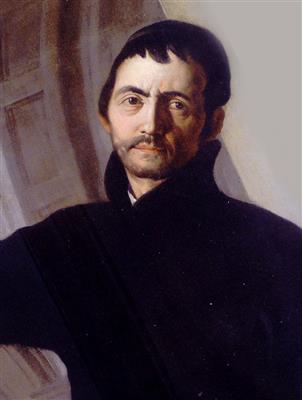
Biography
Pozzo was a Jesuit lay brother, not a formally trained painter. He entered the order in 1665[1] and largely educated himself by copying Venetian and Lombard masters before the Jesuit father general Gian Paolo Oliva summoned him to Rome in 1681. His first major Roman commission was quadratura fresco work in the corridor adjacent to St Ignatius's rooms at the Gesù (1681-1686[1]). He followed this with an illusionistic painted dome inserted into the choir of Sant'Ignazio in 1685, a practical solution to a funding shortfall that had left the building without its intended masonry dome. The painted canvas was so convincing that congregants initially assumed it was real.
The theoretical apparatus behind his illusionism was codified in Perspectiva pictorum et architectorum, published in two volumes in 1693[1] and 1698. The treatise, illustrated with engravings of altars, churches, and theatrical stages, was translated into German, English, Flemish, and Chinese, giving Baroque[1] church decoration its most influential manual and spreading the Jesuit ceiling style across Catholic Europe and into East Asia.
In 1702[1], Emperor Leopold I brought Pozzo to Vienna, where he painted the salon ceiling at the Liechtenstein Palace (1704-07) and designed churches in Dubrovnik and Ljubljana that shaped Central European Baroque[1] for a generation. He died in the city in 1709[1].
Timeline
- 1642Born in Italy.
- 1665Entered the Jesuit order.
- 1681Summoned to Rome by Jesuit father Gian Paolo Oliva.
- 1681Began quadratura fresco work in the corridor adjacent to St Ignatius's rooms at the Gesù (completed in 1686).
- 1685Inserted an illusionistic painted dome into the choir of Sant'Ignazio, Rome.
- 1693Published the first volume of Perspectiva pictorum et architectorum.
- 1694Completed the ceiling fresco in Sant'Ignazio, Rome.
- 1698Published the second volume of Perspectiva pictorum et architectorum.
- 1702Brought to Vienna by Emperor Leopold I.
- 1709Died in Vienna at 67.
Notable Works
Tap to view larger.
Next stop
Baroque →
Explore the artists and ideas of Baroque.
Related Artists


Frequently Asked Questions
When did Andrea Pozzo live and work?
Andrea Pozzo was born in Trento in 1642[1] and died in 1709[1]. He was active as a painter, architect, sculptor, theatrical stage designer, and art theoretician. In 1665[1], Pozzo became a Jesuit lay brother. Three years later, the order sent him to Milan. By 1671, he was creating decorations for a festival honouring the canonisation of the Jesuit priest St Francis Borgia. He established a reputation as a painter, and in 1678, he was summoned to Turin to create frescoes in the Church of Santi Martiri. That same year, he decorated the Church of San Francesco in Mondovi with a nave fresco depicting the Apotheosis of St Francis Xavier. In 1681, Gian Paolo Oliva, father general of the Society of Jesus, called Pozzo to Rome. There, he painted quadratura frescoes in the corridor to the Camere di Sant’Ignazio in the Church of Il Gesù between 1681 and 1686. By 1685, he painted an illusionistic dome in the centre of the choir of the Jesuit Church of Sant’Ignazio. His St Ignatius in Glory, created between 1691 and 1694, in the Church of Sant’Ignazio in Rome, is considered a Baroque[1] masterpiece.Where was Andrea Pozzo from?
Andrea Pozzo was born in 1642[1], in Trento, Italy. He is remembered as an Italian painter, architect, sculptor, theatrical stage designer, and art theoretician of the Baroque[1]. In 1665[1], Pozzo became a Jesuit lay brother. Three years later, the order sent him to Milan. By 1678, he had established a reputation as a painter, and he was summoned to Turin to create frescoes in the Church of Santi Martiri. That same year, he decorated the Church of San Francesco in Mondovi with a nave fresco depicting the Apotheosis of St Francis Xavier. Pozzo was summoned to Rome in 1681 to paint frescoes in the corridor to the Camere di Sant’Ignazio in the Church of Il Gesù. By 1685, he had painted an illusionistic dome in the Jesuit Church of Sant’Ignazio. In 1702, Pozzo was called to Vienna, where he decorated the Jesuit church, now the University Church, and painted the ceiling of the salone in the Liechtenstein Summer Palace (1704-07). He died in Vienna in 1709[1].Who did Andrea Pozzo influence?
Andrea Pozzo, a Jesuit lay brother, was an Italian painter, architect, sculptor, theatrical stage designer, and art theoretician. Though not strictly an architect, his two-volume treatise, *Perspectiva pictorum et architectorum*, published in 1693[1] and 1698, had a considerable effect on architects across Europe. Translations appeared in English, German, and Flemish; a manuscript version even appeared in Chinese. The treatise includes diagrams for drawing the orders in perspective, along with designs for altars, tabernacles, temporary structures for festivals, all designed with complex curvilinear plans and architectural features, in a manner similar to Antonio Gherardi. Pozzo's ceiling fresco in Sant'Ignazio in Rome represents a high point in Roman church interior decoration. Called to Vienna in 1702, he decorated the Jesuit church (now the University Church) and painted the ceiling of the salone in the Liechtenstein Summer Palace (1704-1707[1]). His work influenced Austrian architects and decorators.Who was Andrea Pozzo?
Andrea Pozzo was an Italian painter, architect, sculptor, theatrical stage designer, and art theoretician. He was also a Jesuit, becoming an architect and a painter through his own genius, rather than formal instruction.What was Andrea Pozzo's art style?
The passages suggest that Andrea Pozzo developed a good style in colouring and design by copying Venetian and Lombard masters. He improved his style in Rome.How did Andrea Pozzo die?
Andrea Pozzo died in 1709[1] at the age of 67.
Sources
Editorial draws on the following primary and tertiary references for Andrea Pozzo.
- [1] wikipedia Wikipedia: Andrea Pozzo Used for: biography, birth dates, death dates, identifiers, movement attribution, nationality.
- [2] book Lilian H. Zirpolo, Historical Dictionary of Baroque Art and Architecture Used for: biography.
- [3] book Blunt, Anthony, 1907-1983, Roman Baroque Used for: biography.
- [4] book Mrs. Mary P. Merrifield, The Art of Fresco Painting in the Middle Ages and the Renaissance Used for: biography.
Editorial overseen by Solis Prints. Sources verified 2026-10-07. Click a source for details, or hover over [N] in the page above to preview.
Editorial standardsMethodologyCorrectionsAI disclosureAbout the editorial team