



Anna Ostroumova-Lebedeva
Anna Ostroumova-Lebedeva's woodcuts of Saint Petersburg did something photographs of the city rarely managed: they made its grey canals and baroque facades feel both monumental and intimate. Born in the city in 1871[1], she spent most of her career engraving the same streets in wood, building a body of work that still defines how the Russian[1] north is visually remembered.
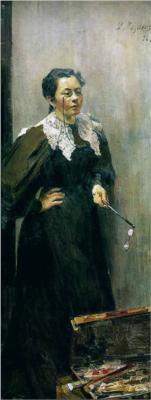
Biography
Her training was exceptional by any measure. After studying at the Stieglitz Central College from 1889[1], she entered the Imperial Academy of Arts in 1892 under Ilya Repin. From 1898 to 1899 she studied in Paris in James Whistler's studio, absorbing his tonal discipline and his serious engagement with Japanese woodcut traditions. She joined the World of Art group in 1899, the circle around Sergei Diaghilev that was then redefining Russian[1] visual culture.
Her first major Saint Petersburg series, produced in 1901[1] for the World of Art journal, included Saint Petersburg: New Holland, a print that established her signature qualities: a clean architectural line, a limited colour palette, and an awareness of what to leave out. She returned to the city's topography repeatedly, producing a lithograph album in 1922 and the Pavlovsk engraving series in 1922-23. In 1942, during the Siege of Leningrad, she produced postcards of city views for soldiers at the front.
She also travelled extensively: xylographs of Finland, Paris, Venice, the Italian lakes, and the Baku oil fields of the Caucasus demonstrate that her appetite for topographic subjects went well beyond her home city. She taught at the Leningrad Academy until 1936[1], and her bookplate commissions for Ivan Pavlov and others place her inside the intellectual milieu of Soviet Leningrad.
Timeline
- 1871Born in Saint Petersburg.
- 1889Began studies at the Stieglitz Central College.
- 1892Entered the Imperial Academy of Arts under Ilya Repin.
- 1898Studied in Paris at James Whistler's studio until 1899, absorbing tonal discipline and engagement with Japanese woodcut traditions.
- 1899Joined the World of Art group, led by Sergei Diaghilev.
- 1901Produced her first major Saint Petersburg series for the World of Art journal, including "Saint Petersburg: New Holland".
- 1922Produced a lithograph album of Saint Petersburg.
- 1922Produced the Pavlovsk engraving series in 1922-23.
- 1936Stopped teaching at the Leningrad Academy.
- 1942During the Siege of Leningrad, she produced postcards of city views for soldiers.
Notable Works
Tap to view larger.
Next stop
Browse the movements →
Every movement in the collection, from the Renaissance to Pop art.
Anna Ostroumova-Lebedeva prints
Hand-finished archival prints from Anna Ostroumova-Lebedeva's body of work.
 Moonlit Night Landscape - Anna Ostroumova-Lebedeva
From £28.00
Moonlit Night Landscape - Anna Ostroumova-Lebedeva
From £28.00
 Petersburg. Rostral column and Exchange - Anna Ostroumova-Lebedeva
From £28.00
Petersburg. Rostral column and Exchange - Anna Ostroumova-Lebedeva
From £28.00
 Winter - Anna Ostroumova-Lebedeva
From £30.00
Winter - Anna Ostroumova-Lebedeva
From £30.00
 Rainbow - Anna Ostroumova-Lebedeva
From £28.00
Rainbow - Anna Ostroumova-Lebedeva
From £28.00
 Self-portrait - Anna Ostroumova-Lebedeva
From £28.00
Self-portrait - Anna Ostroumova-Lebedeva
From £28.00
 Neva through the columns of the Exchange - Anna Ostroumova-Lebedeva
From £28.00
Neva through the columns of the Exchange - Anna Ostroumova-Lebedeva
From £28.00
Related Artists



Take Anna Ostroumova-Lebedeva home.
See all Anna Ostroumova-Lebedeva prints →Frequently Asked Questions
What is Anna Ostroumova-Lebedeva known for?
Anna Ostroumova-Lebedeva is known for her woodcuts of Saint Petersburg. Her prints captured the city's canals and baroque facades, conveying both monumentality and intimacy.What is Anna Ostroumova-Lebedeva's most famous work?
Anna Ostroumova-Lebedeva (1871[1]-1955[1]) was a Russian[1] artist, primarily known for her wood engravings and watercolours. She was one of the first women to become a wood-engraver in Russia. While it is difficult to identify a single "most famous" work, her cityscapes of St Petersburg are among her most recognisable and celebrated. These works often depict the city's canals, bridges, and architectural landmarks. They capture the atmosphere of St Petersburg with a distinctive style that blends realism and a sense of romanticism. Ostroumova-Lebedeva's series of St Petersburg views, created mainly in the early 20th century, gained considerable attention. These prints and watercolours were praised for their technical skill and artistic interpretation. They offer a view into the city's unique character, and they remain popular among collectors and admirers of Russian art. Her contributions to Russian art history are significant, particularly in the realm of printmaking.What should I know about Anna Ostroumova-Lebedeva's prints?
Anna Ostroumova-Lebedeva (1871[1]-1955[1]) was a Russian[1] artist known for her work in printmaking, specifically woodcuts and lithography. During the early 20th century, artists in Russia experimented with printmaking techniques, sometimes using lithography and woodcuts for book covers and posters. These prints often featured bold graphics and typography. Aleksandr Rodchenko, Varvara Stepanova, and El Lissitzky are other artists who employed similar techniques. Their work includes lithographic covers for publications such as *New Lef*, *Red Students*, *Soviet Cinema*, and *Architecture: Works from the Architecture Faculty of Vkhutemas*. Stepanova also created a lithograph cover for Vladimir Maiakovskii's *Menacing Laughter* in 1932[1]. These prints were not always on high-quality materials, with artists sometimes using cheaper stock and woodblock illustrations.What style or movement did Anna Ostroumova-Lebedeva belong to?
Anna Ostroumova-Lebedeva was associated with several artistic movements during her career. Her early work has links to the Symbolist movement, which favoured subjective expression and mystical themes. Later, she became involved with the Mir iskusstva (World of Art) group, which promoted a revival of interest in classical art and design, and the integration of art into everyday life. After the Russian[1] Revolution, Ostroumova-Lebedeva engaged with artistic trends in the Soviet Union. Although not directly associated with Constructivism, which focused on functional design and the abolition of alienation in art, she adapted her style to align with the new Soviet ideology. The emphasis on surface and figural construction in painting during this period also influenced her artistic approach. Her wood engravings, particularly those depicting urban subjects, demonstrate a concern with form and composition that reflects the artistic debates of the time.What techniques or materials did Anna Ostroumova-Lebedeva use?
Anna Ostroumova-Lebedeva was a printmaker known for her mastery of wood engraving and watercolour. She studied at the Stieglitz School in Saint Petersburg, and later with James Whistler. Wood engraving is a relief printing technique using the end grain of a block of wood. This allows for finer detail than traditional woodcuts, which use the side grain. Ostroumova-Lebedeva's prints often feature delicate lines and subtle tonal variations, achieved through careful manipulation of the engraving tools. Watercolour was another important medium for Ostroumova-Lebedeva. She frequently combined watercolour washes with her wood engravings, adding colour and atmosphere to her compositions. Her watercolours demonstrate a delicate touch and a sensitivity to light and colour. She often used a limited palette, creating a sense of harmony and unity in her work. Her artistic practice included both printmaking and painting, often in combination. She is recognised for her skill in both disciplines.What was Anna Ostroumova-Lebedeva known for?
Anna Ostroumova-Lebedeva (1871[1]-1955[1]) was a Russian[1] artist, and an important female member of the World of Art association, close to their journal, *Mir iskusstva*. She is known as one of the group's members who reappropriated images of 18th-century St Petersburg. After the October Revolution, the State Porcelain Factory began producing sculptures reflecting the new reality. There was a bust of Marx, in two sizes, by Kuznetsov (1918[1]) and then *Krasnogvardeets* (The Red Guard, 1918), also by Kuznetsov. This defender of the people's state is the first Soviet sculpture in porcelain representing a man of the new epoch. Her familiarity with icons encouraged her to disregard perspective in her many fantastic compositions for porcelain. Her designs are full of energy and impetuous rhythm with exaggerated frontal figures and objects. Occasionally she portrayed people of the new regime.When did Anna Ostroumova-Lebedeva live and work?
Anna Ostroumova-Lebedeva (1871[1]-1955[1]) was a Russian[1] artist, primarily known for her watercolour paintings and wood engravings. She was born in St Petersburg, and much of her career was centred in that city (later named Petrograd, then Leningrad). She studied at the Stieglitz School of Technical Drawing, and later at the Imperial Academy of Arts, under Ilya Repin. Ostroumova-Lebedeva travelled to Paris to study with James McNeill Whistler in 1898[1]. She joined the Mir iskusstva (World of Art) movement in 1899, becoming a prominent member. The group promoted artistic innovation and the synthesis of various art forms. During the early Soviet period, Ostroumova-Lebedeva continued to work in Leningrad, producing city views that reflected the changing urban environment. She taught at the Leningrad Institute of Painting, Sculpture and Architecture from 1934 to 1935. She remained active as an artist until her death in 1955.Where can I see Anna Ostroumova-Lebedeva's work?
Anna Ostroumova-Lebedeva's artworks can be viewed in several museum collections. These include the State Russian[1] Museum in St. Petersburg, the State Tret'iakov Gallery in Moscow, and the Kuskovo State Porcelain Museum. Others are the Museum Ludwig (Collection Ludwig, Cologne) and the Museum of Fine Arts, Ekaterinburg. Some specific examples include Costume design for Nikolai Gogol', The Inspector General, House of Publishing, Leningrad, 1927[1], held at the State Russian Museum, St. Petersburg. Also, Vasilii Kandinskii's White Oval, 1919, is at the State Tret'iakov Gallery, Moscow and his Composition No. 224 (On White I), 1920, is at the State Russian Museum, St. Petersburg. Finally, his Cup and saucer, 1923, is part of the Kuskovo State Porcelain Museum collection.Where was Anna Ostroumova-Lebedeva from?
Anna Ostroumova-Lebedeva was born in St Petersburg, Russia, in 1871[1]. She came from an upper middle-class family; her father worked as a government official. Ostroumova-Lebedeva began her artistic training in St Petersburg, first at the Stieglitz Central School of Technical Drawing, then at the Imperial Academy of Arts. At the Academy, she studied under Ilya Repin, a leading Russian[1] realist painter. She was one of the first women to graduate from the Academy. Although she travelled widely in Europe, including to Paris to study with James McNeill Whistler, St Petersburg remained her home and the primary subject of her art. She is particularly known for her cityscapes of St Petersburg, capturing its architecture, canals, and atmosphere in various seasons. She died in Leningrad (as St Petersburg was then known) in 1955[1]. Her work offers a valuable record of the city's appearance during the late 19th and early 20th centuries.Who did Anna Ostroumova-Lebedeva influence?
Anna Ostroumova-Lebedeva (1871[1]-1955[1]) was a Russian[1] artist known for her wood engravings and watercolours, particularly cityscapes. Though sources don't directly discuss those she influenced, some connections can be drawn between her and other artists. Elizaveta Kruglikova, a contemporary of Ostroumova-Lebedeva, also worked with printmaking techniques, including monotype. Both artists captured city life in their works; Kruglikova focused on Paris, while Ostroumova-Lebedeva depicted St. Petersburg. Liubov Popova and Vera Udaltsova were influenced by French Cubism, evident in their adoption of Cubist principles. Udaltsova explored Cubism as an exercise in analysis and deconstruction, sometimes incorporating Cyrillic characters to give her work a Russian identity. These artists, including Ostroumova-Lebedeva, contributed to the diverse artistic environment of early 20th-century Russia.Who influenced Anna Ostroumova-Lebedeva?
Anna Ostroumova-Lebedeva's artistic development occurred in the context of late 19th- and early 20th-century Russian[1] art. She entered the art world at a time when artists explored new approaches. Training at the Stieglitz School of Technical Drawing, and later at the Imperial Academy of Arts, exposed her to diverse styles. At the Academy, she studied under Ilya Repin, a prominent Russian realist painter. Repin's influence can be seen in her early works, which display a concern for realistic representation. Exposure to Western European art also shaped her style. A period in Paris allowed her to study with James McNeill Whistler, whose influence led to an appreciation for atmospheric effects and tonal harmonies, particularly in her cityscapes. Whistler's aestheticism, with its emphasis on mood and subtle colour, resonated with Ostroumova-Lebedeva's artistic sensibilities. She adapted these influences, synthesising them with her own vision to create a distinctive style, particularly evident in her wood engravings and watercolours of St Petersburg.Why are Anna Ostroumova-Lebedeva's works important today?
Anna Ostroumova-Lebedeva (1871[1]-1955[1]) was one of Russia's first female wood-engravers. She is also noted for her cityscapes in watercolour and other media. She studied with, and was influenced by, James McNeill Whistler. She later became a member of the artistic group Mir iskusstva (World of Art), associated with Léon Bakst and Alexandre Benois. This group favoured Symbolist and Art Nouveau styles. They often looked to the past for inspiration, in particular to eighteenth-century art and design. During the early Soviet era, Ostroumova-Lebedeva continued to produce city views. However, these prints and watercolours reflected the new political order. She depicted a modernising, industrialising city. Her style moved away from Art Nouveau towards a more realist aesthetic, suiting the new regime's preferences. She also taught printmaking at various institutions. Today, her works provide insight into the artistic transitions of early twentieth-century Russia. They document both the pre-revolutionary and Soviet periods. Her technical skill in wood engraving, a medium that experienced a revival at the turn of the century, is also significant.
Sources
Editorial draws on the following primary and tertiary references for Anna Ostroumova-Lebedeva.
- [1] wikipedia Wikipedia: Anna Ostroumova-Lebedeva Used for: biography, birth dates, death dates, identifiers, movement attribution, nationality.
- [2] book 01-2015-druck.indd Used for: stylistic analysis.
- [3] book Berghaus, Günter(Editor), 2015 Used for: stylistic analysis.
- [4] book guggenheim-amazonsofavantga00exte Used for: biography, stylistic analysis.
- [5] book Yevgenia Petrova (editor), Origins of the Russian avant-garde_ celebrating the 300th anniversary of St. Petersburg_ the Walters Art Museum, Baltimore (13 February-25 May 2003), Fine Arts Museums of San Francisco (29 June-21 September 2003) Used for: biography.
- [6] book Peter. Leek, Russian Painting Used for: biography.
Editorial overseen by Solis Prints. Sources verified 2026-10-14. Click a source for details, or hover over [N] in the page above to preview.
Editorial standardsMethodologyCorrectionsAI disclosureAbout the editorial team