



Anne Vallayer-Coster
- allegory
- genre art
- still life
- portrait
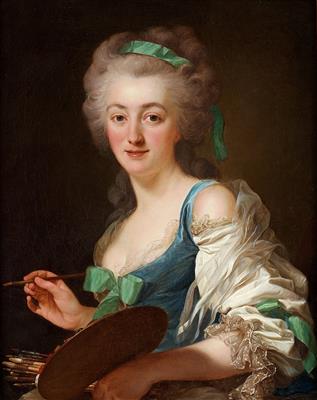
When the Académie Royale de Peinture et de Sculpture admitted Anne Vallayer-Coster in 1770[2], the bar was deliberately set as high as the institution could make it. She was twenty-six, she had no formal academic training (women were barred from the life-drawing classes that formed the foundation of history painting), and the Académie restricted female membership to four at any one time. Her reception work, "Attributes of Painting, Sculpture and Architecture," now in the Louvre, made the case on its own terms.
Biography
Vallayer-Coster was born in Paris in 1744[2], the daughter of a goldsmith who worked at the Gobelins manufactory. She grew up surrounded by craft and decorative excellence, and it shows: her still lifes are precisely observed, the surfaces of vegetables, flowers, game, and musical instruments rendered with close attention to material properties that drew consistent favourable comparisons with Jean-Baptiste-Siméon Chardin, the dominant figure in French[2] still-life painting. Being compared to Chardin in the 1770s was not a modest compliment.
She began exhibiting at the Salon in 1771[2] and attracted the attention of Marie-Antoinette, who became an important patron and supporter. The queen owned at least one of Vallayer-Coster's Vestal pictures, arranged lodgings for her in the Louvre, and signed her marriage contract. The patronage network of prominent women supporting female artists was, as the scholar Jennifer Milam has noted, "a peculiarity of the late 18th century," and Vallayer-Coster benefited from it more directly than most.
She also produced portraits, including one of Marie-Antoinette in pastel and studies of the aunts of Louis XVI, now at Versailles, though critics found these less compelling than her still lifes. She returned to flowers and composed arrangements for the remainder of her career, continuing to work well after the Revolution. She died in 1818[2], by which point the world that had created the Académie and its hierarchies had been comprehensively dismantled.
Timeline
- 1744Born in Paris. Her father was a goldsmith working at the Gobelins manufactory.
- 1770Admitted to the Académie Royale de Peinture et de Sculpture at 26. She had no formal academic training.
- 1770Created "Attributes of Painting, Sculpture and Architecture" as her reception work for the Académie.
- 1771Began exhibiting at the Salon.
- 1771Attracted the attention of Marie-Antoinette, who became an important patron.
- 1771Marie-Antoinette owned at least one of Vallayer-Coster's Vestal pictures.
- 1771Arranged lodgings for her in the Louvre.
- 1771Produced a portrait of Marie-Antoinette in pastel.
- 1771Created studies of the aunts of Louis XVI, now at Versailles.
- 1818Died at 74.
Notable Works
Tap to view larger.
Where to See Anne Vallayer-Coster
1 museum worldwide.
-
1 works
Collection Rau for UNICEF
Remagen, Germany
Next stop
Browse the movements →
Every movement in the collection, from the Renaissance to Pop art.
Related Artists


Frequently Asked Questions
What is Anne Vallayer-Coster known for?
Anne Vallayer-Coster is known for her still lifes, which feature precisely observed surfaces of vegetables, flowers, game, and musical instruments. Her attention to material properties in these works led to comparisons with Jean-Baptiste-Siméon Chardin.What is Anne Vallayer-Coster's most famous work?
It is difficult to name one single work as Anne Vallayer-Coster's 'most famous', as her notability rests on her collective artistic output and skill, particularly within the genre of still life[2]. She gained recognition in the late 18th century for her exceptional ability to depict a variety of objects, from flowers and fruit to musical instruments and scientific tools. Vallayer-Coster's paintings often feature complex arrangements, careful attention to detail, and a mastery of colour and texture. These qualities made her popular among collectors and at the French[2] Royal court. Rather than one specific piece, it is her innovative approach to still life, elevating it to a higher status, that defines her contribution to art history.What should I know about Anne Vallayer-Coster's prints?
Information regarding Anne Vallayer-Coster's prints is scarce. Printmaking of the 18th century served to disseminate images and information to a broader public, and was often a collaborative process. For instance, the brothers Jan and Egidius Sadeler produced prints of Jacopo Bassano's paintings, such as Annunciation to the Shepherds, increasing the painting's exposure. Similarly, Wallerant Vaillant created a mezzotint of Judith, after Guido Reni, around 1672. Prints were sometimes made after an artist's drawings, as well as paintings. Two volumes published in 1726 and 1728 contain prints of drawings by Watteau. These prints provide a record of Watteau's drawings, including those now lost. Some collectors altered drawings in their possession. Camille Groult, for example, was known to 'embellish' works.What techniques or materials did Anne Vallayer-Coster use?
Anne Vallayer-Coster's artistic practice involved the careful selection and application of materials to achieve specific visual effects. Like many artists of her time, she would have been concerned with the formal qualities of her chosen media. Vallayer-Coster worked primarily with oil paints, a medium that allowed for a wide range of effects through varied application. The choice of oil paint itself influenced the character of her work, as the qualities of oil affect how colours appear. The same pigment will present differently depending on whether it is used in watercolour or oil. Artists of the period often sought to emulate the techniques of earlier masters, but the precise duplication of their methods was difficult because of subtle differences in materials available. The artist's individual touch also played a significant role, as no two artists use colour material in exactly the same manner. The very choice of material is conditioned by the effect the artist intends to achieve.When did Anne Vallayer-Coster live and work?
Anne Vallayer-Coster was active as an artist in France during the second half of the eighteenth century. Born in 1744[2], she gained recognition for her still lifes and flower paintings. In 1770[2], Vallayer-Coster was accepted into the Académie Royale de Peinture et de Sculpture, a notable achievement at a time when opportunities for women artists were limited. Her reception piece, Attributes of Painting, Sculpture and Architecture (Musée du Louvre, Paris), secured her place in the Académie. From 1771, she began exhibiting at the Salons. Vallayer-Coster received patronage from Queen Marie-Antoinette, who commissioned portraits and arranged for her to have lodgings in the Louvre. Between 1778 and 1780, she painted portraits of Marie-Antoinette (Florence Bouchy-Picon) and the aunts of Louis XVI (Musée National du Château de Versailles, Paris). Although she achieved some success as a portraitist, she is better known for her still-life works. Vallayer-Coster continued to paint until her death in 1818[2].Where can I see Anne Vallayer-Coster's work?
To view works by Anne Vallayer-Coster, you can visit several museums. In France, the Musée du Louvre in Paris holds pieces by the artist. Other French[2] museums with her work include the Musée des Beaux-Arts in Nantes, and the Musée Fabre in Montpellier. Outside France, collections can be found at the Art Gallery of New South Wales in Sydney, and the Musées Royaux des Beaux-Arts de Belgique in Brussels. In the United States, Vallayer-Coster's paintings are held in the collections of the National Gallery of Art in Washington, DC, and the Metropolitan Museum of Art in New York. These institutions provide opportunities to study her still lifes and other works.Where was Anne Vallayer-Coster from?
Anne Vallayer-Coster (1744[2]-1818[2]) was French[2]. She is remembered as one of the most successful female artists of her time, notable for her still lifes and flower paintings. Vallayer-Coster gained membership to the Académie Royale de Peinture et de Sculpture in 1770[2]. This was a period when opportunities for women artists within the Académie were limited. Her reception piece, Attributes of Painting, Sculpture and Architecture (Musée du Louvre, Paris), secured her place. As an academician, she began exhibiting at the Salons in 1771. Although her flower paintings initially brought her the most recognition, she also produced portraits and trompe l’oeil bas-reliefs. Between 1778 and 1780, she painted portraits of women at court, including Queen Marie-Antoinette (Florence Bouchy-Picon) and the aunts of Louis XVI (Musée National du Château de Versailles, Paris). Queen Marie-Antoinette seems to have taken an interest in Vallayer-Coster, arranging lodgings for her in the Louvre and signing her marriage contract. Later in her career, Vallayer-Coster focused on still lifes, creating masterful studies of flowers in oil, gouache and watercolour.Who did Anne Vallayer-Coster influence?
It is difficult to identify direct artistic descendants of Anne Vallayer-Coster. Art-historical studies tend to focus on the influence of seventeenth-century Dutch painters such as Hals, Vermeer, Ruisdael, and Rembrandt. According to Harold Bloom's "anxiety of influence" theory, artists respond to the art of their forerunners through a process of appropriation. Some scholars have noted similarities between Vallayer-Coster and later artists. For example, the still lifes of Anne Bremer, a San Francisco artist, have been compared to those of Henri Fantin-Latour, as well as John La Farge and J. Alden Weir. Fantin-Latour is also seen as transposing Vermeer's "Lacemaker" in his work. Additionally, the interiors of Danish artists Carl Holsøe and Vilhelm Hammershøi evoke Vermeer, with their simple compositions and silvery light. These artists, along with Christoffer Wilhelm Eckersberg and Whistler, created quiet domestic scenes that suggest reflection and repose.Who was Anne Vallayer-Coster?
Anne Vallayer-Coster (1744[2]-1818[2]) was a successful French[2] artist, most noted for her still-life paintings and her depictions of flowers. In an era when the Académie Royale de Peinture et de Sculpture offered limited opportunities to women artists, Vallayer-Coster was admitted as a member in 1770[2]. Her entry piece was titled Attributes of Painting, Sculpture and Architecture (Musée du Louvre, Paris). From 1771, she began exhibiting at the Salons. Although she also painted portraits and trompe l’oeil bas-reliefs, her flower paintings initially attracted the most attention. Between 1778 and 1780, she painted portraits of prominent women at court, including Louis XVI's aunts (Musée National du Château de Versailles, Paris) and Queen Marie-Antoinette, whom she depicted in pastel (Florence Bouchy-Picon). Marie-Antoinette owned one of Vallayer-Coster’s Vestal pictures and appears to have taken a special interest in the artist, arranging lodgings for her in the Louvre and signing her marriage contract. Critics favourably compared Vallayer-Coster’s early still-life paintings to those of Jean-Baptiste-Siméon Chardin. However, her portraits were less well received when compared with those of Élisabeth Vigée Le Brun and Adélaïde Labille-Guiard. For the remainder of her career, Vallayer-Coster concentrated on still lifes, creating masterful studies of flowers in oil, gouache, and watercolour.How did Anne Vallayer-Coster die?
Anne Vallayer-Coster died in 1818[2] at the age of 74.
Sources
Editorial draws on the following primary and tertiary references for Anne Vallayer-Coster.
- [1] museum Collection Rau for UNICEF Used for: museum holdings.
- [2] wikipedia Wikipedia: Anne Vallayer-Coster Used for: biography, birth dates, death dates, identifiers, movement attribution, nationality.
- [3] book Milam, Jennifer Dawn, Historical Dictionary of Rococo Art Used for: biography, stylistic analysis.
Editorial overseen by Solis Prints. Sources verified 2026-09-16. Click a source for details, or hover over [N] in the page above to preview.
Editorial standardsMethodologyCorrectionsAI disclosureAbout the editorial team