



Antoine Pesne
A portrait painted in Venice, shown to the right German nobleman at the right moment, gave Antoine Pesne one of the most secure careers available to an 18th-century painter. The great-nephew of Charles de La Fosse, a senior figure at the Académie Royale de Peinture et de Sculpture, Pesne trained with the full weight of French[1] academic formation behind him: the Académie Royale in Paris, then the Académie de France in Rome during the first decade of the 1700s. But it was a Venetian commission that redirected his life. The portrait caught the eye of Frederick I of Prussia, who summoned Pesne to Berlin.
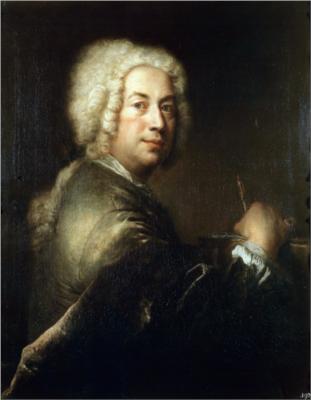
Biography
He arrived in Prussia and stayed, eventually becoming court painter to Frederick the Great, for whom he produced the bulk of his output: portraits, allegorical ceilings, mythological panels. Frederick was already collecting Antoine Watteau and Nicolas Lancret, and Pesne adapted accordingly, learning to handle the fête galante manner well enough to be trusted with the figure painting in a collaborative Schloss Rheinsberg scene with the architect Georg Wenzeslaus von Knobelsdorff (1737[1], now Charlottenburg, Berlin). The ceiling fresco Zephyr Crowns Flora (1747) remains in situ at Sanssouci, Potsdam.
His portrait practice is best represented by The Dancer Barbara Campanini (c.1745[1], Charlottenburg), depicting a celebrated Venetian dancer through principles of complement and contrast in the pose and architectural setting. Frederick kept the painting behind his desk at Charlottenburg. Pesne had been received into the Académie Royale as a full member in Paris in 1720, having spent an intervening decade working at Dresden, Dessau, London, and back in Paris, where he painted the collector Pierre-Jean Mariette in 1723. Jennifer Milam's assessment in her Historical Dictionary of Rococo[1] Art is frank: his talents were not as distinguished as those of Watteau or Lancret, but he was not a slavish imitator, and his portraits work.
Timeline
- 1683Born in Paris. He was the great-nephew of Charles de La Fosse.
- 1700Studied at the Académie Royale in Paris, then the Académie de France in Rome during the first decade of the 1700s.
- 1720Became a full member of the Académie Royale in Paris.
- 1723Painted a portrait of the collector Pierre-Jean Mariette in Paris.
- 1737Collaborated with Georg Wenzeslaus von Knobelsdorff on a Schloss Rheinsberg scene, now at Charlottenburg, Berlin.
- 1745Painted "The Dancer Barbara Campanini", now at Charlottenburg.
- 1747Created the ceiling fresco "Zephyr Crowns Flora" at Sanssouci, Potsdam.
- 1757Died at 74.
Notable Works
Tap to view larger.
Next stop
Rococo →
Explore the artists and ideas of Rococo.
Antoine Pesne prints
Hand-finished archival prints from Antoine Pesne's body of work.
 Louise Eleonore von Wreech - Antoine Pesne
From £37.00
Louise Eleonore von Wreech - Antoine Pesne
From £37.00
 Portrait of Mary Susanne Dinglinger, born Gutermann - Antoine Pesne
From £28.00
Portrait of Mary Susanne Dinglinger, born Gutermann - Antoine Pesne
From £28.00
 Portrait of the Crown Prince Friedrich Ludwig of Württemberg and his wife Henriette Marie of Brandenburg-Schwedt - Antoine Pesne
From £28.00
Portrait of the Crown Prince Friedrich Ludwig of Württemberg and his wife Henriette Marie of Brandenburg-Schwedt - Antoine Pesne
From £28.00
 Friedrich Hoffmann, German physician - Antoine Pesne
From £28.00
Friedrich Hoffmann, German physician - Antoine Pesne
From £28.00
 Portrait of the dancer Barbara Campanini, known as La Barbarina - Antoine Pesne
From £28.00
Portrait of the dancer Barbara Campanini, known as La Barbarina - Antoine Pesne
From £28.00
 Princess Amalia of Prussia as an Amazon - Antoine Pesne
From £28.00
Princess Amalia of Prussia as an Amazon - Antoine Pesne
From £28.00
Related Artists




Take Antoine Pesne home.
See all Antoine Pesne prints →Frequently Asked Questions
What is Antoine Pesne known for?
Antoine Pesne is known for portraits, allegorical ceilings, and mythological panels. He is also known for adapting to the fête galante style of Antoine Watteau and Nicolas Lancret, and for figure painting in the Schloss Rheinsberg scene with architect Georg Wenzeslaus von Knobelsdorff.What is Antoine Pesne's most famous work?
It is difficult to identify one single work as Antoine Pesne's most famous. He was a prolific portraitist, and many of his paintings are well known. Pesne's broader artistic output included many engravings; for example, Jean Pesne (died 1700[1]) created engravings of Nicolas Poussin's Virgin and Child and Virgin and Child with St. John. Similarly, Antoine Trouvain (died 1708) made an engraving of Poussin's Moses and the Daughters of Jethro, while Louis de Chatillon (died 1734) engraved Poussin's Landscape with a Storm. Gerard Audran (died 1703) engraved The Vision of Sta. Francesca Romano, and Benoit Audran the Elder (died 1721) engraved The Flight into Egypt. These engravings after Poussin's works demonstrate the artistic milieu in which Pesne and his contemporaries operated.What should I know about Antoine Pesne's prints?
Antoine Pesne was primarily a painter, rather than a printmaker. Born in Paris in 1683[1], he is better known for his portraits of European royalty and aristocracy. Pesne trained with his father, the painter Thomas Pesne, and his uncle, the engraver Charles Pesne. He received a stipend to study in Italy from 1705[1] to 1710. In 1711, he was appointed court painter to Frederick I of Prussia; he later became director of the Berlin Academy. Pesne remained in this role for much of his career, although he travelled to Paris and London. He died in Berlin in 1757[1]. Prints related to Pesne fall into a few categories. Some are reproductive engravings of his paintings, made by other artists. These prints circulated his compositions to a wider audience. Other prints are portraits of Pesne himself. One example is a 1737 engraving by Johann Martin Bernigeroth, after a painting by Georg Lisiewski. Finally, Pesne is known to have produced a small number of etchings. These include a self-portrait and studies of heads. These etchings display a painterly style; they translate his skill with colour and tone into a monochrome medium.When did Antoine Pesne live and work?
Antoine Pesne (1683[1]-1757[1]) was a French[1]-born painter who spent much of his career in Prussia. Born in Paris, he initially trained with his father and uncle, both artists. Pesne received instruction at the Académie Royale, and won the Prix de Rome in 1703[1]; however, he did not take up his Roman scholarship immediately. In 1705, he travelled to Italy, studying in Venice, Rome, and Naples. By 1710, Pesne was court painter to Frederick I in Berlin. He became director of the Berlin Academy of Arts in 1722. Pesne's position at the Prussian court was secure; he remained there for the rest of his working life, even after Frederick II succeeded to the throne. Pesne's portraits were popular with the Prussian aristocracy. He painted members of the royal family, as well as other prominent figures. His style blended French and Italian influences, characterised by its elegance and attention to detail. Examples of his work are in collections such as the Louvre, the National Portrait Gallery, and the Charlottenburg Palace.Where can I see Antoine Pesne's work?
Antoine Pesne's work can be seen in various locations, particularly in Germany and France. As a painter who served at the Prussian court of Frederick the Great, Pesne's art provides a link between French[1] and Frederican Rococo[1] styles. One can view the collaborative painting of Schloss Rheinsberg (1737[1]) at Schloss Charlottenburg, Berlin, which he created with Georg Wenzeslaus von Knobelsdorff. Also at Schloss Charlottenburg, Berlin, is The Dancer Barbara Campanini (circa 1745). Pesne's decorative work at Rheinsberg, Berlin and Potsdam often featured allegorical and mythological themes. His ceiling at Sanssouci, titled Zephyr Crowns Flora (1747), remains in situ. In Paris, the Musée Carnavalet holds his portrait of Pierre-Jean Mariette (1723).Where was Antoine Pesne from?
Antoine Pesne was born in Paris in 1683[1]. His family had artistic connections; his father was the painter Thomas Pesne, and his mother came from the Coypel family of artists. Pesne initially trained with his father, then with his uncle Charles-Antoine Coypel. In 1704[1], he received the Prix de Rome, but did not travel to Rome until 1705, remaining there until 1710. He then spent a year in Venice. In 1711, Pesne was called to Berlin by Frederick I of Prussia. After Frederick's death in 1713, Pesne worked for a time at the court of Dresden, and also in London. However, he returned to Berlin in 1720, becoming court painter to Frederick William I. He was a founder of the Berlin Academy of Arts in 1730, and became its director. Pesne remained in this role for the rest of his life, painting portraits of the Prussian royal family and other members of the court. He died in Berlin in 1757[1].Who did Antoine Pesne influence?
Nicolas Poussin, a French[1] painter whose work greatly influenced artists for centuries, can be seen as an influence on Antoine Pesne. Poussin's impact extended to painters, intellectuals, iconographers, and art historians. His work appealed to an elite audience, and he is often called "the philosopher-painter". Poussin's classical ideals, which include reason, harmony, balance, moderation, clarity, and concentration, have been viewed as the source of great art. Jacques-Louis David, a French painter of the late 1700s, brought Poussin's style back to prominence in France. Jean-Auguste-Dominique Ingres continued this tradition. Paul Cézanne also admired Poussin greatly. Even Pablo Picasso drew inspiration from Poussin's classical style, particularly during his return to naturalism after the First World War. Poussin's influence has been felt most strongly during periods when an intellectual approach to painting prevailed. His example demonstrates that classicism can produce works that appeal to both the mind and the heart.Who influenced Antoine Pesne?
It is difficult to assess Antoine Pesne's influences based on the passages provided. They do not contain specific information about Pesne or his artistic development. However, the passages do discuss the general transmission of artistic ideas and techniques. For instance, the text mentions that artists like Ingres followed the example of their masters by teaching and collaborating with students. This suggests that artistic influence can occur through direct instruction and studio practice. The passages also note the broader influence of artists such as Watteau, Poussin, and David, whose work affected various aspects of culture, including theatre, fashion, literature, and historical interpretation. These examples suggest that an artist's impact can extend beyond the art world and into other intellectual and professional spheres. Without more specific information, it is impossible to determine which artists or movements had a direct impact on Antoine Pesne's work.Who was Antoine Pesne?
Antoine Pesne (1683[1]-1757[1]) was a French[1]-born painter who is significant for linking French and Frederican Rococo[1] styles. He served at the Prussian court of Frederick the Great. Pesne was the great-nephew of the academician Charles de La Fosse. He studied at the Académie Royale de Peinture et de Sculpture, and at the Académie de France in Rome during the early 1700s. While in Venice, he painted a portrait of a German nobleman. Frederick I, then king of Prussia, saw it and invited Pesne to work at the Prussian court in Berlin. After Frederick I's death in 1713[1], Pesne worked at the courts of Dresden and Dessau. He later visited London and Paris, where he became a full member of the Académie Royale in 1720. In 1723, while in Paris, Pesne painted a portrait of Pierre-Jean Mariette (Musée Carnavalet, Paris), a prominent collector and print expert with international connections. Pesne's prior service at the Prussian court in Berlin, along with his French background, appealed to Frederick II. After Frederick II was reinstated as crown-prince at Rheinsberg, Pesne returned to the Prussian court. He began incorporating the style of fête galante painters, such as Antoine Watteau and Nicolas Lancret, into his work.Why are Antoine Pesne's works important today?
Antoine Pesne (1683[1]-1757[1]) was a court painter, primarily active in Berlin. While not as universally known as some of his contemporaries, his artistic contributions remain relevant for several reasons. Pesne's career trajectory avoids the extremes of some artists. Nicolas Poussin, for example, maintained steady acclaim, while others, such as Fragonard, experienced periods of obscurity before rediscovery. Pesne's work, while not always at the forefront of art historical discussion, has not suffered total neglect. His importance also stems from his role in bridging artistic styles. Poussin combined the study of nature and classical antiquity. Similarly, Pesne integrated French[1], Italian, and Dutch influences into his portraits and history paintings, creating a distinctive style that appealed to the Prussian court. Studying Pesne allows historians to examine the transmission and adaptation of artistic ideas across Europe during the 18th century. His portraits offer insights into the social and cultural milieu of the Prussian elite.How did Antoine Pesne die?
Antoine Pesne died in 1757[1] at the age of 74.
Sources
Editorial draws on the following primary and tertiary references for Antoine Pesne.
- [1] wikipedia Wikipedia: Antoine Pesne Used for: biography, birth dates, death dates, identifiers, movement attribution, nationality.
- [2] book Milam, Jennifer Dawn, Historical Dictionary of Rococo Art Used for: biography, stylistic analysis.
Editorial overseen by Solis Prints. Sources verified 2026-09-16. Click a source for details, or hover over [N] in the page above to preview.
Editorial standardsMethodologyCorrectionsAI disclosureAbout the editorial team