



Anton Heyboer
In 1951[1] Anton Heyboer voluntarily admitted himself to a psychiatric hospital near Santpoort and emerged with a complete philosophical and visual universe. Diagnosed with a "Christus complex," he developed what he called The System: a personal cosmology grounded in Kabbalistic numerology, in which each number from 1 to 9 represented a primal concept (being, the father, the mother, and so on). This framework governed every mark he made for the rest of his life.

Biography
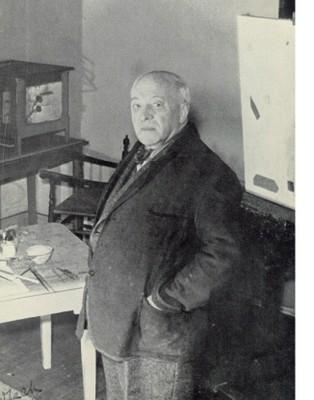
Born in the Dutch[1] East Indies in 1924[1], Heyboer arrived in the Netherlands as a teenager and spent seven months in a forced-labour camp in Berlin's Prenzlauer Berg district in 1943[1]. He survived the war and began painting intensively in Drenthe, inspired by Van Gogh's letters. By the mid-1950s he had settled in Den Ilp, a small village north of Amsterdam, where he built his own huts and boats and established a commune with five women known publicly as "De Bruiden van Heyboer" (Heyboer's Brides). It became a counter-cultural landmark in 1960s Dutch life.
His primary medium from the late 1950s was etching, which he treated in a way no printmaker had before: each impression was manually reworked with matchsticks and etching ink so that no two were identical. Voluptuous female figures sit alongside dense handwriting, biblical references, and the numerical schema of The System. By 1966[1] MoMA had acquired his work; in 1975 LACMA presented him alongside David Hockney and Lucian Freud.
The break came in 1984[1] when he formally severed ties with his gallery and overpainted many returned works with red paint. He spent his final two decades selling directly from Den Ilp, entirely outside the art market. Queen Beatrix awarded him the Order of Orange-Nassau in 2002. He died in Den Ilp in 2005[1], aged 81.
Timeline
- 1924Born in the Dutch East Indies.
- 1943Spent seven months in a forced-labour camp in Berlin's Prenzlauer Berg district.
- 1950Began painting intensively in Drenthe, inspired by Van Gogh's letters.
- 1950Developed 'The System', a personal cosmology grounded in Kabbalistic numerology.
- 1951Voluntarily admitted himself to a psychiatric hospital near Santpoort.
- 1955Settled in Den Ilp, north of Amsterdam, and established a commune with five women.
- 1966The Museum of Modern Art (MoMA) acquired his work.
- 1975The Los Angeles County Museum of Art (LACMA) presented his work alongside David Hockney and Lucian Freud.
- 1984Formally severed ties with his gallery and overpainted many returned works with red paint.
- 2002Awarded the Order of Orange-Nassau by Queen Beatrix.
- 2005Died in Den Ilp, aged 81.
Notable Works
Tap to view larger.
Next stop
Browse the movements →
Every movement in the collection, from the Renaissance to Pop art.
Anton Heyboer prints
Hand-finished archival prints from Anton Heyboer's body of work.


Related Artists


Take Anton Heyboer home.
See all Anton Heyboer prints →Frequently Asked Questions
What is Anton Heyboer known for?
Anton Heyboer is known for his etching work from the late 1950s. He treated each impression in a unique way, manually reworking them with matchsticks and etching ink, ensuring no two were identical.What is Anton Heyboer's most famous work?
Anton Heyboer was a Dutch[1] artist known for his distinctive, symbolic drawings and etchings. While it is difficult to name one single work as his 'most famous', several pieces have received significant attention and acclaim. His series of drawings exploring personal philosophies and spiritual concepts are highly regarded. These works often incorporate symbols, figures, and text, reflecting Heyboer's unique worldview. He developed a 'language' of 24 signs that recurred throughout his art. Heyboer's etchings, characterised by their raw, expressive lines, also form an important part of his artistic output. These prints often depict figures and scenes from his personal life. He is also known for living in a commune with several wives, who sometimes collaborated on his art.What should I know about Anton Heyboer's prints?
Anton Heyboer (1924[1]-2005[1]) was a Dutch[1] artist known for his etchings and unconventional lifestyle. He developed a unique symbolic language in his art, using signs and figures to represent philosophical ideas about life, death, and the universe. Heyboer's printing technique involved working directly on the copper plate, often without preliminary sketches. This spontaneous approach resulted in prints with a raw, expressive quality. He embraced imperfections and variations in the printing process, making each print unique. His prints often feature recurring motifs, such as circles, lines, and human figures, arranged in complex compositions. These elements represent his personal philosophy and spiritual beliefs. Heyboer's work is associated with the COBRA art movement, though he remained an independent figure. COBRA artists valued experimentation and spontaneity, qualities evident in Heyboer's prints. He gained international recognition for his art, and his prints are held in numerous public and private collections. His singular vision and distinctive style set him apart from his contemporaries.What style or movement did Anton Heyboer belong to?
Anton Heyboer (1924[1]-2005[1]) defies easy categorisation, though his work has connections to several currents in twentieth-century art. He is often associated with the Cobra group (1948[1]-1951[1]), an association of artists from Copenhagen, Brussels, and Amsterdam. Cobra artists embraced spontaneity and experimentation, drawing inspiration from children's art and primal myths. Heyboer shared Cobra's interest in direct, uninhibited expression. However, Heyboer remained an individualist. His artistic vision was deeply personal, shaped by his experiences during the Second World War and his unconventional lifestyle. He developed a unique symbolic language in his drawings and etchings. These symbols, often related to his spiritual beliefs and personal relationships, recur throughout his oeuvre. Heyboer's work also has links to Art Brut, a term coined by Jean Dubuffet to describe art created outside the boundaries of academic tradition. Art Brut celebrates the raw, untutored creativity of self-taught artists or those on the margins of society. Heyboer, who largely rejected the established art world, fits this description in some respects. His art is characterised by its directness and lack of pretension. While not strictly an Art Brut artist, Heyboer shared its spirit of independence.When did Anton Heyboer live and work?
Anton Heyboer was born on 9 February 1924[1] in Indonesia. He died on 16 May 2005[1], in Den Ilp, Netherlands. Heyboer was a Dutch[1] self-taught artist. He is known for his drawings and etchings. In 1934[1], his family returned to the Netherlands, settling north of Amsterdam. During World War II, Heyboer was forced to work in a German factory. He resisted and was imprisoned. After the war, he refused military service. He was jailed again. In the 1950s, Heyboer lived on a houseboat. He began to develop his distinctive artistic style, characterised by symbolic figures and personal mythology. In 1961, he bought a farm in Den Ilp, north of Amsterdam. He lived there with several women, creating a self-sufficient community. Heyboer's work gained international recognition, with exhibitions in major museums and galleries. He is regarded as an important figure in postwar Dutch art.Where can I see Anton Heyboer's work?
Anton Heyboer's works appear in several European collections. The Stedelijk Museum in Amsterdam holds a number of his etchings and drawings. These include early pieces from the 1950s, as well as later works that demonstrate his symbolic language. Museum Voorlinden, located in Wassenaar, Netherlands, also has Heyboer's art in its collection. This museum focuses on modern and contemporary art, and it provides a context for understanding Heyboer's place within the Dutch[1] art scene. Internationally, Heyboer's art has been exhibited in various galleries and museums, mainly in Germany and Belgium. While specific locations may vary depending on current exhibitions, it is worth checking museum listings in these countries for potential displays of his work. Catalogues from past exhibitions can also provide insight into the range and scope of his artistic output. These resources offer opportunities to study his techniques and themes.Who did Anton Heyboer influence?
It is difficult to determine the exact nature of Anton Heyboer's influence on other artists. However, some historical context can be provided. In the late 19th century, critics began to consider how Frans Hals's work related to later artistic movements. Hals's impact on painters has been significant in the history of Western art. However, focusing on the art it inspired, rather than on its sources, removes it from the temporal and cultural contexts of its production. As recently as 1990[1], Claus Grimm described Hals’s rough manner as a “peculiar quirk” in 17th-century Holland. Until Pieter Biesboer demonstrated that the artist’s sitters and clients were members of the economic and cultural elite in Haarlem, Hals and his paintings were widely believed to have been misunderstood and unappreciated by the painter’s contemporaries.Who was Anton Heyboer?
Information about Anton Heyboer is not found in the reference passages. The passages do contain biographical notes on Georges Vantongerloo, Emilio Vedova, Adriaen Brouwer, Pieter Aertsen, and Joachim Beuckelaer. Vantongerloo, born in Antwerp in 1886, studied at the Academie des Beaux-Arts of Antwerp and Brussels. He collaborated with Piet Mondrian, Bart van der Leek, and Theo van Doesburg on the magazine *De Stijl*, which was founded in 1917. Vedova was born in Venice in 1919. Around 1942[1], he joined the Milanese artists' association Corrente. Brouwer, who was born in Flanders, lived in Amsterdam and Haarlem before returning to Antwerp. His rough peasant types recall the work of Pieter Brueghel. Aertsen was born in Amsterdam in 1508. He became a free master of the Painters' Guild in 1535 and was admitted to citizenship of Antwerp in 1542. Beuckelaer was born at Antwerp about 1535, became a master in 1560, and died young in 1574.Why are Anton Heyboer's works important today?
Anton Heyboer (1924[1]-2005[1]) was a Dutch[1] artist known for his etching technique and philosophical ideas. He developed a unique symbolic language in his art. These symbols represented his complex worldview. Heyboer's unconventional lifestyle also contributed to his notability. He lived in a commune with several wives and rejected societal norms. This lifestyle was closely linked to his artistic practice. His art explored themes of freedom, connection, and the search for meaning. His technical skill in etching is notable. Heyboer refined his method, producing prints with distinctive lines and textures. He embraced imperfections and spontaneity. His work stands apart from more conventional printmaking. Interest in Heyboer's art persists because of its singular nature. His combination of personal philosophy, symbolic imagery, and etching skill created a body of work that continues to fascinate. His art offers a window into his unique perspective on existence.What was Anton Heyboer's art style?
Anton Heyboer's art style incorporated voluptuous female figures, dense handwriting, biblical references, and the numerical schema of his personal cosmology, known as The System. This system was grounded in Kabbalistic numerology, where each number from 1 to 9 represented a primal concept.How did Anton Heyboer die?
Anton Heyboer died in 2005[1] at the age of 81.
Sources
Editorial draws on the following primary and tertiary references for Anton Heyboer.
- [1] wikipedia Wikipedia: Anton Heyboer Used for: biography, birth dates, death dates, identifiers, movement attribution, nationality.
- [2] book Joseph Leo Koerner;, Bosch and Bruegel Used for: biography.
- [3] book Lassaigne, Jacques, 1910-, Flemish painting Used for: biography.
- [4] book Masterpieces of western art : a history of art in 900 individual studies from the Gothic to the present day Used for: biography.
- [5] book Metropolitan Museum Of Art, Metropolitan Museum Of Art - Dutch Painting, the Golden Age_ an Exhibition of Dutch Pictures of the Seventeenth Century, under the High Patronage of Her Majesty the Queen of the Netherlands - Metropolitan Museum of Art, Toledo Museum of Art, Art Used for: biography.
- [6] book John Michael Montias, Vermeer and His Milieu _ A Web of Social History Used for: stylistic analysis.
- [7] book John Michael Montias, Vermeer and His Milieu _ A Web of Social History Used for: stylistic analysis.
- [8] book John Michael Montias, Vermeer and His Milieu _ A Web of Social History Used for: stylistic analysis.
Editorial overseen by Solis Prints. Sources verified 2026-09-30. Click a source for details, or hover over [N] in the page above to preview.
Editorial standardsMethodologyCorrectionsAI disclosureAbout the editorial team