

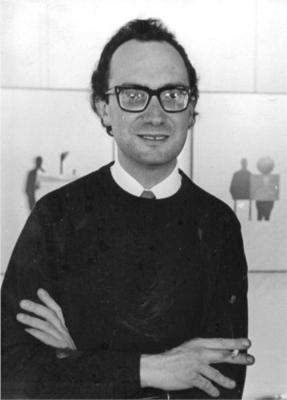
Antonio Areal
Antonio Areal spent only 44 years on earth and produced a body of work that reads as a compressed map of Portuguese[1] modernism's transitions from the 1950s to the 1970s. Born in Porto in 1934[1], he came to Lisbon during his formative years and was drawn initially to Surrealism, engaging with the brief, embattled Portuguese Surrealist circle at a time when the Estado Novo regime kept close watch on avant-garde dissent. Abstract art was tolerated by the dictatorship precisely because its content was illegible as political opposition; Areal worked within that contradiction without ever resolving it neatly.
Biography
By the mid-1950s he had begun moving away from Surrealism's literary imagery toward the gestural freedoms of action painting, a shift that placed him at the centre of Portuguese[1] Abstract Expressionism. He participated in the I Salon of Abstract Art in Lisbon in 1954[1] and the Retrospective of Non-Figurative Painting in 1958, two of the era's significant institutional acknowledgments that abstraction was becoming central rather than marginal to Portuguese practice.
He was also a writer. Alongside his painting, Areal produced art criticism and theoretical writing that situated his own practice within broader European debates about the relationship between form, gesture, and meaning. This double activity as practitioner and critic gave his relatively small output an intellectual density unusual in the Portuguese[1] context.
Areal died in Lisbon in 1978[1], having barely entered middle age. His daughter Sofia Areal became a painter in her own right. The brevity of his career and the limited international circulation of Portuguese[1] art during the Salazar and early post-revolutionary years kept him less visible outside Portugal than his ambitions and quality warranted.
Timeline
- 1934Born in Porto, Portugal.
- 1950Moved to Lisbon during his formative years and was drawn to Surrealism, at 16.
- 1954Participated in the I Salon of Abstract Art in Lisbon, at 20.
- 1955Began moving away from Surrealism towards Abstract Expressionism, at 21.
- 1958Participated in the Retrospective of Non-Figurative Painting, at 24.
- 1978Died in Lisbon at 44. His daughter Sofia Areal also became a painter.
Notable Works
Tap to view larger.
Next stop
Browse the movements →
Every movement in the collection, from the Renaissance to Pop art.
Related Artists

Frequently Asked Questions
What is Antonio Areal's most famous work?
It is difficult to name one single work as Antonio Areal's 'most famous'. However, a pair of allegories on death have remained popular: these are sometimes described as 'hieroglyphs of our afterlife'. Commissioned by Don Miguel de Mafiara, a Knight of the Order of Calatrava, the paintings were created for the brotherhood of the hospital and its church. Mafiara, in penitence for his earlier life, requested artwork that reflected on mortality. His grave's epitaph describes him as 'the worst person who ever lived on earth', and his will accuses himself as an adulterer and servant of the devil. One of the allegories, *The Allegory of Death*, depicts the Grim Reaper. The Reaper stands over symbols of power with one foot on a globe. He carries a coffin and scythe, extinguishing a candle while staring at the viewer.What should I know about Antonio Areal's prints?
Antonio Areal, born in 1934[1], is a Portuguese[1] artist known for his abstract paintings and prints. He studied at the Escola Superior de Belas Artes do Porto, concluding his studies in 1961[1]. Areal then became a teacher, remaining at the school until 2004. His early work shows geometric forms and a restricted palette. Later, Areal began to use brighter colours and looser shapes. His prints often explore similar themes to his paintings, such as the interplay between colour, form, and texture. Areal's prints are often produced using techniques like etching, lithography, and screen printing. They demonstrate his interest in process and experimentation. He is interested in the possibilities of layering and manipulating images. His work has been exhibited in Portugal and internationally, and he has received several awards throughout his career. Areal's prints offer an accessible way to engage with his distinctive abstract aesthetic.What style or movement did Antonio Areal belong to?
Without more information about Antonio Areal's work, it is difficult to determine a specific style or movement. However, I can discuss the broader context of artistic movements during the Baroque period, as well as information about artists named Antonio. The Baroque period, which began in the early 17th century, followed Mannerism. Early Baroque artists aimed to instil coherence and correct proportions in their work. Later Baroque art saw the development of dynamic movement, with forms that blended and merged. This was achieved through use of a spiral line, which gave vitality to compositions. Baroque sculpture saw a similar thread of energy running through figures. Two artists named Antonio from the Baroque period are Antonio Raggi and Antonio Gherardi. Raggi created sculptures such as *Noli Me Tangere* and *Baptism of Christ*.Where can I see Antonio Areal's work?
It is difficult to pinpoint exactly where one might view Antonio Areal's work today. However, some museums housing similar artworks may be a good place to start your search. Consider visiting the Museo Archeologico, Florence; the Lateran Museum, Rome; or the Museo Capitolino. These museums hold artworks of comparable styles and eras. Checking their online collections or contacting their curatorial departments might provide information on whether they hold any pieces by Areal or artists from his circle. Additionally, major museums sometimes have works in storage that are not always on public display. Inquiring about their complete holdings could reveal further possibilities for viewing Areal's art. Auction houses and specialist art dealers may also handle works by Areal from time to time; checking auction catalogues and contacting dealers specialising in similar art could prove fruitful.Who influenced Antonio Areal?
Antonio Areal's influences are complex. His artistic approach combines memories and present reality. He has an affinity for Antoni Tàpies's mystical relationship to reality, particularly Tàpies's abstract concept of space, mysterious transformations of materials, and "floating" objects. Areal's work has been compared to that of Genovés and Canogar, artists of critical realism who made direct political or social statements. However, Areal's connection to informalism is also important. Although the next generation of artists sought more anonymous figuration, often inspired by the media, they did not abandon the chromatic sobriety, attention to materials, or underlying expressionism of their predecessors. Carmen Calvo studied the work of Paul Cézanne and Henri Matisse during a two-month stay in Paris in 1971[1]. She also studied Egyptian art at the Louvre. Calvo's interest in archaeology, especially the processes of discovering, reconstructing, and compiling remains from Near Eastern cultures, served as a source of inspiration for her later works.Who was Antonio Areal?
Why are Antonio Areal's works important today?
It is difficult to assess Antonio Areal's importance based on the documentation available. However, some context can be provided regarding related Spanish artists and art-world trends. During the second half of the 17th century, flower painting gained acceptance as a speciality. Juan de Arellano (1614-1676[1]), who trained with Juan de Soils near Madrid, distinguished himself in this area. He began painting flowers at the age of thirty-two, after producing landscapes and religious works. More broadly, the presence of Spanish art in an international context has been debated. Despite improvements to the Spanish art system (museums, galleries, magazines, universities), Spanish artists are still inadequately represented in the global art world. One exception is Santiago Sierra, who developed as an artist in Mexico.What was Antonio Areal's art style?
Initially drawn to Surrealism, Antonio Areal moved away from its literary imagery toward the gestural freedoms of action painting. This shift placed him at the centre of Portuguese[1] Abstract Expressionism.How did Antonio Areal die?
Antonio Areal died in 1978[1] at the age of 44.
Sources
Editorial draws on the following primary and tertiary references for Antonio Areal.
- [1] wikipedia Wikipedia: Antonio Areal Used for: biography, birth dates, death dates, identifiers, movement attribution, nationality.
- [2] book guggenheim-beforepicassoaft00swee Used for: biography.
- [3] book guggenheim-guhe00solo Used for: biography.
- [4] book guggenheim-newimagesfromspa00ro Used for: biography.
- [5] book Gombrich, E. H. (Ernst Hans), 1909-2001, New light on old masters Used for: biography, stylistic analysis.
Editorial overseen by Solis Prints. Sources verified 2026-10-15. Click a source for details, or hover over [N] in the page above to preview.
Editorial standardsMethodologyCorrectionsAI disclosureAbout the editorial team