



Antonio Ciseri
- portrait
Antonio Ciseri arrived in Florence at the age of twelve, having crossed from his native Ronco sopra Ascona in the Swiss canton of Ticino, and never returned permanently to Switzerland. He trained under Pietro Benvenuti at the Accademia di Belle Arti, where Raphael's compositional clarity and Giuseppe Bezzuoli's theatrical instincts shaped his early formation.
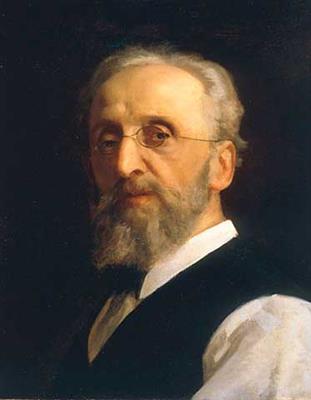
Biography
His large-scale religious paintings became his most significant contribution. The Transport of Christ to the Sepulchre (1864[1]–70) placed him at the forefront of Italian[1] academic religious painting: the surface described by contemporaries as nearly photographic in effect, the composition retaining a Raphaelesque order. His most ambitious canvas, Ecce Homo, was commissioned by the Italian government and occupied him from 1871 until his death in 1891[1], when it was completed from his studies.
In 1849[1] Ciseri founded a private art school in Florence. His students included the Macchiaioli painter Silvestro Lega and Juan Manuel Blanes, who became the most significant painter in Uruguayan history. That two such different figures emerged from the same studio speaks to what Ciseri offered: rigorous draughtsmanship, precise observation of surface and light, and an insistence on compositional order.
He also worked as a portraitist for the Italian[1] royal house, painting King Umberto I and Queen Margherita of Savoy. His final decades balanced large commissioned religious canvases, portrait[1] work, and the teaching that shaped a generation of artists across two continents.
Timeline
- 1821Born in Ronco sopra Ascona, in the Swiss canton of Ticino.
- 1833Moved to Florence at 12.
- 1849Founded a private art school in Florence.
- 1864Began work on "The Transport of Christ to the Sepulchre".
- 1870Completed "The Transport of Christ to the Sepulchre".
- 1871Commissioned by the Italian government to paint "Ecce Homo".
- 1891Died in 1891, while working on "Ecce Homo". The painting was completed from his studies.
Notable Works
Tap to view larger.
Next stop
Browse the movements →
Every movement in the collection, from the Renaissance to Pop art.
Related Artists



Frequently Asked Questions
What is Antonio Ciseri known for?
Antonio Ciseri is known for his large-scale religious paintings, particularly The Transport of Christ to the Sepulchre and Ecce Homo. The Transport of Christ to the Sepulchre placed him at the forefront of Italian[1] academic religious painting, with contemporaries describing its surface as nearly photographic in effect.Who was Antonio Ciseri?
Antonio Ciseri was an artist who trained under Pietro Benvenuti at the Accademia di Belle Arti. He founded a private art school in Florence in 1849[1] and taught artists such as Silvestro Lega and Juan Manuel Blanes. He also worked as a portraitist for the Italian[1] royal house, painting King Umberto I and Queen Margherita of Savoy.What was Antonio Ciseri's art style?
Antonio Ciseri's style involved rigorous draughtsmanship, precise observation of surface and light, and an insistence on compositional order. His early formation was shaped by Raphael's compositional clarity and Giuseppe Bezzuoli's theatrical instincts.How did Antonio Ciseri die?
Antonio Ciseri died in 1891[1] at the age of 70.
Sources
Editorial draws on the following primary and tertiary references for Antonio Ciseri.
- [1] wikipedia Wikipedia: Antonio Ciseri Used for: biography, birth dates, death dates, identifiers, movement attribution, nationality.
- [2] book Braun, Emily, 1957-; Asor Rosa, Alberto; Royal Academy of Arts (Great Britain), Italian art in the 20th century : painting and sculpture, 1900-1988 Used for: biography.
- [3] book Masterpieces of western art : a history of art in 900 individual studies from the Gothic to the present day Used for: biography.
- [4] book Post-impressionism : cross-currents in European painting Used for: biography, stylistic analysis.
- [5] book Post-impressionism : cross-currents in European painting Used for: biography.
- [6] book Metropolitan Museum of Art (New York, N.Y.), The Age of Caravaggio Used for: biography, stylistic analysis.
Editorial overseen by Solis Prints. Sources verified 2026-10-07. Click a source for details, or hover over [N] in the page above to preview.
Editorial standardsMethodologyCorrectionsAI disclosureAbout the editorial team